Roku 2 XD (3050) vs Roku Ultra (2024)
Better figure, where one is clearly better
| Roku2 XD (3050) | RokuUltra (2024) | |
|---|---|---|
| Overview | ||
| Released | July 2011 | September 2024 |
| Video and audio | ||
| Resolution | 1080p | 4K (better) |
| HDR | None | Dolby Vision, HDR10+, HDR10 and HLG (better) |
| Dolby Atmos | – | Yes |
| Video | 1080p, 720p or 480p through HDMI; 480i composite video through the included custom A/V cable (The Gadgeteer) | Up to 2160p at 60 fps (3840 × 2160) with up-scaling from 720p and 1080p; HDMI Quick Media Switching (QMS); AV1, HEVC, H.264 and VP9 from USB |
| HDR | – | Dolby Vision at 60 fps, HDR10, HDR10+ and HLG |
| Audio | Analogue stereo through the A/V cable; HDMI digital audio with 5.1 passthrough where available. The maker's original Netflix implementation supported Dolby Digital Plus | Dolby Atmos decode via HDMI; DTS Digital Surround pass-through; AC-4 and DD+ with Atmos, FLAC, ALAC and other formats from USB |
| Performance | ||
| Software | Roku OS | Roku OS |
| Chip details | ARM11 at 600 MHz in Roku's exact Giga/3050X developer row | Quad-core Arm Cortex-A55; Roku quotes over 30% faster than other Roku players |
| Memory | 256 MB in Roku's exact 3050X developer row | 2 GB |
| Storage | microSD expands storage for Roku channels and games, rather than playing personal files from the card; no published aggregate user capacity | – |
| Software and services | Roku lists OS 9.1 as the last compatible version for 3050X. Channels and services depend on region and software; this is the 2011 Roku 2 XD rather than the original 2010 XD | – |
| Connections | ||
| Wi-Fi | Wi-Fi 4 | Wi-Fi 6 |
| Ethernet | No | Yes |
| Voice remote | No | Yes |
| Ports | HDMI, microSD channel-storage slot, 3.5 mm composite/stereo A/V, power and reset; no Ethernet or USB media port | HDMI 2.1b; USB 3.0; 10/100 Ethernet; power |
| Wi-Fi and Bluetooth | 802.11n Wi-Fi, compatible with b/g; Bluetooth 3.0 for the optional gaming remote (The Gadgeteer) | 802.11ax dual-band MIMO Wi-Fi 6 (2.4 GHz and 5 GHz); Bluetooth audio streaming |
| Smart home | – | Works with Roku Smart Home, Apple AirPlay and HomeKit, Google Home and Alexa |
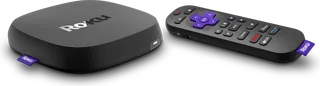
| Remote | Original standard infrared remote with Back, Home, Options and Instant Replay; no microphone, headphone socket or motion control. Bluetooth gaming remote sold separately | Roku Voice Remote Pro (2nd edition) with hands-free voice, backlit buttons, TV power and volume, Quick Launch and Live TV Guide buttons, lost-remote finder; rechargeable over USB-C |
| Design | ||
| Type | Box | Box |
| Power | Less than 2 W stated in the original maker announcement; 5.2 V / 1.0 A power adaptor identified in The Gadgeteer's XD test | 12 V, 1.5 A power adaptor; about 4.5 W when streaming 4K |
| Size | 3.3 × 3.3 × 0.9 inches (The Gadgeteer) | 124.4 × 127.0 × 25.4 mm; 167.2 g |
| In the box | Player, infrared remote, two AAA batteries, custom RCA-to-3.5 mm composite/stereo cable, mains power adaptor and setup guide; HDMI cable and microSD card sold separately | Roku Ultra, Roku Voice Remote Pro (2nd edition), USB-C charging cable for the remote, Premium High Speed HDMI cable, power adaptor |

More comparisons
- Roku Streaming Stick (2025) vs Roku Ultra (2024)
- Roku Streaming Stick Plus (2025) vs Roku Ultra (2024)
- Roku 2 XD (3050) vs Roku Streaming Stick (2025)
- Roku 2 XD (3050) vs Roku Streaming Stick Plus (2025)
- Roku Ultra (2024) vs Roku XDS (2100)
- Roku Ultra (2024) vs Roku XD (2050)
- Roku LT (2400) vs Roku Ultra (2024)
- Roku 2 XS (3100) vs Roku Ultra (2024)
- Roku 3 (4200) vs Roku Ultra (2024)
- Roku 4 (4400) vs Roku Ultra (2024)
- Roku Premiere (3920) vs Roku Ultra (2024)
- Roku Express (3930) vs Roku Ultra (2024)
- Roku Express 4K (3940) vs Roku Ultra (2024)
- Roku Streaming Stick (3500) vs Roku Ultra (2024)
- Roku Streaming Stick (3600) vs Roku Ultra (2024)
- Roku Express+ (3710) vs Roku Ultra (2024)