Samsung Galaxy A07 vs Samsung Galaxy A16 LTE
Better figure, where one is clearly better
| SamsungGalaxy A07 | SamsungGalaxy A16 LTE | |
|---|---|---|
| Overview | ||
| Released | August 2025 | November 2024 |
| Display | ||
| Screen size | 6.7″ | 6.7″ |
| Resolution | 1600 × 720 | 2340 × 1080 (better) |
| Sharpness | 262 pixels per inch | 385 pixels per inch (better) |
| Panel | LCD | OLED |
| Refresh rate | 90 Hz | 90 Hz |
| Display type | PLS LCD | Super AMOLED, FHD+ and 16 million colours; full rectangle 6.7 inches or 6.5 inches accounting for rounded corners |
| Always-on display | – | Not supported, according to GSMArena |
| Performance | ||
| Chip | MediaTek Helio G99 | MediaTek Helio G99 |
| Memory | 4 GB – 8 GB (better) | 4 GB |
| Storage | 64 GB, 128 GB, 256 GB (better) | 128 GB |
| CPU | – | Maker lists octa-core CPU at 2.2/2 GHz; MediaTek Helio G99 identification confirmed by GSMArena and Notebookcheck; GSMArena identifies 6 nm, two Cortex-A76 at 2.2 GHz and six Cortex-A55 at 2 GHz |
| GPU | – | Mali-G57 MC2 identified by GSMArena; Notebookcheck calls the same two-core GPU Mali-G57 MP2 |
| Storage type | Dedicated microSD slot supports cards up to 2 TB | UK 4 GB RAM/128 GB storage with 108.3 GB available; hybrid microSD slot supports up to 1.5 TB; UFS 2.2 identified by Notebookcheck |
| Cameras | ||
| Main camera | 50 MP | 50 MP |
| Ultra wide camera | None | 5 MP |
| Telephoto camera | None | None |
| Optical zoom | None | None |
| Front camera | 8 MP | 13 MP (better) |
| Main camera | 50 MP, F1.8, autofocus; no optical image stabilisation | 50 MP, f/1.8 and autofocus; no OIS; rear LED flash |
| Ultra wide camera | – | 5 MP, f/2.2; additional 2 MP f/2.4 macro camera |
| Front camera | 8 MP, F2.0 | 13 MP, f/2.0, fixed focus; no OIS or flash |
| Zoom | – | Up to 10× digital zoom; no optical telephoto |
| Video recording | Full HD 1920 × 1080 at 30 fps | Full HD at 30 fps; slow motion HD at 120 fps |
| Front video | – | Full HD at 30 fps confirmed by GSMArena |
| Camera features | 2 MP F2.4 depth camera | Main-camera Pro mode and manual night mode for main and front cameras reported by GSMArena |
| Battery and charging | ||
| Battery | 5,000 mAh | 5,000 mAh |
| Video playback (maker's claim) | – | Up to 18 hours |
| Wired charging | Up to 25 W | Up to 25 W |
| Wireless charging | None | None |
| Battery life detail | – | Non-removable; 5,000 mAh typical and 4,860 mAh rated; current UK page lists energy class B and minimum 1,200 endurance cycles |
| Wired charging | – | 25 W Super Fast Charging; wall charger sold separately |
| Design | ||
| Type | Standard | Standard |
| Weight | 184 g (better) | 200 g |
| Thickness | 7.6 mm (better) | 7.9 mm |
| Height × width | 167.4 × 77.4 mm | 164.4 × 77.9 mm |
| Water and dust resistance | – | IP54 |
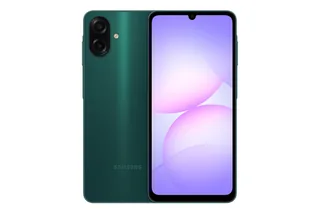
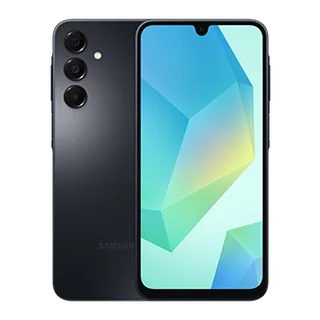
| Colours | Green, light violet and black in Indonesia | Black, Light Green and Grey; availability varies by region |
| Water resistance detail | – | IP54; maker test sprays 10 litres of fresh water per minute for five minutes at all angles; not for swimming or immersion, and resistance can decline with wear |
| Biometrics | Side fingerprint reader | Fingerprint reader; side-mounted power-button location confirmed by GSMArena and Notebookcheck; Samsung Knox Vault isolates sensitive credentials |
| Sensors | – | Accelerometer, fingerprint, geomagnetic and light sensors; virtual proximity sensing |
| Speakers | – | Mono speaker; no stereo support |
| Software | ||
| Operating system | Android | Android |
| Software at launch | Android with One UI 7.0 | One UI 6.1; Android 14 confirmed by GSMArena and Notebookcheck |
| Software updates | – | Up to six generations of OS upgrades and six years of security maintenance; current UK specification page separately lists security validity until 31 August 2031 |
| In the box | – | USB-C cable and SIM tool confirmed by GSMArena; power adaptor sold separately |
| Connectivity | ||
| Mobile network | – | LTE FDD bands 1/3/5/7/8/20/28 and TDD 38/40/41; WCDMA 1/5/8 and quad-band GSM; no 5G |
| SIM | Dual nano-SIM plus dedicated microSD slot on Caribbean SM-A075M | Dual nano-SIM; second slot shared with microSD |
| Wi-Fi | Wi-Fi 802.11a/b/g/n/ac at 2.4 and 5 GHz on SM-A075M | Wi-Fi 5, 802.11 a/b/g/n/ac, 2.4/5 GHz, VHT80 and Wi-Fi Direct |
| Bluetooth | Bluetooth 5.3 on SM-A075M | Bluetooth 5.3 |
| NFC | – | Supported on UK SM-A165FZKBEUB |
| USB | USB Type-C 2.0; 3.5 mm headphone socket | USB-C, USB 2.0; USB-C audio and no 3.5 mm headphone socket |
| Positioning | GPS, GLONASS, BeiDou, Galileo and QZSS on SM-A075M | GPS, GLONASS, BeiDou, Galileo and QZSS |
More comparisons
- Samsung Galaxy A07 vs Samsung Galaxy A08
- Samsung Galaxy A08 vs Samsung Galaxy A16 LTE
- Samsung Galaxy A07 vs Samsung Galaxy A18
- Samsung Galaxy A16 LTE vs Samsung Galaxy A18
- Samsung Galaxy A07 vs Samsung Galaxy A27 5G
- Samsung Galaxy A16 LTE vs Samsung Galaxy A27 5G
- Samsung Galaxy A07 vs Samsung Galaxy A37 5G
- Samsung Galaxy A07 vs Samsung Galaxy A57 5G
- Samsung Galaxy A16 LTE vs Samsung Galaxy A37 5G
- Samsung Galaxy A16 LTE vs Samsung Galaxy A57 5G
- Motorola Moto G (2026) vs Samsung Galaxy A16 LTE
- Nothing Phone (3a) Lite vs Samsung Galaxy A07
- Samsung Galaxy A16 LTE vs Samsung Galaxy A17 5G
- Samsung Galaxy A07 vs Samsung Galaxy A17 5G
- Motorola motorola edge 60 fusion vs Samsung Galaxy A07
- Motorola moto g86 5G vs Samsung Galaxy A07