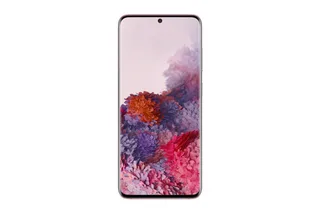
Samsung Galaxy S20 vs Samsung Galaxy S25 Ultra
Better figure, where one is clearly better
| SamsungGalaxy S20 | SamsungGalaxy S25 Ultra | |
|---|---|---|
| Overview | ||
| Released | March 2020 | February 2025 |
| Display | ||
| Screen size | 6.2″ | 6.9″ |
| Resolution | 3200 × 1440 (better) | 3120 × 1440 |
| Sharpness | 566 pixels per inch (better) | 498 pixels per inch |
| Panel | OLED | LTPO OLED |
| Refresh rate | 120 Hz | 120 Hz |
| Peak brightness | – | 2,600 nits |
| Display type | Quad HD+ Dynamic AMOLED 2X Infinity-O Display (3,200 × 1,440), HDR10+ certified; 120 Hz supported at up to FHD+ (60 Hz by default); 6.2 inches as a full rectangle, 6.1 inches with rounded corners | Dynamic AMOLED 2X, Quad HD+, 16M colours; Super Smooth 120 Hz adaptive refresh rate (1–120 Hz); 6.9 inches as a full rectangle, 6.8 inches allowing for the rounded corners |
| Pixel density | 563 ppi (Samsung) | – |
| Brightness detail | Up to 1,200 nits peak (Samsung) | – |
| Screen protection | Corning Gorilla Glass 6 front and back (Corning) | Corning Gorilla Armor 2 (glass-ceramic with an anti-reflective surface treatment) |
| Display features | – | Vision booster; Adaptive colour tone; ProScaler image upscaling |
| Performance | ||
| Chip | Exynos 990 | Snapdragon 8 Elite for Galaxy |
| Memory | 8 GB – 12 GB | 12 GB |
| Storage | 128 GB | 256 GB, 512 GB, 1 TB (better) |
| CPU | 7 nm, 64-bit octa-core, 2.73 GHz + 2.5 GHz + 2 GHz; 8 GB of LPDDR5 RAM (4G) or 12 GB (5G) | Octa-core (4.47 GHz, 3.5 GHz); 3 nm |
| GPU | – | Real-time ray tracing; Vulkan optimisation |
| Cooling | – | Larger vapour chamber with a new thermal interface material (TIM) |
| Storage type | 128 GB (104 GB available); microSD card slot up to 1 TB (shared with the second SIM) | – |
| Cameras | ||
| Main camera | 12 MP | 200 MP (better) |
| Ultra wide camera | 12 MP | 50 MP |
| Telephoto camera | 64 MP | 50 MP |
| Optical zoom | 1.06× | 5× (better) |
| Front camera | 10 MP | 12 MP (better) |
| Main camera | 12 MP wide-angle, F1.8, 79°, Super Speed Dual Pixel AF, OIS | 200 MP wide, F1.7, 85° field of view, OIS, autofocus; Adaptive Pixel sensor |
| Ultra wide camera | 12 MP, F2.2, 120° | 50 MP, F1.9, 120° field of view; macro shots |
| Telephoto camera | 64 MP, F2.0, 76°, PDAF, OIS; approximately 1.06x optical zoom (Notebookcheck) | 50 MP, F3.4, 22° field of view, OIS, 5x optical zoom |
| Second telephoto camera | – | 10 MP, F2.4, 36° field of view, OIS, 3x optical zoom |
| Front camera | 10 MP, Dual Pixel AF, F2.2, 80° | 12 MP, F2.2, 80° field of view, autofocus |
| Zoom | Hybrid Optic Zoom 3x; Space Zoom (digital) up to 30x | 3x and 5x optical zoom; 2x and 10x optical-quality zoom (Adaptive Pixel sensor); Space Zoom up to 100x digital |
| Video recording | 8K (7,680 × 4,320) at 24 fps; 4K at 60 fps; up to 960 fps super slow motion at HD resolution | Up to 8K (7680 × 4320) at 30 fps; 10-bit HDR recording by default; Log video; slow motion at 240 fps (FHD) and 120 fps (FHD and UHD) |
| Camera features | Single Take; Night mode; Super Steady video | ProVisual Engine; Nightography; Audio Eraser; Expert RAW; Filters made from your own photos |
| Battery and charging | ||
| Battery | 4,000 mAh | 5,000 mAh (better) |
| Video playback (maker's claim) | – | Up to 31 hours |
| Wired charging | Up to 25 W | Up to 45 W (better) |
| Wireless charging | Yes (wattage not published) | Up to 15 W |
| Battery life detail | 4,000 mAh typical, 3,880 mAh rated; internet use up to 14 hours (LTE) or 15 hours (Wi-Fi); talk time up to 20 hours (4G) | 5,000 mAh typical, 4,855 mAh rated; at least 2,000 charge cycles; EU energy class B, 44 h 54 min per charge cycle |
| Wired charging | 25 W fast charger included; compatible with QC2.0 and AFC | Up to 65% in around 30 minutes with a 45 W adapter (sold separately); compatible with QC2.0 and AFC/PD |
| Wireless charging | Fast Wireless Charging 2.0 with chargers of 10 W or more (WPC) | Fast Wireless Charging 2.0 (WPC Qi); Qi certified at 15 W (Extended Power Profile) |
| Charges other devices | Wireless PowerShare | Wireless PowerShare |
| Design | ||
| Type | Standard | Standard |
| Weight | 163 g (better) | 218 g |
| Thickness | 7.9 mm (better) | 8.2 mm |
| Height × width | 151.7 × 69.1 mm | 162.8 × 77.6 mm |
| Water and dust resistance | IP68 | IP68 |
| Stylus | – | Yes |
| Materials | Gorilla Glass 6 front and back with a metal frame | Titanium frame (not the volume and side keys) |
| Colours | Cosmic Grey, Cloud Blue, Cloud Pink | Titanium Silverblue, Titanium Black, Titanium Grey, Titanium Whitesilver; Titanium Jetblack, Titanium Jadegreen and Titanium Pinkgold (Samsung.com only) |
| Water resistance detail | IP68, up to 1.5 m for 30 minutes | IP68, tested for submersion in up to 1.5 m of fresh water for up to 30 minutes; not advised for beach or pool use |
| Biometrics | Ultrasonic in-screen fingerprint sensor, face recognition | Fingerprint sensor |
| Sensors | Ultrasonic fingerprint, accelerometer, barometer, gyro, geomagnetic, Hall, proximity, RGB light | Accelerometer, barometer, fingerprint sensor, gyro sensor, geomagnetic sensor, Hall sensor, light sensor, proximity sensor |
| Speakers | Stereo speakers and earphones sound by AKG; Dolby Atmos | Stereo speakers |
| Software | ||
| Operating system | Android | Android |
| Software at launch | Android 10 | One UI 7 (Android 15) |
| Software updates | – | Seven generations of OS upgrades and seven years of security updates; security updates until 31 January 2032 (UK) |
| AI features | – | Galaxy AI, including Now Brief, Now Bar and Audio Eraser; Circle to Search with Google (finger or S Pen); Gemini on the side button |
| Connectivity | ||
| Satellite messaging | – | Yes |
| Mobile network | 5G model: 5G Sub6 (NSA, SA, DSS); both models: LTE Cat 20 (up to 2.0 Gbps down, 200 Mbps up), 4×4 MIMO, up to 7CA, LAA | 5G Sub6 (FDD, TDD, SDL); 4G LTE (FDD, TDD); 3G WCDMA; 2G GSM |
| SIM | Hybrid dual SIM (nano-SIM plus nano-SIM or microSD) and eSIM | Two nano-SIMs, nano-SIM and eSIM, or dual eSIM |
| Wi-Fi | Wi-Fi 6 (802.11a/b/g/n/ac/ax), 2.4 and 5 GHz, HE80, MIMO, 1024-QAM | Wi-Fi 7 (802.11a/b/g/n/ac/ax/be), 2.4, 5 and 6 GHz, EHT320, MIMO, 4096-QAM |
| Bluetooth | Bluetooth 5.0; ANT+ | Bluetooth 5.4 |
| Ultra Wideband | – | Yes |
| NFC | Yes | Yes |
| Satellite features | – | Works with O2 Satellite in the UK (texts, supported apps, maps and location sharing where O2 has no signal; not emergency calls) |
| USB | USB Type-C; no 3.5 mm headphone jack | USB Type-C, USB 3.2 Gen 1 |
| Positioning | GPS, Galileo, Glonass, BeiDou | GPS, Glonass, Beidou, Galileo, QZSS |

More comparisons
- Samsung Galaxy S25 Ultra vs Samsung Galaxy S26 FE
- Samsung Galaxy S20 vs Samsung Galaxy S26 FE
- Samsung Galaxy S25 Ultra vs Samsung Galaxy S26
- Samsung Galaxy S25 Ultra vs Samsung Galaxy S26 Ultra
- Samsung Galaxy S25 Ultra vs Samsung Galaxy S26+
- Samsung Galaxy S20 vs Samsung Galaxy S26
- Samsung Galaxy S20 vs Samsung Galaxy S26 Ultra
- Samsung Galaxy S20 vs Samsung Galaxy S26+
- Samsung Galaxy S25 Ultra vs Xiaomi POCO F8 Ultra
- Apple iPhone 17 Pro Max vs Samsung Galaxy S25 Ultra
- Samsung Galaxy S25 FE vs Samsung Galaxy S25 Ultra
- Samsung Galaxy S20 vs Samsung Galaxy S25 FE
- Samsung Galaxy S25 Ultra vs Xiaomi Xiaomi 17 Pro
- Samsung Galaxy S25 Ultra vs Xiaomi Xiaomi 17 Pro Max
- Samsung Galaxy S25 Ultra vs Xiaomi Xiaomi 15T Pro
- Samsung Galaxy S25 Edge vs Samsung Galaxy S25 Ultra