Samsung Galaxy Watch Ultra vs Samsung Galaxy Watch8
Better figure, where one is clearly better
| SamsungGalaxy Watch Ultra | SamsungGalaxy Watch8 | |
|---|---|---|
| Overview | ||
| Released | July 2024 | July 2025 |
| Display | ||
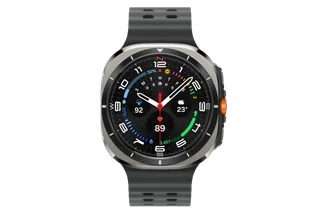
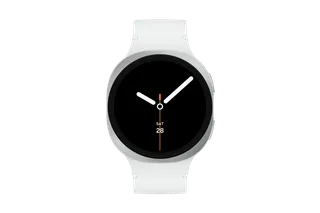
| Case sizes | 47 mm | 40 mm or 44 mm |
| Panel | OLED | OLED |
| Peak brightness | 3,000 nits | 3,000 nits |
| Always-on display | Yes | Yes |
| Display detail | Super AMOLED with full-colour Always On Display; 1.5-inch (37.3 mm) with 480 x 480 pixels; 16M colours; Night Mode on its own watch faces | Super AMOLED with full-colour Always On Display; 40 mm has 1.34 inches (34 mm) with 438 x 438 pixels; 44 mm has 1.47 inches (37.3 mm) with 480 x 480 pixels; 16M colours |
| Screen protection | Sapphire Crystal | Sapphire Crystal |
| Health and fitness | ||
| ECG | Yes | Yes |
| Blood oxygen | Yes | Yes |
| Skin temperature | Yes | Yes |
| Sleep apnoea alerts | Yes | Yes |
| High blood pressure alerts | No | No |
| Body composition | Yes | Yes |
| Fall detection | Yes | Yes |
| Crash detection | No | No |
| GPS | Dual-band (L1 and L5) | Dual-band (L1 and L5) |
| Water resistance | 100 m (better) | 50 m |
| Sensors | Samsung BioActive Sensor (optical bio-signal sensor, electrical heart signal sensor and bioelectrical impedance analysis sensor); temperature sensor; accelerometer; barometer; gyro sensor; geomagnetic sensor; light sensor | Samsung BioActive Sensor (optical bio-signal sensor, electrical heart signal sensor and bioelectrical impedance analysis sensor); infrared temperature sensor; accelerometer; barometer; gyro sensor; geomagnetic sensor; light sensor |
| Health features | ECG with Irregular Heart Rhythm Notification, blood pressure (calibrated against an arm cuff every 4 weeks) and sleep apnoea detection in the Samsung Health Monitor app, which needs a Galaxy phone; AGEs Index; sleep analysis; body composition; heart rate alerts | ECG with Irregular Heart Rhythm Notification, blood pressure (calibrated against an arm cuff every 4 weeks) and CE-marked sleep apnoea detection in the Samsung Health Monitor app, which needs a Galaxy phone; Antioxidant Index; Energy Score; Bedtime Guidance and Sleep Coaching; Vascular Load; body composition; stress tracking and guided meditation; Cycle Tracking |
| Fitness features | Multi-sports tile for triathlons; Functional Threshold Power (FTP) for cycling in 4 minutes; Personalised Heart Rate Zone; Quick Button to start and control workouts; works from 500 m below sea level to 9,000 m altitude | Running Coach; automatic workout detection |
| Safety features | Emergency Siren up to 86 dB, heard up to 180 m away (hold the Quick Button); Emergency SOS; Fall Detection | Emergency SOS; Fall Detection |
| Battery and connections | ||
| Battery life (maker's claim) | Up to 60 hours | Up to 30 hours |
| In low-power mode | Up to 100 hours | – |
| Mobile data option | Yes | Yes |
| Works with | Android | Android |
| Chip | Exynos W1000 | Exynos W1000 |
| Storage | 32 GB | 32 GB |
| Battery life detail | Up to 60 hours with Always On Display on and up to 80 hours with it off; up to 100 hours in Power Saving; up to 48 hours of outdoor workout with GPS in Exercise Power Saving; 590 mAh typical capacity | Up to 30 hours with Always On Display on and up to 40 hours with it off; 325 mAh (40 mm) and 435 mAh (44 mm) typical capacity |
| Charging | Fast Charging (WPC-based wireless charging) | Fast Charging (WPC-based wireless charging); wireless charger in the box |
| Connectivity | LTE with eSIM (4G LTE and 3G); Bluetooth 5.3; Wi-Fi 802.11a/b/g/n at 2.4 GHz and 5 GHz; NFC; L1 + L5 dual-frequency GPS with Glonass, Beidou and Galileo; pairs with Android 11 or later phones with more than 1.5 GB of memory | LTE models with eSIM (4G LTE and 3G); Bluetooth 5.3; Wi-Fi 802.11a/b/g/n at 2.4 GHz and 5 GHz; NFC; L1 + L5 dual-frequency GPS with Glonass, Beidou and Galileo; pairs with Android 12 or later phones with more than 1.5 GB of memory |
| Storage | 2 GB memory; 32 GB storage (21.1 GB available); the Galaxy Watch Ultra (2025), sold from July 2025, has 64 GB (50.0 GB available) | 2 GB memory; 32 GB storage (20.2 GB available on the 44 mm Bluetooth model) |
| Design | ||
| Weight (lightest version) | 60.5 g | 30 g (better) |
| Software | Wear OS | Wear OS |
| Case materials | Grade 4 titanium on the front and back cover areas of the frame, the rest a mix of plastic and grade 2 titanium; Sapphire Crystal; 10ATM and IP68; MIL-STD-810H; works on the wrist from -20°C to 55°C | Armor Aluminium case; Sapphire Crystal; 5ATM and IP68; MIL-STD-810H |
| Size | 47.1 x 47.4 x 12.1 mm; 60.5 g (watch body without band) | 40 mm is 42.7 x 40.4 x 8.6 mm and 30.0 g; 44 mm is 46.0 x 43.7 x 8.6 mm and 34.0 g (watch body without band) |
| Bands | – | Dynamic Lug System; Sport, Fabric, Hybrid and Athleisure bands |
| Colours | Titanium Silver, Titanium Gray, Titanium White; the 2025 version adds Titanium Blue | Graphite, Silver |
More comparisons
- Google Pixel Watch 5 vs Samsung Galaxy Watch8
- Google Pixel Watch 5 vs Samsung Galaxy Watch Ultra
- Samsung Galaxy Watch Ultra vs Samsung Galaxy Watch Ultra2
- Samsung Galaxy Watch Ultra2 vs Samsung Galaxy Watch8
- Samsung Galaxy Watch8 vs Samsung Galaxy Watch9
- Samsung Galaxy Watch Ultra vs Samsung Galaxy Watch9
- Google Pixel Watch 4 vs Samsung Galaxy Watch8
- Google Pixel Watch 4 vs Samsung Galaxy Watch Ultra
- Samsung Galaxy Watch7 vs Samsung Galaxy Watch8
- Samsung Galaxy Watch8 vs Samsung Galaxy Watch8 Classic
- Samsung Galaxy Watch Ultra vs Samsung Galaxy Watch8 Classic
- Google Pixel Watch 3 vs Samsung Galaxy Watch8
- Samsung Galaxy Watch Ultra vs Samsung Galaxy Watch7