Samsung OLED S95D vs Sony BRAVIA 8 II
Better figure, where one is clearly better
| SamsungOLED S95D | SonyBRAVIA 8 II | |
|---|---|---|
| Overview | ||
| Released | 2024 | June 2025 |
| Display | ||
| Panel | QD-OLED | QD-OLED |
| Panel detail | QD-OLED confirmed by What Hi-Fi? and TechRadar; maker OLED Glare Free coating | – |
| Resolution | 3840 × 2160 (4K) | 3840 × 2160 (4K) |
| Refresh rate | 144 Hz (better) | 120 Hz |
| HDR formats | HDR10, HDR10+, HLG | Dolby Vision, HDR10, HLG |
| HDR extras | OLED HDR Pro; HDR10+ Adaptive and Gaming. HDR10 and HLG confirmed by What Hi-Fi? | IMAX Enhanced |
| Screen finish | Matte OLED Glare Free | Low-reflection film |
| Peak brightness | – | About 1,800 cd/m² calibrated and up to 2,200 cd/m² in Vivid mode, HDR (FlatpanelsHD, 65″) |
| Colour range | – | XR Triluminos Max |
| Picture processing | Real Depth Enhancer, 4K AI Upscaling and HDR Brightness Optimizer | XR Contrast Booster 25, XR 4K Upscaling, AI scene recognition, ambient light sensor |
| Picture modes | Filmmaker Mode, Smart Calibration Basic and expert calibration | Vivid, Standard, Cinema, Professional, Calm, Photo, IMAX Enhanced, Dolby Vision (Vivid, Bright, Dark, Game), FPS Game, RTS Game; Studio Calibrated modes for Netflix, Prime Video and Sony Pictures Core |
| Motion handling | UK sheet lists 100 Hz with up to 144 Hz; Motion Xcelerator 144Hz and 4K 144 Hz input on every HDMI port | XR OLED Motion |
| Sizes | ||
| Sizes | 55, 65, 77″ | 55, 65″ |
| Largest size | 77″ (better) | 65″ |
| Gaming | ||
| HDMI ports | 4 (all HDMI 2.1 at 4K 120 Hz+) (better) | 4 (2 HDMI 2.1 at 4K 120 Hz+) |
| Variable refresh rate | HDMI VRR, FreeSync Premium Pro | HDMI VRR |
| Auto low latency mode | Yes | Yes |
| HDMI detail | Four HDMI inputs on One Connect Y24 4K, each supporting 4K at 144 Hz; eARC and Anynet+ HDMI-CEC | HDMI 2.1 features: 4K 120 fps, eARC, VRR, ALLM, SBTM (Source-Based Tone Mapping); HDCP 2.3 on all four inputs |
| Input lag | – | 17 ms at 60 Hz, about half that at 120 Hz (FlatpanelsHD) |
| Game features | ALLM, HGiG, Game Motion Plus, Dynamic Black EQ, super-ultrawide view and Mini Map Zoom | Game Menu; Auto HDR Tone Mapping and Auto Genre Picture Mode with a PS5; Dolby Vision Game mode |
| Cloud gaming | Samsung Gaming Hub supported in the UK; accounts and subscriptions may be required | – |
| Smart TV and sound | ||
| Smart TV platform | Tizen | Google TV |
| Processor | NQ4 AI Gen2 Processor | XR Processor |
| Speakers | 70 W, 4.2.2 channels (better) | 50 W, 2.2 channels |
| Dolby Atmos | Yes | Yes |
| DTS:X | – | Yes |
| eARC | Yes | Yes |
| Wi-Fi | Wi-Fi 5 | Wi-Fi 6E |
| Bluetooth | 5.2 | 5.3 |
| Speaker detail | Object Tracking Sound+ and Q-Symphony with compatible Samsung soundbars | Acoustic Surface Audio+ with 2 actuators and 2 subwoofers, 15 W + 15 W + 10 W + 10 W |
| Audio features | Active Voice Amplifier Pro, Adaptive Sound Pro and 360 Audio | Acoustic Center Sync, Voice Zoom 3, 3D Surround Upscaling, S-Force Front Surround, automatic room and position sound calibration, S-Master digital amplifier |
| Voice assistants | Bixby and built-in Alexa; works with Google Assistant speakers | Google Assistant built in with hands-free voice search; works with Alexa and Apple HomeKit |
| Casting | Apple AirPlay, Tap View and mobile mirroring; Multi View up to two videos | Google Cast, Apple AirPlay |
| Software updates | Maker lists security updates through 31 December 2029; no OS-upgrade count inferred | – |
| TV tuners | Dual DVB-T2/C/S2 tuners, analogue tuner, CI+ 1.4 and HbbTV | DVB-T/T2, DVB-C and DVB-S/S2; 2 terrestrial/cable and 2 satellite digital tuners; CI+ |
| USB | Three USB-A and one USB-C connection in the maker table | 2 × USB; USB hard disk recording |
| Ethernet | One LAN port | 1 × Ethernet |
| Optical audio out | One digital optical audio output | 1 × optical digital audio out (shared with the S-Center speaker input) |
| Design and power | ||
| Size | Without stand, W × H × D; 55-inch 1224.6 × 706.3 × 11 mm; 65-inch 1443.5 × 829.4 × 11 mm; 77-inch 1716.6 × 984.1 × 11.2 mm | Without stand, 55″ 1224 × 707 × 34 mm; 65″ 1443 × 830 × 34 mm |
| Stand | With stand, 55-inch height 771.4 mm/depth 267.9 mm/23.9 kg; 65-inch 894.4 mm/267.9 mm/29 kg; 77-inch 1048.1 mm/286.4 mm/40 kg. Stand width 360 mm across sizes | Aluminum Edge Stand with two heights (standard and soundbar) |
| VESA pattern | 55/65-inch 400 × 300 mm; 77-inch 400 × 400 mm | 300 × 300 mm |
| Power use | Typical/max 55-inch 82/350 W, 65-inch 100/440 W and 77-inch 128/600 W; standby 0.5 W | 55″ 334 W, 65″ 418 W rated; 0.5 W standby |
| Energy class | UK table G at 55 inches, F at 65/77 inches | – |
| Colours | Graphite Black front and Titan Black stand | Black |
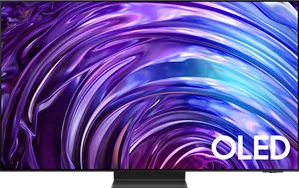
| In the box | TM2360E and UK TM1240A remotes, user manual and power cable; One Connect box. Released year kept because maker US actual availability is April 2024 after March preorders, while TechRadar reports March. Maker front thumbnail is low resolution and retains OLED screen branding | – |

More comparisons
- Samsung OLED S95D vs Samsung OLED S95H
- Sony BRAVIA 7 II vs Sony BRAVIA 8 II
- Sony BRAVIA 8 II vs Sony BRAVIA 9 II
- LG OLED evo G6 vs Samsung OLED S95D
- Sony BRAVIA 3 II vs Sony BRAVIA 8 II
- Sony BRAVIA 8 II vs Sony XEL-1
- Sony BRAVIA 8 II vs Sony Trinitron KV-1310
- Sony BRAVIA 8 II vs Sony FD Trinitron WEGA XBR KD-34XBR970
- LG OLED evo G3 vs Sony BRAVIA 8 II
- LG OLED evo G2 vs Sony BRAVIA 8 II
- Samsung OLED S95C vs Sony BRAVIA 8 II
- Sony A95L vs Sony BRAVIA 8 II
- Sony A95K vs Sony BRAVIA 8 II
- LG OLED C6 (2016) vs Sony BRAVIA 8 II
- LG OLED C7 vs Sony BRAVIA 8 II
- LG OLED C8 vs Sony BRAVIA 8 II