Sony Alpha 68 vs Sony Alpha SLT-A58
Better figure, where one is clearly better
| SonyAlpha 68 | SonyAlpha SLT-A58 | |
|---|---|---|
| Overview | ||
| Released | March 2016 | April 2013 |
| Image and sensor | ||
| Camera type | Translucent mirror | Translucent mirror |
| Sensor format | APS-C | APS-C |
| Sensor type | Exmor CMOS | Exmor APS HD CMOS |
| Sensor dimensions | 23.5 × 15.6 mm | 23.2 × 15.4 mm |
| Effective resolution | 24.2 MP | 20.1 MP |
| Largest image | 6000 × 4000 | 5456 × 3632 |
| RAW recording | Yes | Yes |
| Standard ISO range | 100–25600 | 100–16000 |
| Sensor detail | 24.8 million total photosites; fixed translucent mirror directs light to the dedicated phase-detection AF sensor while the imaging sensor supplies live view | 20.4 million total photosites; fixed translucent mirror feeds the dedicated phase-detection AF module while the main sensor supplies live view |
| Image formats | JPEG Extra Fine/Fine/Standard, RAW (Sony ARW 2.3) and RAW+JPEG; 3:2 or 16:9 stills | JPEG, RAW (Sony ARW 2.3) and RAW+JPEG; 3:2 or 16:9 stills; no 3D panorama |
| ISO detail | Standard still-image ISO 100–25600; movie ISO 100–12800 | Auto ISO 100–3200; standard ISO 100–16000; multi-frame noise reduction extends to ISO 25600; movies ISO 100–3200 |
| Image processor | BIONZ X | BIONZ |
| Lens and shooting | ||
| Lens mount | Sony A-mount | Sony A-mount |
| Stabilisation | Sensor shift | Sensor shift |
| Maximum continuous burst | 5 fps | 5 fps |
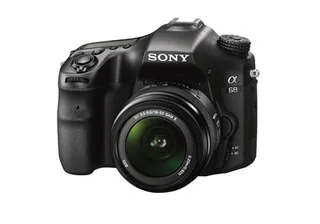
| Lens detail | Sony, Minolta and Konica Minolta A-mount AF lenses; photograph shows the optional DT 18–55mm F3.5–5.6 SAM II kit lens | Sony, Minolta and Konica Minolta A-mount AF lenses; kit lenses are separate from body specifications |
| Autofocus | 79 dedicated phase-detection points including 15 cross sensors and a central F2.8 sensor; AF-S, AF-A, AF-C and manual focus; EV −2–18 at ISO 100; Eye AF, Eye-Start AF, Lock-on AF and expanded flexible spot | 15 phase-detection points including three cross sensors; AF-S, AF-A, AF-C and manual focus; EV −1–18 at ISO 100 with an F2.8 lens; Lock-on AF, zone/local selection and flash assist |
| Shutter | 1/4000–30 seconds and Bulb; flash sync 1/160 second; selectable electronic first curtain | 1/4000–30 seconds and Bulb; flash sync 1/160 second; electronic first curtain selectable |
| Burst detail | Full-resolution continuous shooting up to 5 fps Hi or 2.5 fps Lo. Tele-zoom Continuous Advance Priority AE reaches 8 fps with a crop to approximately 6 MP JPEG (PhotographyBlog and Amateur Photographer) | Full-resolution continuous shooting up to 5 fps Hi or 2.5 fps Lo; Tele-zoom Continuous Advance Priority AE reaches 8 fps with central crop to approximately 5 MP JPEG (PhotographyBlog and Expert Reviews). Maker ordinary Hi buffer: seven Fine or eight Standard JPEG, six RAW or five RAW+JPEG; cropped mode 16 Fine or 19 Standard JPEG. Performance depends on card and shooting conditions |
| Stabilisation detail | SteadyShot INSIDE sensor shift for stills; electronic stabilisation for movies | SteadyShot INSIDE sensor shift for stills; electronic stabilisation for movies |
| Flash | Built-in flash, guide number 12 metres at ISO 100 with 16 mm coverage; Multi Interface Shoe | Automatic pop-up flash, guide number 10 metres at ISO 100; ADI/pre-flash TTL; Multi Interface Shoe; compatible external flash required for wireless and high-speed sync |
| Exposure controls | PASM, automatic, scene, panorama and memory-recall modes; 1200-zone metering; ±5 EV compensation in 1/3 or 1/2 steps; D-Range Optimizer and Auto HDR | PASM, Intelligent Auto, Superior Auto, scene, panorama and Picture Effect modes; 1200-zone metering; ±3 EV still or ±2 EV movie compensation in 1/3 steps; D-Range Optimizer, Auto HDR and Auto Object Framing |
| Video | ||
| Highest video resolution | 1920 × 1080 at 30 fps | 1920 × 1080 at 30 fps |
| Video detail | XAVC S Full HD at 30p/25p depending on region, or 24p, at 50 Mbps. AVCHD Full HD at 60i/50i or 24p/25p, at approximately 24 or 17 Mbps; no Full HD 50p/60p. MP4 up to 1440 × 1080 at 12 Mbps. Main frame rate reflects the highest published progressive regional setting | Japan/NTSC configuration: Full HD AVCHD 2.0 at 60 interlaced fields per second with 30 fps sensor output, or 24p, at approximately 24 or 17 Mbps. PAL models use 50i or 25p. No 50p/60p Full HD. MP4 up to 1440 × 1080 at 30 fps; main rate is sensor output, not interlaced field rate. Maker continuous limit approximately 29 minutes or 2 GB. Manual movie exposure and autofocus cannot operate together (Expert Reviews) |
| Audio | Built-in stereo microphone and mono playback speaker; 3.5 mm microphone input | Built-in stereo microphone and mono playback speaker; 3.5 mm external microphone input |
| Screen and viewfinder | ||
| Viewfinder | Electronic | Electronic |
| Screen size | 2.7″ | 2.7″ |
| Screen dots | 460,800 | 460,800 |
| Touchscreen | – | No |
| Tilting screen | Yes | Yes |
| Display detail | Approximately 135° upward and 55° downward tilt; backlit top status display | Maker Japanese table specifies approximately 135° upward/55° downward tilt; PhotographyBlog and Expert Reviews describe 90°/45°. Dots count colour subpixels; focus peaking and magnification |
| Viewfinder detail | 0.39-type OLED Tru-Finder with 1,440,000 dots and 100% coverage; approximately 0.88× magnification with a 50 mm lens, equivalent to 0.57× on full frame | 0.39-type OLED Tru-Finder with 1,440,000 dots, 100% coverage and approximately 0.88× magnification with a 50 mm lens |
| Connections and design | ||
| Wi-Fi | No | No |
| Battery life (maker's claim) | 580 photographs | 690 photographs |
| Body weight | 596 g | 492 g (better) |
| Release detail | Sony Denmark specifies March 2016 retail availability; the USA and Canada announcement specifies April 2016 | Sony Asia Pacific and Hong Kong specify April 2013 retail availability |
| Recording media | Single slot for SD/SDHC/SDXC including UHS-I, Memory Stick PRO Duo, PRO-HG Duo or XC-HG Duo | Single slot accepting SD/SDHC/SDXC, Memory Stick PRO Duo, PRO-HG Duo and XC-HG Duo |
| Ports | Multi/Micro USB terminal, micro HDMI Type D, 3.5 mm microphone input, DC input and Multi Interface Shoe | USB 2.0 Multi/Micro USB terminal supporting PC remote, micro HDMI Type D, 3.5 mm microphone and DC input; Multi Interface Shoe; no headphone output |
| Wireless connections | No Wi-Fi (Amateur Photographer) | – |
| Battery life detail | NP-FM500H; current Sony support claim up to 580 photographs | NP-FM500H; maker CIPA claim approximately 690 photographs with viewfinder or 700 with LCD |
| Charging | Supplied BC-VM10A external battery charger | Supplied BC-VM10A external charger; no in-body charging |
| Dimensions | Approximately 142.6 × 104.2 × 80.9 mm (width × height × depth) | Approximately 128.6 × 95.5 × 77.7 mm (width × height × depth), excluding protrusions |
| Weight detail | Current Sony support specifies approximately 596 g body only or 675 g with battery and Memory Stick PRO Duo. The earlier Danish announcement lists 610 g/690 g | Approximately 492 g body only, 573 g including battery and Memory Stick PRO Duo |
| Colours | Black | Black |
| In the box | NP-FM500H battery, BC-VM10A charger, power lead, shoulder strap, Micro USB cable, body cap, eyepiece cup and shoe cap; lens depends on kit | NP-FM500H battery, BC-VM10A charger, shoulder strap, Micro USB cable, body cap and eyepiece cup; lenses depend on kit |

More comparisons
- Sony Alpha 68 vs Sony Alpha 7R VI
- Sony Alpha 7R VI vs Sony Alpha SLT-A58
- Sony Alpha 7 V vs Sony Alpha SLT-A58
- Sony Alpha 68 vs Sony Alpha 7 V
- Sony Alpha 1 II vs Sony Alpha 68
- Sony Alpha 1 II vs Sony Alpha SLT-A58
- Sony Alpha 68 vs Sony Alpha 9 III
- Sony Alpha 9 III vs Sony Alpha SLT-A58
- Sony Alpha 68 vs Sony Alpha 7C II
- Sony Alpha 68 vs Sony Alpha 7CR
- Sony Alpha 7C II vs Sony Alpha SLT-A58
- Sony Alpha 7CR vs Sony Alpha SLT-A58
- Sony Alpha 6700 vs Sony Alpha SLT-A58
- Sony Alpha 6700 vs Sony Alpha 68
- Sony Alpha 68 vs Sony Alpha 7R V
- Sony Alpha 7R V vs Sony Alpha SLT-A58