Sony Cyber-shot DSC-H10 vs Sony Cyber-shot DSC-W300
Better figure, where one is clearly better
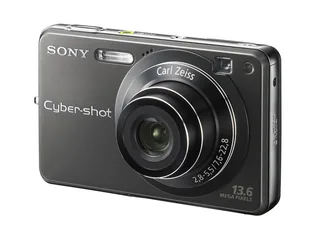
| SonyCyber-shot DSC-H10 | SonyCyber-shot DSC-W300 | |
|---|---|---|
| Overview | ||
| Released | 2008 | 2008 |
| Image and sensor | ||
| Camera type | Compact | Compact |
| Sensor format | Other | 1/1.7-type |
| Sensor type | Super HAD CCD | Super HAD CCD |
| Effective resolution | 8.1 MP | 13.6 MP |
| Largest image | 3264 × 2448 | 4224 × 3168 |
| RAW recording | No | No |
| Standard ISO range | 100–3200 | 80–3200 |
| Sensor detail | 1/2.5-type colour Super HAD CCD, approximately 8.286 million total and 8.083 million effective photosites, rounded to 8.1 MP; optical format does not establish physical sensor dimensions | 1/1.7-type primary-colour Super HAD CCD, approximately 13.6 million effective and 13.9 million total photosites; optical format is not physical dimensions |
| Image formats | Exif 2.21 JPEG still images; DCF and DPOF supported, no RAW recording. Sharpness, contrast and colour modes can be adjusted | JPEG, maximum 4224 × 3168 pixels; 4224 × 2816 in 3:2 or 4224 × 2376/1920 × 1080 in 16:9 |
| ISO detail | – | Auto or ISO80–3200 at full resolution; EX High Sensitivity extends to ISO6400 at reduced 3-megapixel resolution |
| Image processor | BIONZ processor, Dynamic Range Optimizer and face detection; Clear RAW NR describes processing before JPEG encoding, not RAW recording | BIONZ with standard and Plus D-range optimisation; Clear RAW NR and adjustable noise-reduction levels; photographs recorded as JPEG rather than RAW |
| Lens and shooting | ||
| Built-in lens | 38–380 mm equivalent | 35–105 mm equivalent |
| Maximum aperture | f/3.5–4.4 | f/2.8–5.5 |
| Optical zoom | 10× | 3× |
| Stabilisation | Optical lens stabilisation | Optical lens stabilisation |
| Maximum continuous burst | – | 1.9 fps |
| Lens detail | Carl Zeiss Vario-Tessar 10× optical zoom; physical 6.3–63 mm, 38–380 mm equivalent, f/3.5 wide to f/4.4 telephoto. Japanese exact table specifies ten elements in nine groups including one aspherical element; supplied adapter supports 58 mm filters and optional conversion lenses | Carl Zeiss Vario-Tessar, actual 7.6–22.8 mm, equivalent to 35–105 mm; six elements in five groups including three aspherical elements. Optional conversion lenses or 37 mm filters require VAD-WF adapter |
| Autofocus | Nine-point multi-area, centre and spot AF, face detection and focus presets; no continuous manual focus. Normal minimum 50 cm wide/90 cm telephoto, macro approximately 2 cm wide/90 cm telephoto. Advanced Sports mode includes predictive autofocus | Nine-area Multipoint, centre or spot AF with illuminator; semi-manual presets 0.5/1/3/7 m or infinity. Auto/macro focus approximately 5 cm wide or 34 cm telephoto. Face detection for up to eight people with child/adult priority and Smile Shutter |
| Shutter | Japanese exact table: Auto 1/4–1/2000 second, Program 1–1/2000, Manual 30–1/2000; operating conditions affect available speeds | Auto approximately 1/4–1/2000 second; Program 1–1/2000 second; Manual 30–1/1000 second |
| Burst detail | Maker UK specifies approximately 0.5-second intervals and up to 100 continuous frames. No reciprocal conversion to a headline frame rate; settings and media affect results | Full-resolution continuous shooting approximately 1.9 fps (Les Numériques exact-model test; maker archive gives up to 100 frames at all sizes). Maker EX High-Speed mode reaches 5 fps only at reduced 3-megapixel resolution; flash slows shooting |
| Stabilisation detail | Optical Super SteadyShot with Continuous or Shooting operation; no infrared NightShot or NightFraming in UK exact table | Optical Super SteadyShot with Shooting or Continuous modes |
| Flash | Built-in pop-up flash, approximately 0.2–7 m wide or 0.9–5.6 m telephoto at ISO Auto; longer high-ISO claims have different conditions. No accessory hotshoe | Built-in flash with Auto, forced, off, slow-sync and red-eye reduction; ISO Auto range approximately 0.2–5.5 m wide or 0.4–2.8 m telephoto |
| Exposure controls | Auto, Program Auto, Manual and nine scene modes. Exact handbook lists no aperture-priority or shutter-priority mode despite UK support table claiming aperture priority. Manual has two ND-filter exposure settings: f/3.5 or f/8 wide, f/4.4 or f/10 telephoto; these do not change depth of field. ±2 EV in 1/3 EV steps and exposure bracketing | Auto, Easy, Program, Manual and scene selections; ±2 EV in 1/3 EV steps and exposure bracketing. One-push custom white balance; iSCN recognises five scene types, Advanced mode can take a second photograph using optimised settings |
| Video | ||
| Highest video resolution | 640 × 480 at 30 fps | 640 × 480 at 30 fps |
| Video detail | MPEG-1 monaural movies: VGA 640×480 at approximately 30 fps Fine requiring Memory Stick PRO Duo, 17 fps Standard or 320×240 at approximately 8 fps. Exact manual limits continuous clips to approximately 10 minutes. DPReview confirms optical zoom cannot change while filming; HD output is for still photographs, not HD movie recording | MPEG Movie VX Fine 640 × 480 at approximately 30 fps requires Memory Stick PRO Duo; Standard approximately 17 fps or Presentation 320 × 240 approximately 8 fps. Manual limits continuous movies to approximately ten minutes; no HD movie recording or playback |
| Audio | Built-in monaural microphone and speaker; monaural movie sound and analogue audio output | MPEG1 mono movie sound; built-in mono microphone and speaker |
| Screen and viewfinder | ||
| Viewfinder | None | Optical |
| Screen size | 3″ | 2.7″ |
| Screen dots | 230,400 | 230,400 |
| Touchscreen | No | No |
| Tilting screen | No | No |
| Display detail | Fixed 3-type Clear Photo LCD Plus TFT, 230400 dots in exact manual and Japanese table; UK table rounds to 230000. No optical or electronic viewfinder | Fixed 2.7-type Clear Photo TFT LCD, 230400 dots; optical zoom viewfinder |
| Connections and design | ||
| Bluetooth | No | – |
| Battery life (maker's claim) | 310 photographs | 300 photographs |
| Body weight | 264 g | 156 g (better) |
| Release detail | Sony Europe notice dated 31 January 2008 planned availability from end of March; Japan scheduled 11 April. Contemporary April and August full tests establish the 2008 retail generation, but earliest actual sale month remains unconfirmed, so year precision retained | Released in 2008. Sony Hong Kong scheduled availability for the end of April 2008, Sony US scheduled May shipping and Sony Japan specified 16 May. These launch announcements do not confirm the actual first retail month |
| Recording media | Approximately 31 MB internal memory; Memory Stick Duo, PRO Duo and PRO-HG Duo supported. PRO-HG operates at PRO Duo speed; PRO Duo required for VGA Fine movies | Approximately 15 MB internal memory; Memory Stick Duo, PRO Duo or PRO-HG Duo. No SD card slot |
| Ports | Multi connector carries Hi-Speed USB 2.0, analogue video and monaural audio. Separate DC IN connector listed by exact Japanese table. Optional component cable provides HD still-image output; no HDMI terminal | Multi-use connector for USB 2.0 Hi-Speed and mono AV output; HD component still-photo output requires optional cable or HD Cyber-shot Station cradle, rather than an HDMI socket |
| Wireless connections | UK maker specification explicitly lists no Bluetooth | – |
| Battery life detail | NP-BG1 lithium-ion battery, 3.6 V, 3.4 Wh/960 mAh. Approximately 310 photographs/155 minutes under maker CIPA still-test conditions. Separate Japanese 170-minute movie-battery claim uses 320-size recording and repeated clips, not VGA Fine. Playback 7400 images/370 minutes is another separate test | Supplied NP-BG1, 3.4 Wh/960 mAh; optional NP-FG1 supported. Manual CIPA claim approximately 300 photographs/150 minutes with LCD on or 340/170 minutes off at 25°C, Normal recording, Single AF, Shooting stabilisation, alternating zoom ends, one shot every 30 seconds, flash every second shot and power cycle every ten |
| Charging | External BC-CSGB/BC-CSGC charger, regional fittings vary; approximately 330 minutes full charge or 270 minutes normal charge from depleted battery at 25°C. Optional AC-LS5K adapter does not charge the battery in the camera | External BC-CSGB/BC-CSGC charger, approximately 330 minutes full charge or 270 minutes normal charge at 25°C; optional AC-LS5K adapter |
| Dimensions | Approximately 106 × 68.5 × 48.9 mm width × height × depth excluding protrusions | 94.3 × 59 × 26.8 mm (width × height × depth), excluding protrusions |
| Weight detail | UK exact support table gives approximately 264 g bare body and 380 g with accessories. Japanese exact specifications and announcement give 265 g bare body, while the English manual and Japanese table give 381 g including NP-BG1 battery, strap, adapter ring, lens hood, cap and other accessories. UK headline retained; one-gram maker discrepancy unresolved | 156 g body-only in Sony Japan specifications; approximately 187 g including NP-BG1, Memory Stick Duo and supplied accessories |
| Materials | – | Stainless-steel body with titanium coating |
| Colours | – | Titanium grey |
| In the box | NP-BG1 battery, external charger, multi-connector USB/AV cable, shoulder strap, lens cap, cap strap, lens hood and adapter ring; regional power fittings vary | NP-BG1, external battery charger, multi-use USB/AV cable, wrist strap, software/handbook CD-ROM and instructions; memory card not supplied |

More comparisons
- Sony Cyber-shot DSC-RX100 VII vs Sony Cyber-shot DSC-W300
- Sony Cyber-shot DSC-H10 vs Sony Cyber-shot DSC-HX99
- Sony Cyber-shot DSC-HX99 vs Sony Cyber-shot DSC-W300
- Sony Cyber-shot DSC-H10 vs Sony Cyber-shot DSC-HX350
- Sony Cyber-shot DSC-HX350 vs Sony Cyber-shot DSC-W300
- Sony Cyber-shot DSC-H10 vs Sony Cyber-shot DSC-HX80
- Sony Cyber-shot DSC-HX80 vs Sony Cyber-shot DSC-W300
- Sony Cyber-shot DSC-H10 vs Sony Cyber-shot DSC-HX90V
- Sony Cyber-shot DSC-HX90V vs Sony Cyber-shot DSC-W300
- Sony Cyber-shot DSC-H10 vs Sony Cyber-shot DSC-WX500
- Sony Cyber-shot DSC-W300 vs Sony Cyber-shot DSC-WX500
- Sony Cyber-shot DSC-H10 vs Sony Cyber-shot DSC-HX400V
- Sony Cyber-shot DSC-H10 vs Sony Cyber-shot DSC-HX60V
- Sony Cyber-shot DSC-HX400V vs Sony Cyber-shot DSC-W300
- Sony Cyber-shot DSC-HX60V vs Sony Cyber-shot DSC-W300
- Sony Cyber-shot DSC-H10 vs Sony Cyber-shot DSC-H400