Sony Cyber-shot DSC-HX20V vs Sony Cyber-shot DSC-S5000
Better figure, where one is clearly better
| SonyCyber-shot DSC-HX20V | SonyCyber-shot DSC-S5000 | |
|---|---|---|
| Overview | ||
| Released | March 2012 | 2012 |
| Image and sensor | ||
| Camera type | Compact | Compact |
| Sensor format | 1/2.3-type | 1/2.3-type |
| Sensor type | Back-illuminated Exmor R CMOS | Super HAD CCD |
| Effective resolution | 18.2 MP | 14.1 MP |
| Largest image | 4896 × 3672 | 4320 × 3240 |
| RAW recording | No | No |
| Standard ISO range | 100–3200 | 100–3200 |
| Sensor detail | 1/2.3-type Exmor R CMOS with approximately 18.9 million total photosites; optical format is distinct from physical sensor dimensions | Optical 1/2.3-type colour Super HAD CCD, approximately 14.1 million effective / 14.5 million total pixels. Optical format is not physical sensor dimensions |
| Image formats | JPEG stills and MPO 3D images; no RAW. High-resolution Sweep Panorama stitches images rather than increasing single-frame resolution | JPEG, DCF, Exif, MPF Baseline and DPOF; maximum 4320×3240, also 3648×2736, 2592×1944 and 640×480; 16:9 4320×2432 or 1920×1080. Sweep Panorama: 360-degree 11520×1080; wide 7152×1080 / 4912×1920; standard 4912×1080 / 3424×1920. Stitched panoramas are separate from single-frame photographs. No RAW |
| ISO detail | Ordinary single-frame ISO 100–3200; ISO 6400 and 12800 use pixel interpolation and superimposing technology | – |
| Image processor | BIONZ | – |
| Lens and shooting | ||
| Built-in lens | 25–500 mm equivalent | 28–140 mm equivalent |
| Maximum aperture | f/3.2–5.8 | f/3.2–6.5 |
| Optical zoom | 20× | 5× |
| Stabilisation | Optical lens stabilisation | Electronic only |
| Maximum continuous burst | 10 fps | – |
| Lens detail | Sony G lens; actual focal length 4.45–89 mm. Movie equivalent range with Standard SteadyShot is 27.5–550 mm at 16:9 or 34–680 mm at 4:3. Clear Image Zoom is digital enlargement | Sony 5× zoom, physical 5.0–25.0 mm F3.2–6.5; 35 mm equivalent 28–140 mm for 4:3 photographs or 30–150 mm for 16:9. Closest focus approximately 10 cm wide / 100 cm telephoto |
| Autofocus | Multi-area, centre and flexible-spot AF with manual focus, face detection and subject tracking. Approximate minimum focusing distance from lens front 1 cm wide or 170 cm telephoto | Multi-point or centre autofocus with automatic macro, tracking focus and up to eight detected faces; Smile Shutter. No AF illuminator or manual focus |
| Shutter | – | Intelligent Auto and Program Auto 2–1/2000 second per exact UK specification; two-step ND filter, wide-angle F3.2/F9.1 |
| Burst detail | Up to ten full-resolution images at 10 fps. Focus, white balance and exposure remain fixed from the first frame; flash disabled. Internal-memory bursts use VGA resolution, so compatible card required for full-resolution bursts | Approximately 0.9-second interval, up to 100 images: Singapore rounds to 1.1 fps and UK to approximately 1 fps. Flash off; focus, white balance and exposure fixed from first frame, interval slows with image size. Self-timer sequence up to five photographs. Finite conditional burst retained separately from unrestricted continuous headline rate |
| Stabilisation detail | Optical SteadyShot; Active movie mode adds electronic correction | Electronic SteadyShot, without optical lens or sensor-shift stabilisation. Exact User Guide notes processing delay and no anti-blur effect with flash |
| Flash | Built-in pop-up flash. Original operating manual specifies ISO Auto range approximately 0.4–7.1 m wide or 1.5–3.9 m telephoto; current UK support lists 1.7 m as the telephoto near limit | Auto ISO range approximately 0.5–3.0 m wide / 0.5–1.5 m telephoto. Auto, forced on, slow sync and off, with red-eye reduction |
| Exposure controls | Intelligent Auto, Superior Auto, Program, Manual, scenes and panorama. Manual aperture uses two settings with an ND filter; no aperture- or shutter-priority exposure modes | Intelligent Auto, Easy, Program Auto, Sweep Panorama and ten scene modes: Soft Snap, Soft Skin, Night Portrait, Night Scene, High Sensitivity, Beach, Snow, Gourmet, Pet and Landscape. Toy Camera, Pop Color, Partial Color and Soft High-key effects. No manual exposure or aperture/shutter priority. ISO Auto or 100, 200, 400, 800, 1600, 3200; ±2 EV in 1/3 EV steps, multi-pattern/centre-weighted/spot metering; DRO Standard/Plus |
| Video | ||
| Highest video resolution | 1920 × 1080 at 60 fps | 640 × 480 at 30 fps |
| Video detail | AVCHD 2.0 records 1920 × 1080 at region-dependent 60p or 50p; main rate represents the 60p version. Interlaced 60i/50i modes count fields. MP4 also supported; optical zoom available during filming. Clips limited to approximately 29 minutes | AVI Motion JPEG, VGA 640×480 or QVGA 320×240 at 30 fps, with monaural audio. Exact Sony instruction and User Guide override Singapore table AVC/MP4 label; shared guide HD modes apply only to DSC-W620. Optical zoom set before recording and cannot change during recording. Maximum movie file 2 GB; shared guide 29-minute limit explicitly applies to W620 |
| Audio | Stereo microphone and mono playback speaker; Dolby Digital stereo in AVCHD or AAC in MP4 | – |
| Screen and viewfinder | ||
| Viewfinder | None | None |
| Screen size | 3″ | 2.7″ |
| Screen dots | 921,600 | 230,400 |
| Touchscreen | No | No |
| Tilting screen | – | No |
| Display detail | Fixed Xtra Fine TFT LCD with TruBlack; no touchscreen | Fixed 2.7-inch TFT, 230,400 dots; dots are not image pixels. Five brightness levels. No touchscreen, tilting or separate viewfinder |
| Connections and design | ||
| Wi-Fi | No | – |
| Battery life (maker's claim) | 320 photographs | 190 photographs |
| Body weight | 221 g | 125 g (better) |
| Release detail | Sony Asia Pacific’s 28 February 2012 announcement lists availability from March 2012. Sony’s US announcement instead lists May 2012; no exact first-sale day is established | Conservative year 2012 supported by the full Smart Photography test dated 10 December 2012 stating its current retail price. Sony Asia January announcement planned February availability but does not establish actual first-sale month. No official exact predecessor relationship established |
| Recording media | Approximately 105 MB internal memory; Memory Stick Duo, PRO Duo and PRO-HG Duo plus SD, SDHC and SDXC. Memory Stick Micro, microSD and microSDHC require separate adapters | Approximately 28 MB internal memory; SD/SDHC, microSD/microSDHC, Memory Stick Duo/PRO Duo/PRO-HG Duo or Memory Stick Micro. Micro cards require an adapter. SD Class 2 or faster recommended for movies per exact guide and instruction. Plain Memory Stick Duo supports still photographs only; card not supplied |
| Ports | Micro USB with Hi-Speed USB 2.0 and mini HDMI, as specified in original operating instructions; current UK support instead lists micro HDMI | Hi-Speed USB 2.0 and standard-definition A/V video with audio through shared USB/A/V OUT terminal. Monaural microphone and speaker. USB mass storage and PTP/MTP per Singapore specification; no HDMI |
| Wireless connections | GPS, compass and GPS log recording; no built-in Wi-Fi. Wireless LAN in the shared operating manual applies only to HX30/HX30V | – |
| Battery life detail | NP-BG1 supplied; NP-FG1 optional. Maker CIPA claim approximately 320 photographs or 160 minutes; GPS disabled for the test | Two AA batteries: supplied LR6 alkaline, optional HR15/51:HR6 NiMH or ZR6 oxy-nickel primary. Approximately 190 shots / 95 minutes CIPA with new alkaline batteries at 25°C, Sony Memory Stick PRO Duo Mark2, panel brightness 3, SteadyShot off, one photograph every 30 seconds, alternating zoom, flash every other photograph and power cycles every ten shots. Separate playback 7600 images / 380 minutes and VGA movie 162 minutes are not still-shooting endurance; movie test restarts after file limits. Lithium, manganese and Ni-Cd unsupported |
| Charging | In-camera micro USB charging using the supplied AC-UB10/UB10B adapter or a computer | No in-camera AA charging; optional NiMH batteries require an external charger |
| Dimensions | 106.6 × 61.9 × 34.6 mm (width × height × depth) in original operating instructions; current UK support lists incompatible 92.9 × 54.4 × 13.4 mm dimensions | 97.5×61.0×29.6 mm width×height×depth, CIPA conditions |
| Weight detail | Approximately 221 g camera only, or 254 g including NP-BG1 battery and Memory Stick Duo | 125 g body only in exact UK/Singapore specifications; 172 g including two batteries and Memory Stick Duo per instruction |
| Materials | Body partly uses Sony SoRPlas recycled polycarbonate | – |
| Colours | Black in Sony’s US launch announcement | – |
| In the box | NP-BG1 battery and case, AC-UB10/UB10B adapter, micro USB cable, wrist strap and operating instructions; mains fittings vary by region | Two AA alkaline batteries, dedicated USB cable, wrist strap and instruction manual; User Guide is online. Memory card and rechargeable batteries/charger separate; regional retailer bundles may differ |

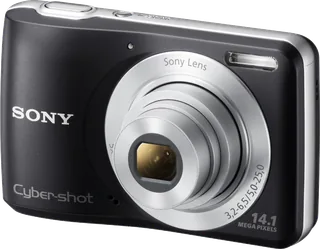
More comparisons
- Sony Cyber-shot DSC-HX20V vs Sony Cyber-shot DSC-RX100 VII
- Sony Cyber-shot DSC-HX20V vs Sony Cyber-shot DSC-HX99
- Sony Cyber-shot DSC-HX99 vs Sony Cyber-shot DSC-S5000
- Sony Cyber-shot DSC-HX20V vs Sony Cyber-shot DSC-HX350
- Sony Cyber-shot DSC-HX350 vs Sony Cyber-shot DSC-S5000
- Sony Cyber-shot DSC-HX20V vs Sony Cyber-shot DSC-HX80
- Sony Cyber-shot DSC-HX80 vs Sony Cyber-shot DSC-S5000
- Sony Cyber-shot DSC-HX20V vs Sony Cyber-shot DSC-HX90V
- Sony Cyber-shot DSC-HX90V vs Sony Cyber-shot DSC-S5000
- Sony Cyber-shot DSC-HX20V vs Sony Cyber-shot DSC-WX500
- Sony Cyber-shot DSC-S5000 vs Sony Cyber-shot DSC-WX500
- Sony Cyber-shot DSC-HX20V vs Sony Cyber-shot DSC-HX400V
- Sony Cyber-shot DSC-HX20V vs Sony Cyber-shot DSC-HX60V
- Sony Cyber-shot DSC-HX400V vs Sony Cyber-shot DSC-S5000
- Sony Cyber-shot DSC-HX60V vs Sony Cyber-shot DSC-S5000
- Sony Cyber-shot DSC-H400 vs Sony Cyber-shot DSC-HX20V