Sony Cyber-shot DSC-HX400V vs Sony Cyber-shot DSC-P10
Better figure, where one is clearly better
| SonyCyber-shot DSC-HX400V | SonyCyber-shot DSC-P10 | |
|---|---|---|
| Overview | ||
| Released | March 2014 | 2003 |
| Image and sensor | ||
| Camera type | Bridge | Compact |
| Sensor format | 1/2.3-type | 1/1.8-type |
| Sensor type | Back-illuminated Exmor R CMOS | Super HAD CCD |
| Effective resolution | 20.4 MP | 5 MP |
| Largest image | 5184 × 3888 | 2592 × 1944 |
| RAW recording | No | No |
| Standard ISO range | 80–3200 | 100–400 |
| Sensor detail | 1/2.3-type progressive-scan Exmor R CMOS, approximately 21.1 million total and 20.4 million effective photosites; optical format is distinct from physical dimensions | 1/1.8-type Super HAD CCD, approximately 5.09 million effective and 5.25 million total photosites in exact manual; UK markets 5.0 megapixels. The 9.04 mm optical designation is not physical sensor width |
| Image formats | JPEG still images; no RAW. Sweep Panorama produces stitched output distinct from single-frame resolution | Exif 2.2 JPEG Fine or Standard; animated GIF for Clip Motion; no RAW or TIFF |
| ISO detail | Ordinary single-frame ISO 80–3200; ISO 6400 and 12800 use multi-shot noise reduction and image compositing | – |
| Image processor | BIONZ X | – |
| Lens and shooting | ||
| Built-in lens | 24–1200 mm equivalent | 38–114 mm equivalent |
| Maximum aperture | f/2.8–6.3 | f/2.8–5.2 |
| Optical zoom | 50× | 3× |
| Stabilisation | Optical lens stabilisation | – |
| Maximum continuous burst | 10 fps | – |
| Lens detail | ZEISS Vario-Sonnar T*, actual 4.3–215 mm; 15 elements in 10 groups including one Super ED, two ED and three aspherical elements, seven-blade iris. Equivalent 24–1200 mm applies to full-resolution 4:3 stills; other aspect ratios and movie stabilisation modes have different crops. Clear Image Zoom and digital zoom are distinct from 50× optical zoom | Sony 3× zoom, actual 7.9–23.7 mm, 38–114 mm equivalent, F2.8–5.2. Not the later Carl Zeiss P100 lens. Optional conversion lenses require VAD-PHA adapter |
| Autofocus | Single AF, DMF and manual focus; continuous AF in Advanced Sports and movie modes. Nine-point Wide, Centre and flexible spot S/M/L with Lock-on AF. Minimum AF distance from lens front approximately 1 cm wide or 240 cm telephoto | Multi-point or centre AF, Single / Monitor / Continuous AF modes and illuminator. Preset distances 0.5, 1, 3, 7 m or infinity, not continuously adjustable manual focus. UK macro specification approximately 10 cm |
| Shutter | Mechanical shutter; manual and shutter priority 30–1/4000 second, aperture priority 8–1/2000, Program 1–1/4000 and Intelligent Auto 4–1/4000 | UK auto specification 1/8–1/2000 second; Twilight mode extends to 2 seconds (Imaging Resource) |
| Burst detail | Approximately 10 fps at maximum resolution for up to ten images; flash and shooting mode affect speed | Three-frame full-resolution burst and three-frame auto exposure bracketing. Multi Burst records 16 reduced-resolution frames within one 1.2M image, not a full-resolution continuous-rate claim |
| Stabilisation detail | Optical SteadyShot for stills; Intelligent Active movie mode combines optical and electronic correction including rotation, with a different field of view | – |
| Flash | Built-in flash; Multi Interface Shoe supports compatible optional flash. ISO Auto range approximately 0.5–8.5 m wide or 2.4–3.5 m telephoto | Built-in flash; ISO Auto approximately 0.5–3.5 m wide or 0.6–2.5 m telephoto. Auto, forced, slow sync, off and red-eye reduction; no accessory shoe |
| Exposure controls | Program, aperture priority, shutter priority, Manual and memory recall; multi-pattern, centre-weighted and spot metering, ±2 EV in 1/3 EV steps | Auto, Program and seven scene modes; no manual exposure or aperture/shutter priority. ±2 EV in 1/3 EV steps; automatic white balance and daylight, cloudy, fluorescent, incandescent and flash presets; no custom white balance |
| Video | ||
| Highest video resolution | 1920 × 1080 at 60 fps | 640 × 480 at 16.6 fps |
| Video detail | AVCHD 2.0 Full HD 1920 × 1080 at 60p in Japan, 28 Mbps; regional versions also use 50p. 60i/50i interlaced modes count fields rather than progressive frames. MP4 up to 1440 × 1080 at 30 fps on the Japanese version, or 25 fps on the UK version. Optical zoom operates during movies; 4K output is for still photographs, not 4K movie recording; maker single-clip limit approximately 29 minutes, with MP4 12M limited to approximately 15 minutes by its 2 GB file limit | MPEG-1 movies with monaural sound: 640×480 at approximately 16.6 fps per UK specification; separate 160×112 mail mode. Clip Motion is animated GIF and Multi Burst is a single composite still, not equivalent VGA video |
| Audio | Built-in stereo microphone; AVCHD Dolby Digital stereo or MP4 AAC stereo; optional compatible microphones connect through the Multi Interface Shoe | Electret condenser microphone and speaker; monaural MPEG-1 movies and voice annotation with still images |
| Screen and viewfinder | ||
| Viewfinder | Electronic | Optical |
| Screen size | 3″ | 1.5″ |
| Screen dots | 921,600 | 123,200 |
| Touchscreen | No | No |
| Tilting screen | Yes | No |
| Display detail | 3.0-type Xtra Fine TFT LCD, 921600 dots on Sony UK's specification (Sony Japan rounds to approximately 921000); tilts approximately 90° up and 60° down | Fixed 1.5-type TFT with 123200 colour-subpixel dots (560×220); approximately 100% LCD field of view |
| Viewfinder detail | 0.2-type electronic finder with approximately 201000-dot equivalent resolution, dioptre adjustment, 100% coverage and automatic eye sensor | Real-image optical viewfinder; Imaging Resource measured approximately 81% frame coverage at both zoom endpoints |
| Connections and design | ||
| Bluetooth | – | No |
| Wi-Fi | Yes | – |
| Battery life (maker's claim) | 300 photographs | 180 photographs |
| Body weight | 633 g | 172 g (better) |
| Release detail | Sony Hong Kong's 27 March 2014 release says the exact HX400V is already available. March precision retained; Sony Japan's earlier announcement sets its regional sale for 4 April 2014, not the worldwide first day | Sony announced planned Japanese availability on 25 April 2003. Contemporary production review and retail pricing confirm sale in 2003; earliest actual worldwide retail month remains unresolved, so year precision retained |
| Recording media | Memory Stick Duo, PRO Duo, PRO-HG Duo and XC-HG Duo plus SD/SDHC/SDXC; micro versions require separate adapters | Memory Stick and Memory Stick PRO using serial interface; 32 MB Memory Stick supplied |
| Ports | Multi/Micro USB terminal with Hi-Speed USB 2.0, micro HDMI and Multi Interface Shoe | USB mini-B (UK explicitly says not Hi-Speed USB 2.0), separate monaural A/V minijack and DC IN under rear cover. PTP transfer |
| Wireless connections | IEEE 802.11b/g/n Wi-Fi at 2.4 GHz, NFC and GPS; maker launch includes GPS route logging. Original PlayMemories Mobile sharing/remote control and downloadable Camera Apps support are launch-era features, not a promise of current service availability | – |
| Battery life detail | NP-BX1; maker CIPA approximately 300 photographs with LCD or 380 with EVF. Actual movie shooting approximately 50/55 minutes or continuous movie shooting approximately 85/95 minutes for LCD/EVF respectively; these are battery claims rather than single-clip limits | NP-FC11 lithium-ion, 3.6 V, 780 mAh / 2.8 Wh. Maker average-condition test at 25°C: approximately 180 shots / 90 minutes LCD on, 240 / 120 minutes LCD off, one shot every 30 seconds, alternate zoom endpoints and flash every other shot. Not labelled CIPA in exact manual. Continuous 160-pixel mail movies approximately 90 / 135 minutes LCD on / off |
| Charging | USB charging; maker specifies USB power supply only with optional AC-UD10 adapter | In-camera charging with AC-LS5 adapter, camera off; approximately 150 minutes at 25°C. Adapter can also power camera externally |
| Dimensions | Approximately 129.6 × 93.2 × 114.8 mm width × height × depth from lens front to viewfinder; depth to rear monitor is 103.2 mm | 108×51.5×35.1 mm width×height×depth excluding maximum protrusions |
| Weight detail | Approximately 633 g body only, or 660 g including NP-BX1 and Memory Stick Duo | Approximately 172 g body only (UK specs and Sony Japan feature); approximately 200 g including NP-FC11, Memory Stick and strap (manual) |
| Materials | – | Aluminium alloy exterior described by maker announcement; no waterproof rating established |
| Colours | Black | Chrome silver and meteor blue confirmed by launch announcement; gold also listed in later Japanese archive, with regional availability. P12 cosmetic/accessory bundle not counted as another P10 hardware generation |
| In the box | NP-BX1 battery, AC-UB10C/UB10D adapter, micro USB cable, shoulder strap, shoe cap, lens cap and instructions; regional mains fittings vary | NP-FC11 battery, AC-LS5 adapter and mains lead, separate USB and A/V cables, 32 MB Memory Stick, wrist strap, software CD and instructions. Manual assigns extra battery/carrying case to P12 only |

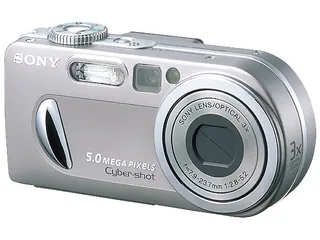
More comparisons
- Sony Cyber-shot DSC-HX400V vs Sony Cyber-shot DSC-HX99
- Sony Cyber-shot DSC-HX99 vs Sony Cyber-shot DSC-P10
- Sony Cyber-shot DSC-HX350 vs Sony Cyber-shot DSC-HX400V
- Sony Cyber-shot DSC-HX350 vs Sony Cyber-shot DSC-P10
- Sony Cyber-shot DSC-HX400V vs Sony Cyber-shot DSC-HX80
- Sony Cyber-shot DSC-HX80 vs Sony Cyber-shot DSC-P10
- Sony Cyber-shot DSC-HX400V vs Sony Cyber-shot DSC-HX90V
- Sony Cyber-shot DSC-HX90V vs Sony Cyber-shot DSC-P10
- Sony Cyber-shot DSC-HX400V vs Sony Cyber-shot DSC-WX500
- Sony Cyber-shot DSC-P10 vs Sony Cyber-shot DSC-WX500
- Sony Cyber-shot DSC-H400 vs Sony Cyber-shot DSC-HX400V
- Sony Cyber-shot DSC-H200 vs Sony Cyber-shot DSC-HX400V
- Sony Cyber-shot DSC-HX300 vs Sony Cyber-shot DSC-HX400V
- Sony Cyber-shot DSC-HX400V vs Sony Cyber-shot DSC-HX60V
- Sony Cyber-shot DSC-HX400V vs Sony Cyber-shot DSC-W800
- Sony Cyber-shot DSC-HX400V vs Sony Cyber-shot DSC-W830