Sony Cyber-shot DSC-HX400V vs Sony Cyber-shot DSC-T1
Better figure, where one is clearly better
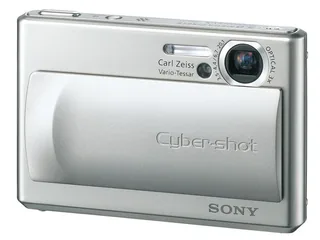
| SonyCyber-shot DSC-HX400V | SonyCyber-shot DSC-T1 | |
|---|---|---|
| Overview | ||
| Released | March 2014 | November 2003 |
| Image and sensor | ||
| Camera type | Bridge | Compact |
| Sensor format | 1/2.3-type | Other |
| Sensor type | Back-illuminated Exmor R CMOS | Super HAD CCD |
| Effective resolution | 20.4 MP | 5.1 MP |
| Largest image | 5184 × 3888 | 2592 × 1944 |
| RAW recording | No | No |
| Standard ISO range | 80–3200 | 100–400 |
| Sensor detail | 1/2.3-type progressive-scan Exmor R CMOS, approximately 21.1 million total and 20.4 million effective photosites; optical format is distinct from physical dimensions | 1/2.4-type interlaced Super HAD CCD; 5.3 million total and 5.1 million effective photosites; 14-bit analogue-to-digital conversion |
| Image formats | JPEG still images; no RAW. Sweep Panorama produces stitched output distinct from single-frame resolution | JPEG stills; 2592 × 1728 3:2 setting and smaller sizes; Fine or Standard compression |
| ISO detail | Ordinary single-frame ISO 80–3200; ISO 6400 and 12800 use multi-shot noise reduction and image compositing | – |
| Image processor | BIONZ X | Real Imaging Processor |
| Lens and shooting | ||
| Built-in lens | 24–1200 mm equivalent | 38–114 mm equivalent |
| Maximum aperture | f/2.8–6.3 | f/3.5–4.4 |
| Optical zoom | 50× | 3× |
| Stabilisation | Optical lens stabilisation | – |
| Maximum continuous burst | 10 fps | – |
| Lens detail | ZEISS Vario-Sonnar T*, actual 4.3–215 mm; 15 elements in 10 groups including one Super ED, two ED and three aspherical elements, seven-blade iris. Equivalent 24–1200 mm applies to full-resolution 4:3 stills; other aspect ratios and movie stabilisation modes have different crops. Clear Image Zoom and digital zoom are distinct from 50× optical zoom | Carl Zeiss Vario-Tessar, actual 6.7–20.1 mm; folded optics with eight groups and eleven elements, including three aspherical elements and a prism; lens moves inside the body rather than extending |
| Autofocus | Single AF, DMF and manual focus; continuous AF in Advanced Sports and movie modes. Nine-point Wide, Centre and flexible spot S/M/L with Lock-on AF. Minimum AF distance from lens front approximately 1 cm wide or 240 cm telephoto | Five-area multi-point AF; normal focus from 50 cm, macro from 8 cm wide or 25 cm telephoto; Magnifying Glass mode focuses from 1–20 cm at wide angle |
| Shutter | Mechanical shutter; manual and shutter priority 30–1/4000 second, aperture priority 8–1/2000, Program 1–1/4000 and Intelligent Auto 4–1/4000 | Maker table specifies 1/8–1/1000 second in Auto, 1–1/1000 second in Program and 1/250–1/1000 second in High-speed Shutter scene |
| Burst detail | Approximately 10 fps at maximum resolution for up to ten images; flash and shooting mode affect speed | Brief burst of up to four full-resolution photographs with speed or framing priority; separate Multi Burst mode is not full-resolution continuous shooting |
| Stabilisation detail | Optical SteadyShot for stills; Intelligent Active movie mode combines optical and electronic correction including rotation, with a different field of view | – |
| Flash | Built-in flash; Multi Interface Shoe supports compatible optional flash. ISO Auto range approximately 0.5–8.5 m wide or 2.4–3.5 m telephoto | Built-in automatic, forced, off or slow-sync flash; no external flash connection |
| Exposure controls | Program, aperture priority, shutter priority, Manual and memory recall; multi-pattern, centre-weighted and spot metering, ±2 EV in 1/3 EV steps | Automatic and program exposure with ±2 EV compensation in 1/3 EV steps; eight scenes including fireworks and Magnifying Glass; Auto, Daylight, Cloudy, Fluorescent, Incandescent and Flash white balance |
| Video | ||
| Highest video resolution | 1920 × 1080 at 60 fps | 640 × 480 at 30 fps |
| Video detail | AVCHD 2.0 Full HD 1920 × 1080 at 60p in Japan, 28 Mbps; regional versions also use 50p. 60i/50i interlaced modes count fields rather than progressive frames. MP4 up to 1440 × 1080 at 30 fps on the Japanese version, or 25 fps on the UK version. Optical zoom operates during movies; 4K output is for still photographs, not 4K movie recording; maker single-clip limit approximately 29 minutes, with MP4 12M limited to approximately 15 minutes by its 2 GB file limit | MPEG-1 with sound; 640 × 480 Fine at approximately 30 fps requires Memory Stick PRO Duo. Maker table gives approximately 17 fps Standard VGA and 8 fps 160 × 112 video-mail recording; duration limited by card capacity |
| Audio | Built-in stereo microphone; AVCHD Dolby Digital stereo or MP4 AAC stereo; optional compatible microphones connect through the Multi Interface Shoe | – |
| Screen and viewfinder | ||
| Viewfinder | Electronic | None |
| Screen size | 3″ | 2.5″ |
| Screen dots | 921,600 | 211,000 |
| Touchscreen | No | – |
| Tilting screen | Yes | – |
| Display detail | 3.0-type Xtra Fine TFT LCD, 921600 dots on Sony UK's specification (Sony Japan rounds to approximately 921000); tilts approximately 90° up and 60° down | Hybrid reflective/backlit TFT LCD with maker-stated 100% coverage; screen is the only viewfinder |
| Viewfinder detail | 0.2-type electronic finder with approximately 201000-dot equivalent resolution, dioptre adjustment, 100% coverage and automatic eye sensor | – |
| Connections and design | ||
| Wi-Fi | Yes | – |
| Battery life (maker's claim) | 300 photographs | 170 photographs |
| Body weight | 633 g | 155 g (better) |
| Release detail | Sony Hong Kong's 27 March 2014 release says the exact HX400V is already available. March precision retained; Sony Japan's earlier announcement sets its regional sale for 4 April 2014, not the worldwide first day | Sony's original Japanese announcement specifies 21 November 2003 first sale; January in US launch coverage refers to later US availability |
| Recording media | Memory Stick Duo, PRO Duo, PRO-HG Duo and XC-HG Duo plus SD/SDHC/SDXC; micro versions require separate adapters | Memory Stick Duo or PRO Duo; supplied 32 MB Duo card and adapter |
| Ports | Multi/Micro USB terminal with Hi-Speed USB 2.0, micro HDMI and Multi Interface Shoe | Camera multi-terminal mates with supplied cradle, which provides Hi-Speed USB 2.0, AV output and DC input |
| Wireless connections | IEEE 802.11b/g/n Wi-Fi at 2.4 GHz, NFC and GPS; maker launch includes GPS route logging. Original PlayMemories Mobile sharing/remote control and downloadable Camera Apps support are launch-era features, not a promise of current service availability | – |
| Battery life detail | NP-BX1; maker CIPA approximately 300 photographs with LCD or 380 with EVF. Actual movie shooting approximately 50/55 minutes or continuous movie shooting approximately 85/95 minutes for LCD/EVF respectively; these are battery claims rather than single-clip limits | NP-FT1 InfoLithium; maker standard-use claim 170 photographs or 85 minutes with LCD on, flash for half of shots, power cycled every ten photographs and one photograph every 30 seconds. The original launch sheet does not call this CIPA testing |
| Charging | USB charging; maker specifies USB power supply only with optional AC-UD10 adapter | Supplied USB cradle and AC power adapter; optional separate BC-TR1 charger |
| Dimensions | Approximately 129.6 × 93.2 × 114.8 mm width × height × depth from lens front to viewfinder; depth to rear monitor is 103.2 mm | 91 × 60 × 21 mm (width × height × depth); 17.3 mm at thinnest section |
| Weight detail | Approximately 633 g body only, or 660 g including NP-BX1 and Memory Stick Duo | Approximately 155 g camera only; 180 g including battery, Memory Stick Duo and hand strap |
| Materials | – | Stainless steel body with sliding front lens cover |
| Colours | Black | Silver or black in Sony's archived Japanese product listing |
| In the box | NP-BX1 battery, AC-UB10C/UB10D adapter, micro USB cable, shoulder strap, shoe cap, lens cap and instructions; regional mains fittings vary | Japanese package includes NP-FT1, AC adapter, USB cradle, USB and AV cables, power cord, hand strap, software CD, 32 MB Memory Stick Duo and adapter |

More comparisons
- Sony Cyber-shot DSC-RX10 V vs Sony Cyber-shot DSC-T1
- Sony Alpha 6700 vs Sony Cyber-shot DSC-T1
- Sony Cyber-shot DSC-RX100 VII vs Sony Cyber-shot DSC-T1
- Sony Cyber-shot DSC-HX400V vs Sony Cyber-shot DSC-HX99
- Sony Cyber-shot DSC-HX99 vs Sony Cyber-shot DSC-T1
- Sony Cyber-shot DSC-HX350 vs Sony Cyber-shot DSC-HX400V
- Sony Cyber-shot DSC-HX350 vs Sony Cyber-shot DSC-T1
- Sony Cyber-shot DSC-HX400V vs Sony Cyber-shot DSC-HX80
- Sony Cyber-shot DSC-HX80 vs Sony Cyber-shot DSC-T1
- Sony Cyber-shot DSC-HX400V vs Sony Cyber-shot DSC-HX90V
- Sony Cyber-shot DSC-HX90V vs Sony Cyber-shot DSC-T1
- Sony Cyber-shot DSC-HX400V vs Sony Cyber-shot DSC-WX500
- Sony Cyber-shot DSC-T1 vs Sony Cyber-shot DSC-WX500
- Sony Cyber-shot DSC-H400 vs Sony Cyber-shot DSC-HX400V
- Sony Cyber-shot DSC-H200 vs Sony Cyber-shot DSC-HX400V
- Sony Cyber-shot DSC-HX300 vs Sony Cyber-shot DSC-HX400V