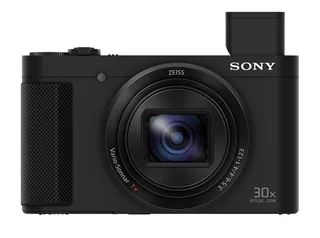
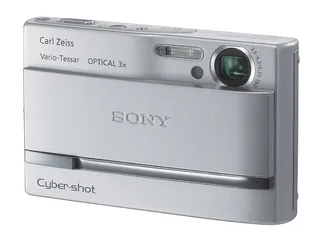
Sony Cyber-shot DSC-HX80 vs Sony Cyber-shot DSC-T9
Better figure, where one is clearly better
| SonyCyber-shot DSC-HX80 | SonyCyber-shot DSC-T9 | |
|---|---|---|
| Overview | ||
| Released | April 2016 | November 2005 |
| Image and sensor | ||
| Camera type | Compact | Compact |
| Sensor format | 1/2.3-type | – |
| Sensor type | Back-illuminated Exmor R CMOS | Super HAD CCD |
| Effective resolution | 18.2 MP | 6 MP |
| Largest image | 4896 × 3672 | 2816 × 2112 |
| RAW recording | No | No |
| Standard ISO range | 80–3200 | 80–640 |
| Sensor detail | 1/2.3-type Exmor R CMOS; approximately 21.1 million total photosites. Optical format is not a physical sensor dimension | 1/2.5-type primary-colour interlaced Super HAD CCD; 6.18 million total and 6 million effective photosites in original Japanese maker table |
| Image formats | JPEG Fine or Standard; 4:3, 3:2, 16:9 and square stills plus Sweep Panorama; no RAW | JPEG; native 2816 × 2112, 2816 × 1872 in 3:2 mode or 1920 × 1080 in 16:9 mode; no RAW recording |
| ISO detail | Single-frame ISO 80–3200; Multi Frame Noise Reduction offers ISO 6400 and 12800 using combined exposures | – |
| Image processor | BIONZ X | Real Imaging Processor with Clear RAW NR before JPEG compression; this processing does not provide RAW file recording |
| Lens and shooting | ||
| Built-in lens | 24–720 mm equivalent | 38–114 mm equivalent |
| Maximum aperture | f/3.5–6.4 | f/3.5–4.3 |
| Optical zoom | 30× | 3× |
| Stabilisation | Optical lens stabilisation | Optical lens stabilisation |
| Maximum continuous burst | 10 fps | – |
| Lens detail | ZEISS Vario-Sonnar T*, actual 4.1–123 mm, 11 elements in 10 groups including five aspherical elements; minimum focus approximately 5 cm wide or 250 cm telephoto | Internal folded Carl Zeiss Vario-Tessar; actual 6.33–19.0 mm in original Japanese maker table, rounded to 6.3–19.0 on UK support |
| Autofocus | Contrast autofocus with wide, centre, flexible spot and expanded flexible spot areas; AF-S, with AF-C in Advanced Sports and movie modes only; no manual focus or lens control ring | Five-point AF with illuminator and preset distances; normal from 0.5 m, macro from 0.08 m wide or 0.25 m telephoto; Magnifying Glass mode from 0.01–0.2 m |
| Shutter | Mechanical shutter; Manual and shutter-priority 30–1/2000 second, aperture-priority 8–1/2000, Program 1–1/2000 and Intelligent Auto 4–1/2000 | Automatic 1/4–1/1000 second; Program 1–1/1000 second in original maker table |
| Burst detail | Approximately 10 full-resolution fps in High or 2 fps in Low; both limited to ten photographs per sequence | Up to seven native 6 MP frames at approximately 0.8-second intervals on UK support; up to 100 smaller VGA frames is a separate mode |
| Stabilisation detail | Optical SteadyShot for stills; Intelligent Active movie stabilisation combines optical and electronic correction | Super SteadyShot optical lens shift; continuous or shooting-only modes for stills, continuous mode for video |
| Flash | Built-in manually raised pop-up flash; ISO Auto range approximately 0.3–5.4 m wide or 2.5–3.0 m telephoto | Built-in automatic, forced, off or slow-sync flash with red-eye reduction; UK maker reach 0.1–2.8 m wide or 0.25–2.3 m telephoto; no hot shoe |
| Exposure controls | P/A/S/M and Memory Recall; multi-pattern, centre-weighted or spot metering; ±3 EV in 1/3 EV steps | Automatic or program exposure; ±2 EV in 1/3 EV steps; ten scenes; three-step saturation, contrast and sharpness; no manual aperture or shutter control |
| Video | ||
| Highest video resolution | 1920 × 1080 at 60 fps | 640 × 480 at 30 fps |
| Video detail | XAVC S Full HD at 60p, 30p or 24p, 50 Mbps; AVCHD Full HD at 60p, 60i or 24p; PAL-region rates differ. Optical zoom during filming; XAVC S requires compatible Class 10 or faster SDXC media | MPEG-1 with mono sound; VGA Fine 30 fps requires Memory Stick PRO Duo; original maker table gives approximately 17 fps Standard VGA and approximately 8 fps video-mail at 160 × 112; maker start guide says the zoom cannot change during movie recording |
| Audio | Stereo microphone and mono playback speaker; XAVC S Linear PCM, AVCHD Dolby Digital or MP4 AAC stereo | – |
| Screen and viewfinder | ||
| Viewfinder | Electronic | None |
| Screen size | 3″ | 2.5″ |
| Screen dots | 921,600 | 230,400 |
| Touchscreen | No | – |
| Tilting screen | Yes | – |
| Display detail | 3.0-type 4:3 TFT LCD, 921600 dots; tilts up 180 degrees without touch control. US specification also gives diagonal as 2.95 inches | 2.5-inch TFT Hybrid Clear Photo LCD Plus; current UK support specifies 230,400 dots, rounded to 230,000 in original Japanese launch sheet; anti-reflection coating; still-image slideshow supports music and effects |
| Viewfinder detail | Retractable 0.2-type OLED, 638400 dots, 100% coverage and 0.50× equivalent magnification; dioptre adjustment −4 to +3 | – |
| Connections and design | ||
| Bluetooth | – | No |
| Wi-Fi | Yes | – |
| Battery life (maker's claim) | 390 photographs | 240 photographs |
| Body weight | – | 134 g |
| Release detail | Sony Canada’s 8 March 2016 announcement states availability in April 2016; month precision retained | Original Japanese launch sheet gives 18 November 2005 first sale |
| Recording media | Memory Stick Duo, PRO Duo, PRO-HG Duo; SD, SDHC and SDXC including UHS-I. Micro formats require adapters | 58 MB internal memory; Memory Stick Duo or Memory Stick PRO Duo slot; no memory card included in original maker accessories list |
| Ports | Micro HDMI and Multi/Micro USB with USB 2.0 | Multi-connector with supplied USB 2.0 Hi-Speed, mono composite AV and DC input cable; PictBridge direct printing |
| Wireless connections | 2.4 GHz IEEE 802.11 b/g/n Wi-Fi and NFC Type 3 for sharing and remote control; no GPS receiver | – |
| Battery life detail | NP-BX1; CIPA claim approximately 390 photographs with LCD or 360 with viewfinder | NP-FT1 InfoLithium T battery; original Japanese maker and current UK support CIPA claim 240 photographs or 120 minutes |
| Charging | In-camera USB charging and USB external power with battery inserted | Supplied BC-CS3 external battery charger |
| Dimensions | 102 × 58.1 × 35.5 mm (width × height × depth), CIPA | 89.7 × 54.9 × 20.6 mm (width × height × maximum depth); depth without lens cover 16.8 mm |
| Weight detail | Sony US specifies body-only weight as 7.69 oz; operating manual gives approximately 245 g including NP-BX1 and Memory Stick. Loaded weight is not body weight | Approximately 134 g camera only; 159 g shooting weight in original maker table |
| Materials | – | Stainless-steel body with sliding lens cover |
| Colours | Black | Silver or black; colour editions share this entry |
| In the box | NP-BX1, AC adapter, micro USB cable, wrist strap and instructions; adapter model varies regionally | NP-FT1 battery and battery case, BC-CS3 charger, multi-connector USB/AV/DC input cable, wrist strap and software CD |
More comparisons
- Sony Cyber-shot DSC-RX10 V vs Sony Cyber-shot DSC-T9
- Sony Alpha 6700 vs Sony Cyber-shot DSC-T9
- Sony Cyber-shot DSC-HX80 vs Sony Cyber-shot DSC-RX100 VII
- Sony Cyber-shot DSC-RX100 VII vs Sony Cyber-shot DSC-T9
- Sony Cyber-shot DSC-HX80 vs Sony Cyber-shot DSC-HX99
- Sony Cyber-shot DSC-HX99 vs Sony Cyber-shot DSC-T9
- Sony Cyber-shot DSC-HX350 vs Sony Cyber-shot DSC-HX80
- Sony Cyber-shot DSC-HX350 vs Sony Cyber-shot DSC-T9
- Sony Cyber-shot DSC-HX80 vs Sony Cyber-shot DSC-HX90V
- Sony Cyber-shot DSC-HX80 vs Sony Cyber-shot DSC-WX500
- Sony Cyber-shot DSC-HX60V vs Sony Cyber-shot DSC-HX80
- Sony Cyber-shot DSC-HX400V vs Sony Cyber-shot DSC-HX80
- Sony Cyber-shot DSC-H400 vs Sony Cyber-shot DSC-HX80
- Sony Cyber-shot DSC-HX80 vs Sony Cyber-shot DSC-W800
- Sony Cyber-shot DSC-HX80 vs Sony Cyber-shot DSC-W830
- Sony Cyber-shot DSC-HX80 vs Sony Cyber-shot DSC-WX350