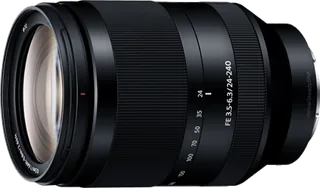
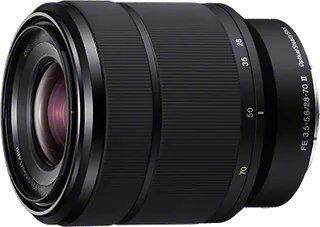
Sony FE 24-240mm F3.5-6.3 OSS vs Sony FE 28-70mm F3.5-5.6 OSS II
Better figure, where one is clearly better
| SonyFE 24-240mm F3.5-6.3 OSS | SonyFE 28-70mm F3.5-5.6 OSS II | |
|---|---|---|
| Overview | ||
| Released | March 2015 | January 2026 |
| Optics | ||
| Lens type | Zoom | Zoom |
| Focal length | 24–240 mm | 28–70 mm |
| Maximum aperture | f/3.5–6.3 | f/3.5–5.6 |
| Minimum aperture | f/22–40 | f/22–36 |
| Optical construction | Seventeen elements in twelve groups | Nine elements in eight groups |
| Special elements | Five aspherical elements and one ED element | Three aspherical elements and one ED glass element |
| Diaphragm | Seven rounded blades | Seven rounded blades |
| Angle of view | 84°–10° full frame; 61°–6°50′ APS-C | 75°–34° full frame; 54°–23° APS-C |
| Mount and compatibility | ||
| Mounts | Sony E | Sony E |
| Image circle | Full frame | Full frame |
| Image circle detail | Full-frame coverage; 36–360 mm equivalent field of view on APS-C | Full-frame coverage; 42–105 mm equivalent field of view on APS-C |
| Teleconverter support | – | Not compatible with SEL14TC or SEL20TC |
| Focus and stabilisation | ||
| Autofocus | Yes | Yes |
| Minimum focus distance | 0.5 m | 0.3 m |
| Maximum magnification | 0.27× | 0.19× |
| Optical stabilisation | Yes | Yes |
| Autofocus detail | Linear-motor autofocus | Linear motor; AF during zooming and up to 120 fps AF/AE tracking with compatible cameras. Sony internal measurements; continuous speed depends on conditions and is slower in AF-C |
| Focus distance detail | Minimum focus distance 0.5 m at 24 mm and 0.8 m at 240 mm | Minimum focus 0.3 m at wide angle and 0.45 m at telephoto |
| Magnification detail | 0.27× maximum magnification | – |
| Stabilisation detail | Built-in Optical SteadyShot; no maker stop rating published in read pages | Optical SteadyShot; coordinated body/lens stabilisation and Active mode support depend on camera compatibility. No lens-only stop rating published |
| Video features | – | Breathing compensation supported on compatible cameras; enabling it slightly changes field of view and image quality and may not completely compensate breathing |
| Design | ||
| Dust and moisture resistant | Yes | Yes |
| Filter diameter | 72 mm | 55 mm |
| Maximum diameter | 80.5 mm | 72.5 mm |
| Length | 118.5 mm | 83 mm |
| Weight | 780 g | 293 g (better) |
| Controls | Manual-focus and zoom rings; no zoom lock switch (Photography Blog and Amateur Photographer) | Zoom and manual-focus rings; focus mode and stabilisation selected on the camera; no aperture ring, switches or buttons |
| Zoom design | Extending 10× zoom barrel (Photography Blog and Amateur Photographer) | Manual zoom with small changes in overall length |
| Filter detail | 72 mm front filter thread | 55 mm front filter thread |
| Weather resistance | Dust and moisture resistant design; not guaranteed to prevent all ingress | Dust- and moisture-resistant design; not guaranteed completely dust- or moisture-proof |
| Dimensions detail | 80.5 mm maximum diameter × 118.5 mm maker length | – |
| Weight detail | Approximately 780 g lens; separate hood and caps excluded | Approximately 293 g lens; separate hood and caps excluded |
| Lens hood | ALC-SH136 petal bayonet hood, supplied | ALC-SH132 petal bayonet hood |
| In the box | ALC-SH136 hood, front and rear lens caps | ALC-SH132 hood, ALC-F55S front cap and ALC-R1EM rear cap; no case listed |
| Release detail | Sony US announcement dated 3 March 2015 specifies March availability; Sony Japan announcement dated 4 March confirms local sale on 13 March. Main release retains earliest maker month; exact first global sale day unconfirmed. Two full independent reviews read: Photography Blog Mark Goldstein using Alpha 7S and Amateur Photographer Richard Sibley, principally Alpha 7R with comparison autofocus tests on Alpha 7 and Alpha 7 II. Different autofocus and value assessments retained. Review stabilisation measurements are not maker ratings. Blog blur paragraph incorrectly names a different lens and is not used; its generalisation about all Alpha 7 bodies lacking stabilisation is not used. No unverified coating or predecessor link | Sony Australia specified mid-January 2026, ahead of Europe and North America February 2026; main date uses January month precision. One qualifying full exact review read: Bryan Carnathan, The Digital Picture, retail-sourced lens, April 2026. Sony Alpha Blog explicitly reuses original-version optical testing and Ken Rockwell redirects performance to original-version testing, so neither is counted as a second independent exact-model test; review summary omitted. Unverified fluorine coating and switch-gasket assertions in The Digital Picture omitted because absent from the read exact Sony specification/feature pages |
More comparisons
- Sony FE 28-60mm F4-5.6 vs Sony FE 28-70mm F3.5-5.6 OSS II
- Sony FE 24–70mm F2.8 GM II vs Sony FE 28-70mm F3.5-5.6 OSS II
- Sony FE 24-50mm F2.8 G vs Sony FE 28-70mm F3.5-5.6 OSS II
- Sony FE 20-70mm F4 G vs Sony FE 28-70mm F3.5-5.6 OSS II
- Sony FE 24-105mm F4 G OSS vs Sony FE 28-70mm F3.5-5.6 OSS II
- Sony FE 28–70mm F2 GM vs Sony FE 28-70mm F3.5-5.6 OSS II
- Sony FE 24-105mm F4 G OSS vs Sony FE 24-240mm F3.5-6.3 OSS
- Sony FE 24-240mm F3.5-6.3 OSS vs Sony FE 70-300mm F4.5-5.6 G OSS
- Sony FE 24-240mm F3.5-6.3 OSS vs Sony FE PZ 28-135mm F4 G OSS