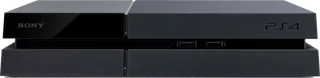
Sony PlayStation 4 vs Sony PlayStation 5
Better figure, where one is clearly better
| SonyPlayStation 4 | SonyPlayStation 5 | |
|---|---|---|
| Overview | ||
| Released | November 2013 | November 2020 |
| Performance | ||
| Type | Home console | Home console |
| CPU | AMD Jaguar, 8 cores | AMD Zen 2, 8 cores |
| GPU | AMD Radeon | AMD RDNA 2 |
| GPU compute | 1.84 TFLOPS | 10.3 TFLOPS (better) |
| Memory | 8 GB | 16 GB (better) |
| Storage | 500 GB | 825 GB (better) |
| Disc drive | Yes | Optional |
| CPU | Single-chip custom processor; x86-64 AMD "Jaguar", 8 cores at 1.6 GHz (Sony and system architect Mark Cerny) | x86-64 AMD Ryzen "Zen 2", 8 cores / 16 threads, variable frequency up to 3.5 GHz; single-chip custom processor |
| GPU | 1.84 TFLOPS AMD Radeon-based engine; 18 compute units at 800 MHz (Sony and Mark Cerny) | AMD Radeon RDNA 2-based graphics engine with ray tracing acceleration, variable frequency up to 2.23 GHz |
| Memory detail | 8 GB GDDR5; a separate 256 MB DDR3 chip and a low-power processor for network tasks (iFixit teardown) | 16 GB GDDR6, 448 GB/s bandwidth |
| Storage detail | 500 GB hard drive, user-replaceable; Blu-ray (6× CAV) and DVD (8× CAV) drive, read only | 825 GB custom SSD with 5.5 GB/s raw read bandwidth; part is reserved for system software. The disc model plays Ultra HD Blu-ray (up to 100 GB per disc), Blu-ray and DVD |
| Storage expansion | External USB 3.0 hard drives for games and apps from system software 4.50 (PlayStation) | – |
| Display and video | ||
| Maximum output | 1080p | 4K up to 120 fps |
| Built-in screen | No built-in screen | – |
| Video output | HDMI out, up to 1080p | HDMI out; supports 4K 120 Hz TVs, 8K TVs and VRR (as specified by HDMI 2.1) |
| Variable refresh rate | – | VRR (HDMI 2.1) |
| HDR | HDR from system software 4.00, including the original PS4 (PlayStation) | – |
| Audio | DIGITAL OUT (OPTICAL) port; audio over HDMI | Tempest 3D AudioTech |
| Design and power | ||
| Weight | 2,800 g (better) | 3,900 g |
| Power use | 250 W maximum rating (CUH-1000 series; Sony) | Maximum rated power 350 W with the disc drive, 340 W Digital Edition (220–240 V) |
| Colours | – | White covers with a black centre |
| Connections | ||
| Ports | 2 × SuperSpeed USB (USB 3.0), AUX port (PlayStation Camera), HDMI out, DIGITAL OUT (OPTICAL), Ethernet (10BASE-T, 100BASE-TX, 1000BASE-T) | Front 1 × USB-A (Hi-Speed USB) and 1 × USB-C (SuperSpeed USB 10 Gbps); back 2 × USB-A (SuperSpeed USB 10 Gbps), HDMI out, Gigabit Ethernet |
| Wi-Fi and Bluetooth | Wi-Fi IEEE 802.11 b/g/n, Bluetooth 2.1 (EDR) | Wi-Fi 6 (IEEE 802.11 a/b/g/n/ac/ax), Bluetooth 5.1 |
| Controller | DUALSHOCK 4 wireless controller with touch pad, light bar and built-in speaker | DualSense wireless controller with haptic feedback and adaptive triggers |
| Backward compatibility | No PS3, PS2 or PS1 discs; some older games are sold as digital re-releases | – |

More comparisons
- Sony PlayStation 5 vs Sony PlayStation 5 Pro
- Sony PlayStation 4 vs Sony PlayStation 5 Pro
- Sony PlayStation 5 vs Sony PlayStation Portal
- Sony PlayStation 4 vs Sony PlayStation Portal
- Sony PlayStation 5 vs Sony PlayStation 5 Slim
- Sony PlayStation 4 vs Sony PlayStation 5 Slim
- Microsoft Xbox Series X vs Sony PlayStation 5
- Microsoft Xbox Series S vs Sony PlayStation 5
- Microsoft Xbox One X vs Sony PlayStation 5
- Sony PlayStation 4 Pro vs Sony PlayStation 5
- Sony PlayStation 4 Slim vs Sony PlayStation 5
- Sony PlayStation 4 (CUH-1200) vs Sony PlayStation 5
- Sony PlayStation 5 vs Sony PlayStation Vita Slim (PCH-2000)
- Sony PlayStation 3 Super Slim vs Sony PlayStation 5
- Sony PlayStation 5 vs Sony PlayStation Vita
- Sony PlayStation 5 vs Sony PSPgo