Xiaomi POCO F7 Pro vs Xiaomi POCO F8 Pro
Better figure, where one is clearly better
| XiaomiPOCO F7 Pro | XiaomiPOCO F8 Pro | |
|---|---|---|
| Overview | ||
| Released | March 2025 | November 2025 |
| Display | ||
| Screen size | 6.67″ | 6.59″ |
| Resolution | 3200 × 1440 (better) | 2510 × 1156 |
| Sharpness | 526 pixels per inch (better) | 419 pixels per inch |
| Panel | OLED | OLED |
| Refresh rate | 120 Hz | 120 Hz |
| Peak brightness | 3,200 nits | 3,500 nits (better) |
| Display type | WQHD+ Flow AMOLED, 12-bit colour, 68 billion colours and 5,000,000:1 contrast | HyperRGB AMOLED with full RGB subpixels, 12-bit colour and DCI-P3; native resolution is 2510 × 1156 |
| Pixel density | 526 ppi | – |
| Brightness detail | 1,800 nits high-brightness mode and 3,200 nits peak covering 25% of the screen | 600 nits typical, 2,000 nits high-brightness mode, 3,500 nits peak covering 25% of the screen and 1 nit minimum |
| Screen protection | Corning Gorilla Glass 7i | Corning Gorilla Glass 7i |
| Display features | DCI-P3, Dolby Vision, HDR10+, circular polarisation, 3,840 Hz PWM dimming, 16,000 brightness levels, 480 Hz touch sampling and 2,560 Hz instant touch sampling in Game Turbo; Original Colour PRO, Pro HDR and TÜV low-blue-light, flicker-free and circadian-friendly certifications | HDR10+, Dolby Vision, DC dimming, 480 Hz touch sampling, 2,560 Hz instant touch sampling in Game Turbo, Wet Touch 2.0 and TÜV low-blue-light, flicker-free and circadian-friendly certifications |
| Performance | ||
| Chip | Qualcomm Snapdragon 8 Gen 3 | Qualcomm Snapdragon 8 Elite |
| Memory | 12 GB | 12 GB |
| Storage | 256 GB, 512 GB | 256 GB, 512 GB |
| CPU | TSMC 4 nm; one Cortex-X4-based prime core up to 3.3 GHz, three Cortex-A720-based performance cores up to 3.2 GHz, two Cortex-A720-based performance cores up to 3.0 GHz and two Cortex-A520-based efficiency cores up to 2.3 GHz; Qualcomm AI engine | 3 nm Qualcomm Oryon CPU; two prime cores up to 4.32 GHz and six performance cores up to 3.53 GHz |
| GPU | Qualcomm Adreno GPU; maker does not give a numeric model suffix | Qualcomm Adreno 830, identified in the maker FAQ |
| AI engine | – | Qualcomm Hexagon NPU |
| Storage type | LPDDR5X RAM and UFS 4.1 storage; 12 GB/256 GB or 12 GB/512 GB; no microSD slot, confirmed by Tech Advisor | LPDDR5X RAM at 9,600 Mbps and UFS 4.1 enhanced storage firmware; 12 GB/256 GB or 12 GB/512 GB |
| Cooling | LiquidCool Technology 4.0, 5,400 mm² 3D dual-channel IceLoop system with separate thermal loops for processor and camera; 12 temperature sensors | LiquidCool Technology and WildBoost performance optimisation |
| Cameras | ||
| Main camera | 50 MP | 50 MP |
| Ultra wide camera | 8 MP | 8 MP |
| Telephoto camera | None | 50 MP |
| Optical zoom | None | 2.5× (better) |
| Front camera | 20 MP | 20 MP |
| Main camera | Light Fusion 800, 50 MP, f/1.6, 1/1.55-inch sensor, 6-element lens, OIS and 4-in-1 binning to 2.0 µm pixels | Light Fusion 800, 50 MP, f/1.88, 1/1.55-inch sensor, OIS, six-element lens and 4-in-1 binning to 2.0 µm pixels |
| Ultra wide camera | 8 MP, f/2.2 | 8 MP, f/2.2 |
| Telephoto camera | – | 50 MP, f/2.2 and 60 mm equivalent focal length; electronic rather than optical stabilisation confirmed by maker FAQ |
| Front camera | 20 MP | 20 MP |
| Zoom | – | 2.5× optical telephoto confirmed by the maker FAQ |
| Video recording | 8K at 24 fps, 4K at 24/30/60 fps, Full HD at 30/60 fps and HD at 30 fps; slow motion Full HD at 120/240/960 fps or HD at 120/240/480/960/1,920 fps | 8K at 30 fps, 4K at 30/60 fps, Full HD at 30/60 fps and HD at 30 fps; slow motion HD or Full HD at 120/240/960 fps |
| Front video | Full HD at 30/60 fps, HD at 30 fps and HD slow motion at 120 fps | Full HD at 30/60 fps, HD at 30 fps and HD slow motion at 120 fps |
| Camera features | Dynamic shots, motion capture and tracking focus, film camera, night, portrait, documents, Pro, panorama, Burst Shot Mode 2.0, long exposure, HDR, video teleprompter, Director Mode, Dual Video and ShootSteady; AI gallery editing varies by software and region | Dynamic Shots, motion capture and tracking focus, documents, portrait, Pro, 50 MP mode, super macro, Burst Shot Mode 2.0, adaptive telephoto, voice shutter, Supermoon, HDR, panorama, long exposure, video teleprompter, time-lapse and ShootSteady |
| Battery and charging | ||
| Battery | 6,000 mAh | 6,210 mAh (better) |
| Wired charging | Up to 90 W | Up to 100 W (better) |
| Wireless charging | None | None |
| Battery life detail | 6,000 mAh typical; maker laboratory claims over 16 hours video playback and at least 80% capacity after 1,600 full charge cycles; Surge P3 charging and Surge G1 battery-management chips | 6,210 mAh typical; maker laboratory claims over 16 hours continuous use and at least 80% capacity after 1,600 cycles |
| Wired charging | 90 W HyperCharge; maker laboratory claim of 1–100% in 37 minutes with Top Speed enabled, screen off and approximately 25°C room temperature; UK box excludes adaptor despite generic measurement footnote mentioning one | 100 W HyperCharge, 100 W PPS and PD 3.0/2.0; maker laboratory claim of 1–100% in 37 minutes at 25°C with Top Speed mode disabled; separate 120 W adaptor recommended |
| Wireless charging | – | Not supported, confirmed by the maker FAQ |
| Charges other devices | – | Up to 22.5 W wired reverse charging for compatible devices tested by POCO |
| Design | ||
| Type | Standard | Standard |
| Weight | 206 g | 199 g (better) |
| Thickness | 8.12 mm | 8 mm (better) |
| Height × width | 160.26 × 74.95 mm | 157.49 × 75.25 mm |
| Water and dust resistance | IP68 | IP68 |
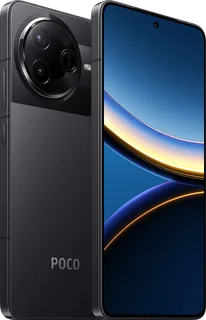
| Materials | Metal middle frame and glass back with gloss/matt finish | Metal frame and one-piece glass back; Titanium Silver is the colour name |
| Colours | Black, Blue and Silver | Black, Blue and Titanium Silver |
| Water resistance detail | IP68; maker test at 2.5 m in static freshwater for 30 minutes; resistance can decline with wear | IP68; maker test in static freshwater at 1.5 m for 30 minutes; resistance can decline with wear |
| Biometrics | Ultrasonic in-display fingerprint reader and AI Face Unlock | Ultrasonic in-display fingerprint reader and AI Face Unlock |
| Sensors | Proximity, ambient light, accelerometer, electronic compass, gyroscope, IR blaster and flicker sensor; X-axis linear vibration motor | Proximity, ambient light, accelerometer, electronic compass, gyroscope, IR blaster, flicker and colour-temperature sensors; X-axis linear vibration motor |
| Speakers | Stereo speakers, three-microphone array, Dolby Atmos, Hi-Res Audio and Hi-Res Wireless Audio | Two symmetrical Bose-tuned 1115F speakers, Dolby Atmos, Hi-Res Audio and Hi-Res Wireless Audio |
| Microphones | – | Three-microphone array |
| Software | ||
| Operating system | Android | Android |
| Software at launch | Xiaomi HyperOS 2; Android 15 confirmed by Tech Advisor and Trusted Reviews | Android 16 with Xiaomi HyperOS 3, confirmed by maker FAQ |
| Safety features | – | Regional Xiaomi Offline Communication supports voice calls over 1 km in open environments with a SIM and signed-in Xiaomi account; actual range depends on surroundings |
| In the box | Phone, USB-C cable, SIM tool, protective case, quick-start guide, warranty card, safety information and desiccant; no UK adaptor; launch purchase promotion offered a separate 120 W adaptor gift | Phone, USB-C cable, SIM tool, protective case, safety information, quick-start guide, warranty card and desiccant; standard UK box excludes adaptor |
| Connectivity | ||
| Mobile network | Dual nano-SIM; 5G SA/NSA, LTE, WCDMA and GSM, 4×4 MIMO; 5G SA n1/n2/n3/n5/n7/n8/n20/n26/n28/n38/n40/n41/n48/n66/n77/n78; Surge T1S antenna tuner | 5G SA/NSA, LTE, WCDMA and GSM; Surge T1+ signal tuner |
| SIM | Dual nano-SIM | Dual nano-SIM, nano-SIM plus eSIM or dual eSIM; eSIM depends on region and carrier |
| Wi-Fi | Wi-Fi 7/6/5/4, 2.4/5 GHz, 2×2 MIMO, Wi-Fi Direct and Miracast; Wi-Fi 7/6 availability depends on region, network and applicable software updates | Wi-Fi 7/6/5/4, 2.4/5 GHz, multi-link operation, 2×2 MIMO, Wi-Fi Direct and Miracast; newer standards depend on region, network and applicable updates |
| Bluetooth | Bluetooth 5.4, Dual-Bluetooth; SBC, AAC, aptX, aptX HD, aptX Adaptive, LDAC, LHDC 5.0, LC3, ASHA and Auracast | Bluetooth 5.4; SBC, AAC, aptX HD, aptX Adaptive, LDAC, LHDC 5.0, LC3, ASHA and Auracast |
| NFC | Supported; regional functions vary | Supported; regional functions vary |
| USB | USB-C | USB-C; maker FAQ describes USB 2.0 interface and cable |
| Positioning | GPS L1/L5, BeiDou B1I/B1C/B2a, Galileo E1/E5a, GLONASS G1, QZSS L1/L5 and NavIC L5; assisted positioning | GPS L1/L5, BeiDou B1I/B1C/B2a, Galileo E1/E5a, GLONASS G1, QZSS L1/L5 and NavIC L5; assisted positioning |

More comparisons
- Samsung Galaxy S26 vs Xiaomi POCO F8 Pro
- Xiaomi POCO F8 Pro vs Xiaomi POCO X8 Pro Max
- Xiaomi POCO F8 Pro vs Xiaomi POCO X8 Pro
- OnePlus OnePlus 15R vs Xiaomi POCO F8 Pro
- Xiaomi POCO F7 Ultra vs Xiaomi POCO F8 Pro
- Xiaomi POCO F8 Pro vs Xiaomi POCO F8 Ultra
- Nothing Phone (3) vs Xiaomi POCO F8 Pro
- Xiaomi POCO F4 vs Xiaomi POCO F8 Pro
- Motorola edge 70 vs Xiaomi POCO F7 Pro
- OPPO Find X9 vs Xiaomi POCO F8 Pro
- Motorola motorola edge 60 vs Xiaomi POCO F8 Pro
- Honor HONOR 400 Pro vs Xiaomi POCO F8 Pro
- Xiaomi POCO F7 vs Xiaomi POCO F8 Pro
- Xiaomi POCO F6 vs Xiaomi POCO F8 Pro
- Xiaomi POCO F6 Pro vs Xiaomi POCO F8 Pro
- Xiaomi POCO F5 vs Xiaomi POCO F8 Pro