Both reviews find performance close to the much dearer 3960X, with strong rendering and encoding results and substantial overclocking headroom. TechRadar questions the overall cost and finds mainstream Sandy Bridge competitive for gaming and lightly threaded work. KitGuru favours the 3930K for most high-end buyers, while noting the flagship's cache advantage in professional workloads and the cooling needed for overclocking.
Six cores with Hyper-Threading; twelve threads. Fully unlocked multiplier, confirmed by Intel's exact-model brief and the reviews. VT-d is supported only by C2 stepping according to Intel.
Clocks
Turbo Boost 2.0 up to 3.80 GHz. First-sale day comes from Legit Reviews' 14 November 2011 report of the exact boxed processor in stock at Newegg, cross-checked with Puget Systems' same-day launch coverage; Intel's specification page gives Q4 2011.
Graphics and AI
Built-in graphics
No
Graphics
No processor graphics; Intel's exact-model comparison-chart row lists graphics as not applicable. A separate graphics solution is required.
Platform
Socket
LGA2011
Base power
130 W
Unlocked
Yes
Cooler in the box
No
Memory support
Four channels of DDR3-1066/1333/1600; up to 51.2 GB/s, without ECC. Intel's later comparison chart incorrectly lists two channels; the original brief and current specification page both establish four.
PCIe
40 PCIe 2.0 lanes according to Intel's specification page.
Process
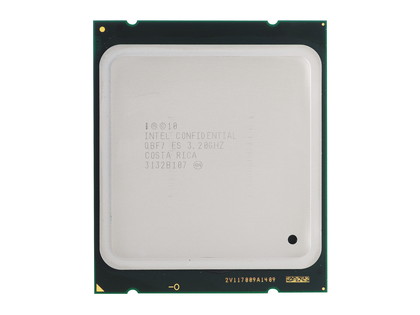
32 nm; Sandy Bridge-E. Package measures 52.5 × 45.0 mm; Intel states a 66.8°C maximum case temperature, not a junction-temperature rating.
Cooler
Intel explicitly says the boxed processor has no fan or heatsink. Requires an LGA2011-compatible cooler and motherboard; Intel's product brief names the X79 platform.