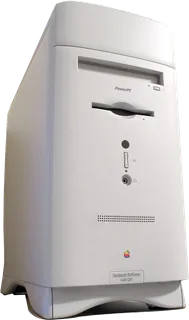
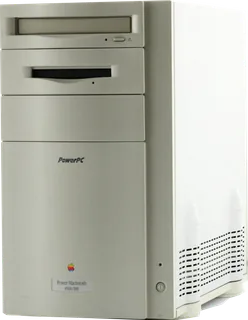
A 200 MHz PowerPC 604e tower with six PCI slots, twelve memory sockets, a bundled graphics card and a 2 GB SCSI hard disk.
Type
Tower
Processor
PowerPC 604e 200 MHz (Power Macintosh 9600/200)
Memory
16 MB – 32 MB
Storage
2 GB
Screen
–
Weight
12.7 kg
What reviewers say
MacUser and BYTE found the 9500/200 fast for demanding graphics work, but competing Mac clones could offer better performance or value. MacUser attributed the faster PowerTower Pro 200's advantage to its larger cache. BYTE found the Apple comparable to the UMAX S900/225 in its application tests, while criticising the awkward case and fewer drive bays than competing towers. BYTE's original value judgement preceded a late Apple price cut noted at press time.
One PowerPC 604e processor at 200 MHz on a removable processor card; 64 KB level-one cache, 50 MHz processor bus and 512 KB level-two cache on the logic board
GPU
Bundled Apple Accelerated Graphics PCI card with 2 MB VRAM, expandable to 4 MB. Exact maker tables give 24-bit colour through 832 × 624, 16-bit at 1024 × 768 and 1152 × 870, and 8-bit at 1280 × 1024 with standard memory; the 4 MB upgrade permits 24-bit through 1152 × 870 and 16-bit at 1280 × 1024. The catalogue appendix claims higher colour depths and is not transferred over the exact model tables
Memory type
16 or 32 MB listed in Apple's service manual and worldwide catalogue; the Japanese configuration has 32 MB. Twelve 168-pin 64-bit 70 ns-or-faster DIMM sockets; matching modules in corresponding sockets enable interleaving. Exact support pages and catalogue give a 768 MB maximum; later shared Service Source gives 1536 MB using 128 MB DIMMs, while English support says those DIMMs were not tested. This expansion discrepancy remains explicit. 4 MB ROM
Storage type
2 GB internal Fast SCSI hard disk, manual-inject Apple SuperDrive floppy and AppleCD 1200i 8× CD-ROM. Additional internal drive bay; external SCSI up to seven devices at 5 MB/s and internal SCSI up to 10 MB/s
Expansion slots
Six PCI 2.0 expansion slots, five free with the supplied graphics card; no NuBus slots. Processor is on a removable card
Display
Screen
None built in
Connections
Ports
Ethernet, headphone jack
Ethernet
0.01 Gb/s
Back ports
One ADB connector, two GeoPort/LocalTalk-compatible serial connectors, external DB-25 SCSI, AAUI-15 and 10BASE-T Ethernet connectors, 16-bit stereo sound input and output. DB-15 display connector belongs to the supplied graphics card. Both Ethernet connectors share one interface; if both are connected the service manual says 10BASE-T takes priority
External displays
One external display through the supplied graphics card, up to 1280 × 1024 with compatible display and cables; colour depth depends on video memory
Speakers
Built-in speaker and 16-bit stereo sound input/output
Microphones
Supports an external Apple PlainTalk microphone; shared service manual lists it as standard but the exact Japanese package list omits it, so regional inclusion remains qualified
Keyboard and mouse
Japanese configuration includes ADB Mouse II, power cable, KanjiTalk 7.5.3 CD-ROM, Apple Internet Starter Kit, manuals and warranty; keyboard and display sold separately. Shared service manual specifies system software 7.5.3 Revision 2 or later for the 200 MHz model
Design and power
Type
Tower
Weight
12.7 kg
Width × depth × height
196 × 400 × 430 mm
Operating system
macOS
Size and weight detail
Exact Japanese specifications and Service Source give 430 mm high, 196 mm wide and 400 mm deep, approximately 12.7 kg depending on installed devices. Worldwide catalogue rounds these to 429 × 196 × 401 mm and 12.6 kg
Power supply
100–240 V AC automatically configured, single phase, 50–60 Hz. Service Source distinguishes 225 W maximum DC power-supply output from input consumption
Power use
340 W maximum continuous AC input and 520 W peak input, excluding monitor; exact Japanese specifications and Service Source agree. English support's 225 W is the DC supply rating, not AC consumption
In the box
English support gives 5 August 1996 as introduction. Apple's November 1996 worldwide product catalogue lists this exact model as an offering, supporting release year 1996; actual first-sale month/day remains unconfirmed
Configurations
Processor
Memory
Storage
Storage type
Graphics
PowerPC 604e 200 MHz (Power Macintosh 9600/200)
16 MB
2 GB
Hard drive
Apple Accelerated Graphics (2 MB VRAM)
PowerPC 604e 200 MHz (Power Macintosh 9600/200)
32 MB
2 GB
Hard drive
Apple Accelerated Graphics (2 MB VRAM)
Pros and cons
Pros
+Upgradeable 200 MHz PowerPC processor
+Six PCI slots and twelve memory sockets
+Bundled graphics card with expandable video memory