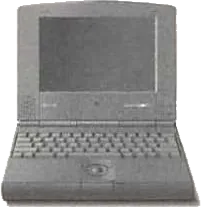
Backlit active-matrix TFT colour LCD; 256 colours at 640 × 480 or thousands at 640 × 400. Apple's exact-model product description gives 8.4 inches; the later service table labels this model 9 inches
Screen finish
Antiglare polariser
Performance
Processor
Motorola 68030 33 MHz
CPU cores
1
Memory
4 MB or 12 MB
Storage
240 MB
CPU
Motorola 68030 at 33 MHz with an integrated memory-management unit and a separate Motorola 68882 maths coprocessor at 33 MHz
GPU
Colour Screen Controller with video RAM; selecting thousands of colours centres a 640 × 400 image with black bands above and below
Memory type
4 MB soldered on the logic board, with one Duo expansion-card slot; maximum 32 MB. Apple memory kits expand to 8 or 12 MB; larger capacities require third-party cards
Storage type
Internal 240 MB SCSI hard drive in the two configurations listed in Apple's product description. The developer note also describes a 160 MB option, without an ordering configuration. External 1.4 MB floppy drive requires a Duo Floppy Adapter or Duo MiniDock
Battery and size
Battery life (maker's claim)
Up to 4 hours
Weight
2.1 kg
Thickness
38 mm
Width × depth
277 × 216 mm
Battery life detail
Removable Type II nickel-metal hydride battery. Apple's product description claims 2–4 hours; the developer note claims 4.5 hours, while the later service manual gives approximately 2–3 hours. Service weight is 2.1 kg with a battery; its paired 4.8 lb figure is inconsistent. Dimensions are rounded from Apple's 10.9 × 8.5 × 1.5 inch support table; the service manual swaps width/depth and pairs 1.5 inches with 36 mm
Charger
AC adapter supplied; service manual gives a 24 V DC, 1.04 A output
Connections
Operating system
macOS
Port detail
152-pin docking connector, RS-422 serial/LocalTalk mini-DIN-8 port, power input and optional internal Express Modem. Additional video, SCSI and floppy connections require docking accessories
External displays
Optional PowerBook Duo Dock or Duo MiniDock provides external video and desktop peripheral expansion
Keyboard
Built-in keyboard with two-level tilt adjustment; 63 keys on the domestic version or 64 on the ISO version
Trackpad
19 mm trackball with two buttons
Speakers
Four-voice, 8-bit monophonic sound input and output at 11 or 22 kHz
Microphones
Built-in omnidirectional electret microphone; the support summary's Mic Type none does not describe the built-in microphone documented in the developer and service manuals
In the box
Computer, battery, AC adapter, System 7.1 software and documentation; desktop docks sold separately. Apple lists introduction on 21 October 1993. The Mac December 1993 buying guide lists the model in the current retail range with a UK basic price; no exact first-sale month is established, so release precision remains the year
Configurations
Processor
Memory
Storage
Motorola 68030 33 MHz
4 MB
240 MB
Motorola 68030 33 MHz
12 MB
240 MB
Pros and cons
Pros
+Active-matrix colour display
+Separate 68882 floating-point coprocessor
+Docking connector for desktop expansion
Cons
−No built-in floppy drive
−Most peripheral connections require a dock
−Thousands of colours reduce the displayed image to 640 × 400