
Apple · PowerBook
PowerBook (FireWire)
The final G3 PowerBook adds two built-in FireWire ports, AirPort card support and a 100 MHz system bus.
Model history · 2 models, 1999–2000
- 1999PowerBook G3 (Bronze Keyboard)Compare
- 2000PowerBook (FireWire)
- Size
- 14.1″
- Display
- –
- Processor
- PowerPC G3 400 MHz (PowerBook FireWire) or PowerPC G3 500 MHz (PowerBook FireWire)
- Memory
- 64 MB – 128 MB
- Weight
- 2.768 kg
- Battery
- 5 h
What reviewers say
Macworld UK found the 500 MHz PowerBook quicker in its own tests and valued built-in FireWire for mobile video work, while criticising the unchanged design and modest base memory. Low End Mac’s long-term owner review praised the accessible upgrades and robust casing, but reported some short-lived DVD drives and ageing display backlights. Its tested machines had aftermarket upgrades, so those speed impressions are not stock benchmarks.
From vintageapplemac.com and lowendmac.com
Specifications
Report a wrong or missing specDisplay
- Screen size
- 14.1″
- Resolution
- 1024 × 768
- Touchscreen
- No
- Display type
- 14.1-inch active-matrix TFT colour LCD. The maker does not publish IPS/TN subtype, brightness or refresh rate.
- Display features
- 1024 × 768 native resolution. VGA and S-video output support an extended desktop or video mirroring.
Performance
- Processor
- PowerPC G3 400 MHz (PowerBook FireWire) or PowerPC G3 500 MHz (PowerBook FireWire)
- CPU cores
- 1
- Graphics
- ATI RAGE Mobility 128 (8 MB SDRAM)
- Memory
- 64 MB or 128 MB
- Storage
- 6 GB to 12 GB
- CPU
- 400 or 500 MHz PowerPC G3, each with 1 MB backside L2 cache and 100 MHz system bus. Exact fitted silicon supplier and process not assigned.
- GPU
- ATI RAGE Mobility 128 graphics controller on AGP 2×, 8 MB video SDRAM. Service Source also names it ATI Rage Mobility M3.
- Memory type
- 64 MB PC100 SDRAM standard on 400 MHz, 128 MB on 500 MHz; two 144-pin SO-DIMM slots, maker maximum 512 MB using up to 256 MB per slot. EDO and some earlier PC66 modules are incompatible.
- Storage type
- Original Apple factory pairs: 400 MHz/64 MB/6 GB Ultra ATA/66 and 500 MHz/128 MB/12 GB Ultra ATA/66, each with DVD-ROM. Apple offered an 18 GB build-to-order drive without an exact associated factory pairing. Later 10 GB/20 GB refresh is reported by Macworld, not folded into the original launch configurations. Apple launch calls the DVD drive 6× maximum; its Service Source describes a 4× drive and DVD-RAM read compatibility.
Battery and size
- Battery life (maker's claim)
- Up to 5 hours
- Battery capacity
- 50 Wh
- Weight
- 2.7678248 kg
- Thickness
- 43.18 mm
- Width × depth
- 322.58 × 264.16 mm
- Battery life detail
- 50 Wh removable lithium-ion battery. Maker claims up to five hours with one battery or ten hours using a second battery in the optical bay. Reference 6.1 lb weight includes DVD and one battery; weight-saving module gives 5.7 lb.
- Charger
- 45 W maximum AC power, 100–240 V, 50–60 Hz.
Connections
- Ports
- 2 × USB-A, Ethernet, headphone jack
- Wi-Fi
- AirPort 802.11b with optional internal card
- Operating system
- macOS
- Port detail
- Two 400 Mbps FireWire ports with FireWire Disk Mode, two USB ports, VGA, S-video, 10/100BASE-T Ethernet, 56K V.90 modem, 4 Mbps IrDA, stereo line input and headphone output. One Type I/II PC Card/CardBus slot. No built-in SCSI or ADB.
- External displays
- External VGA monitors and PAL/NTSC S-video televisions; internal/external extended desktop and video mirroring.
- Keyboard
- Full-size keyboard with inverted-T arrows and embedded numeric keypad; flip-up access to RAM, AirPort card and hard drive.
- Trackpad
- Built-in trackpad with tap, double-tap and drag.
- Speakers
- Built-in stereo speakers.
- Microphones
- Built-in microphone and line input.
- In the box
- Mac OS 9 and 6× maximum DVD-ROM drive in both Apple launch configurations; AirPort card optional. Apple’s 16 February 2000 release explicitly says available immediately at Apple Store and authorised resellers. Current support identifies a 15 February introduction; the first confirmed on-sale day is the 16th. The support table labels its 10.4 × 12.7 × 1.7-inch axes inconsistently; the case orientation gives 12.7-inch width, 10.4-inch depth and 1.7-inch thickness.
Configurations
| Processor | Memory | Storage | Graphics |
|---|---|---|---|
| PowerPC G3 400 MHz (PowerBook FireWire) | 64 MB | 6 GB | ATI RAGE Mobility 128 (8 MB SDRAM) |
| PowerPC G3 500 MHz (PowerBook FireWire) | 128 MB | 12 GB | ATI RAGE Mobility 128 (8 MB SDRAM) |
Pros and cons
Pros
- Two FireWire 400 and two USB ports
- DVD-ROM drive standard
- Hot-swappable optical drive or second battery
Cons
- No built-in SCSI port
- AirPort wireless card sold separately
- Original 400 MHz model shipped with 64 MB memory
Closest rivals
Model | Size | Display | Processor | Memory | Weight | Battery | Released |
|---|---|---|---|---|---|---|---|
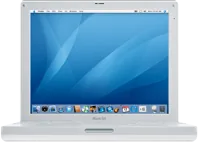
| 14.1″ | – | PowerPC G3 600 MHz (iBook14 Early2002) | 256 MB – 640 MB | 2.7 kg | 6 h | Jan 2002 | |
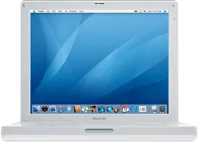
| 14.1″ | – | PowerPC G3 900 MHz (iBook Early 2003) | 256 MB – 640 MB | 2.7 kg | 6 h | Apr 2003 | |
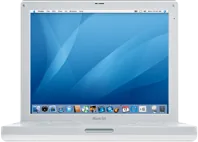
| 14.1″ | – | PowerPC G3 800 MHz (iBook Late 2002) | 256 MB – 640 MB | 2.7 kg | 6 h | Nov 2002 |
Previous model: PowerBook G3 (Bronze Keyboard).
Sources
- support.apple.com/en-us/112178
- apple.com/newsroom/2000/02/16Apple-Unveils-New-PowerBook-The-Fastest-Portable-E…
- macdat.net/files/pdf/apple/servicesource/powerbook_g3_pismo.pdf
- macworld.com/article/159851/buzzstorage.html
Photo: upload.wikimedia.org
