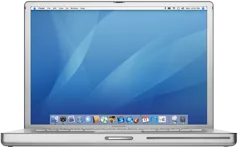
PowerPC G4 1.5 GHz (PowerBook 15-inch Early 2005) or PowerPC G4 1.67 GHz (PowerBook 15-inch Early 2005)
Memory
512 MB – 2 GB
Weight
2.5 kg
Battery
4.5 h
What reviewers say
Reviews find the brighter backlit keyboard and two-finger scrolling useful everyday improvements, while the faster processor and disk bring a modest upgrade. ATPM praises refinement over Titanium models but reports occasional trackpad drag failures and a stiff button. Macworld considers the range appealing but still relatively expensive.
15.2-inch TFT widescreen; panel technology and refresh unpublished.
Performance
Processor
PowerPC G4 1.5 GHz (PowerBook 15-inch Early 2005) or PowerPC G4 1.67 GHz (PowerBook 15-inch Early 2005)
CPU cores
1
Graphics
ATI Mobility Radeon 9700 (64 MB DDR) or ATI Mobility Radeon 9700 (128 MB DDR)
Memory
512 MB or 2 GB
Storage
80 GB to 100 GB
CPU
1.5 or 1.67 GHz PowerPC G 4 with 512 KB on-chip L 2 and 167 MHz bus. Retained sheet processor paragraph omits 1.5 GHz, but factory configuration table and UK release confirm it. Exact silicon supplier omitted.
GPU
ATI Mobility Radeon 9700 with 64 MB DDR standard; 128 MB plus dual-link DVI build-to-order restricted to 1.67 GHz. UK release higher-base bullet ambiguously mentions dual-link with 64 MB; its BTO paragraph and full sheet tie dual-link to 128 MB.
Memory type
512 MB PC 2700 DDR 333 in a single SO-DIMM; two slots, maximum 2 GB.
Storage type
80 GB 5400 rpm Ultra ATA/100 standard on both processors; 100 GB build-to-order alternative, with Sudden Motion Sensor. Combo on 1.5 GHz base, 8× DVD±RW/CD-RW SuperDrive on 1.67 GHz; SuperDrive upgrade available.
Battery and size
Battery life (maker's claim)
Up to 4.5 hours
Battery capacity
50 Wh
Weight
2.5 kg
Battery life detail
50 Wh lithium-ion, up to 4.5 hours. Maker reference 2.5 kg includes battery and optical drive; varies by configuration/manufacturing. Published dimensions: height 2.8 cm, width 34.8 cm, depth 24.1 cm.
Charger
65 W power adapter
Materials
Aluminium enclosure
Connections
Ports
2 × USB-A, Ethernet, headphone jack
Wi-Fi
AirPort Extreme 802.11g/b
Bluetooth
2.0 + EDR
Operating system
macOS
Port detail
Two USB 2.0 ports, one FireWire 400 and one FireWire 800, Gigabit Ethernet, 56K V.92 modem, Type I/II PC Card slot, DVI, S-video, audio input and headphone output.
External displays
DVI with VGA adapter and S-video/composite output; up to 2048×1536 external. Optional 128 MB dual-link configuration on 1.67 GHz supports 30-inch Cinema HD display.
Keyboard
Full-size illuminated fibre-optic keyboard with ambient light sensor on both processor configurations; Apple states up to ten times brighter backlighting than previous generation.
Trackpad
Two-finger scrolling/panning, tap, double-tap and drag support
Speakers
Stereo speakers with midrange-enhancing third speaker
Microphones
Internal omnidirectional microphone
In the box
Apple announced 31 January 2005 with availability planned later that week. Ken Mingis’s 10 February Computerworld account confirms 15-inch units had reached buyers by then; February precision retained without a verified first shipping day. Launch Mac OS X 10.3 Panther and iLife ’05.
Configurations
Processor
Memory
Storage
Graphics
PowerPC G4 1.5 GHz (PowerBook 15-inch Early 2005)
512 MB
80 GB
ATI Mobility Radeon 9700 (64 MB DDR)
PowerPC G4 1.5 GHz (PowerBook 15-inch Early 2005)
2 GB
80 GB
ATI Mobility Radeon 9700 (64 MB DDR)
PowerPC G4 1.5 GHz (PowerBook 15-inch Early 2005)
512 MB
100 GB
ATI Mobility Radeon 9700 (64 MB DDR)
PowerPC G4 1.5 GHz (PowerBook 15-inch Early 2005)
2 GB
100 GB
ATI Mobility Radeon 9700 (64 MB DDR)
PowerPC G4 1.67 GHz (PowerBook 15-inch Early 2005)
512 MB
80 GB
ATI Mobility Radeon 9700 (64 MB DDR)
PowerPC G4 1.67 GHz (PowerBook 15-inch Early 2005)
512 MB
80 GB
ATI Mobility Radeon 9700 (128 MB DDR)
PowerPC G4 1.67 GHz (PowerBook 15-inch Early 2005)
2 GB
80 GB
ATI Mobility Radeon 9700 (64 MB DDR)
PowerPC G4 1.67 GHz (PowerBook 15-inch Early 2005)
2 GB
80 GB
ATI Mobility Radeon 9700 (128 MB DDR)
PowerPC G4 1.67 GHz (PowerBook 15-inch Early 2005)
512 MB
100 GB
ATI Mobility Radeon 9700 (64 MB DDR)
PowerPC G4 1.67 GHz (PowerBook 15-inch Early 2005)
512 MB
100 GB
ATI Mobility Radeon 9700 (128 MB DDR)
PowerPC G4 1.67 GHz (PowerBook 15-inch Early 2005)
2 GB
100 GB
ATI Mobility Radeon 9700 (64 MB DDR)
PowerPC G4 1.67 GHz (PowerBook 15-inch Early 2005)
2 GB
100 GB
ATI Mobility Radeon 9700 (128 MB DDR)
Pros and cons
Pros
+Backlit keyboard on both processor configurations
+Two-finger scrolling and hard-drive motion protection