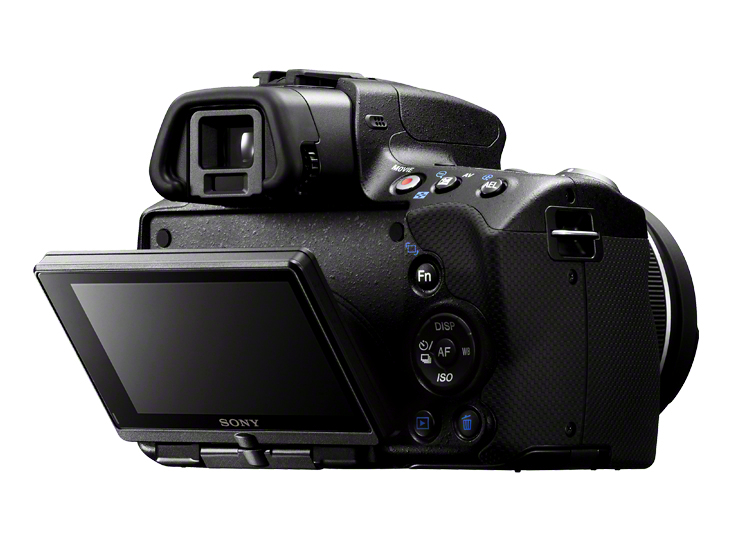
Photo 1 of 2
Sony Alpha SLT-A33 · Photo source
Sony · Alpha
Alpha SLT-A33
A 14.2 MP APS-C A-mount camera with a fixed translucent mirror, sensor-shift stabilisation and phase-detection autofocus during video.
- Type
- Translucent mirror
- Sensor
- APS-C
- Megapixels
- 14.2
- Lens
- Sony A-mount
- Video
- 1920 × 1080 at 29.97 fps
- Body weight
- 433 g
What reviewers say
Both reviews praised image quality, quick autofocus and video focusing, while finding that JPEG noise reduction softened detail. PhotographyBlog liked the viewfinder but found its burst display awkward for following subjects. PhotoReview found the 3D panorama mode difficult to use and obtained better RAW detail with Adobe's converter than Sony's software.
From photographyblog.com and photoreview.com.au
Specifications
Report a wrong or missing specImage and sensor
- Camera type
- Translucent mirror
- Sensor format
- APS-C
- Sensor type
- Exmor APS HD CMOS
- Sensor dimensions
- 23.4 × 15.6 mm
- Effective resolution
- 14.2 MP
- Largest image
- 4592 × 3056
- RAW recording
- Yes
- Standard ISO range
- 100–12800
- Sensor detail
- 14.6 million total photosites; fixed translucent mirror directs light to a separate phase-detection AF sensor while the main sensor supplies live view
- Image formats
- JPEG, RAW (Sony ARW 2.2) and RAW+JPEG; 3:2 or 16:9 stills; Sweep Panorama and 3D MPO panorama recording
- ISO detail
- Auto ISO 100–1600; multi-frame noise reduction extends sensitivity to ISO 25600; movie Auto ISO 100–1600
- Image processor
- BIONZ
Lens and shooting
- Lens mount
- Sony A-mount
- Stabilisation
- Sensor shift
- Maximum continuous burst
- 7 fps
- Lens detail
- Compatible Sony, Minolta and Konica Minolta A-mount AF lenses; kit lenses are separate from body specifications
- Autofocus
- 15-point phase-detection AF with three cross sensors; EV −1–18 at ISO 100; single-shot, automatic and continuous AF, manual focus and Eye-Start AF
- Shutter
- 1/4000–30 seconds and Bulb; flash sync 1/160 second
- Burst detail
- Up to 7 fps in Continuous Advance Priority AE, with focus and exposure adjusted during AF-C according to the maker manual; AF-S fixes focus to the first frame. Ordinary continuous drive reaches 6 fps; its maker buffer figures are 16 Fine JPEG, 20 Standard JPEG, seven RAW or seven RAW+JPEG frames. PhotographyBlog's exposure-lock description conflicts with the manual.
- Stabilisation detail
- SteadyShot INSIDE sensor-shift system; maker claim approximately 2.5–4 stops depending on lens and conditions
- Flash
- Automatic pop-up flash, guide number 10 in metres at ISO 100; ADI and pre-flash TTL control; compatible external flash required for wireless flash and high-speed sync
- Exposure controls
- PASM, Auto, Auto+, scene, panorama and Continuous Advance Priority AE modes; 1200-zone main-sensor metering; ±2 EV compensation in 1/3 steps; D-Range Optimizer and three-frame Auto HDR
Video
- Highest video resolution
- 1920 × 1080 at 29.97 fps
- Video detail
- Japan/NTSC specification is 1920 × 1080 AVCHD at 59.94 interlaced fields/s from 29.97 sensor frames/s, approximately 17 Mbps; PAL bodies use 50i from 25 frames/s. MP4 supports 1440 × 1080 and VGA. At 20°C Sony claims approximately 11 minutes of continuous recording with SteadyShot enabled or 29 minutes disabled; higher temperatures shorten this further.
- Audio
- Built-in stereo microphone, mono playback speaker and external microphone input
Screen and viewfinder
- Viewfinder
- Electronic
- Screen size
- 3″
- Screen dots
- 921,600
- Tilting screen
- Yes
- Display detail
- Xtra Fine TruBlack LCD; 180° tilt and 270° rotation on a bottom hinge; dots count colour subpixels
- Viewfinder detail
- Electronic finder with approximately 100% coverage, 1.10× magnification with a 50 mm lens, and 1,152,000 effective equivalent dots out of 1,440,000 total; electronic level and grid display
Connections and design
- Battery life (maker's claim)
- 270 photographs
- Body weight
- 433 g
- Release detail
- Sony's US announcement specifies September 2010 retail availability; Sony Japan specifies 10 September 2010. The month is the earliest maker-stated precision found across regions.
- Recording media
- Single slot accepting SD, SDHC, SDXC, Memory Stick PRO Duo and PRO-HG Duo
- Ports
- USB 2.0 Hi-Speed, mini HDMI Type C, external microphone input and wired remote terminal; optional infrared remote and AC adaptor
- Battery life detail
- NP-FW50; CIPA maker claim approximately 270 photographs using the viewfinder or 340 using the LCD
- Charging
- Supplied BC-VW1 external battery charger
- Dimensions
- Approximately 124.4 × 92 × 84.7 mm (width × height × depth)
- Weight detail
- Approximately 433 g body only; 492 g including battery and Memory Stick PRO Duo
- Colours
- Black
- In the box
- NP-FW50 battery, BC-VW1 charger, USB cable, shoulder strap, caps and software CD; kit lenses depend on configuration
Pros and cons
Pros
- Continuous phase-detection autofocus for stills and movies
- Sensor-shift stabilisation and RAW recording
- Articulating screen and electronic viewfinder
Cons
- Limited movie exposure controls
- Shorter continuous movie recording when stabilisation is enabled
Closest rivals
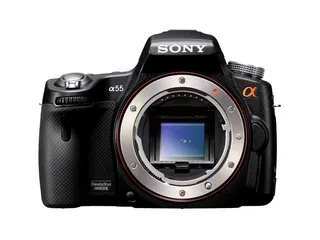
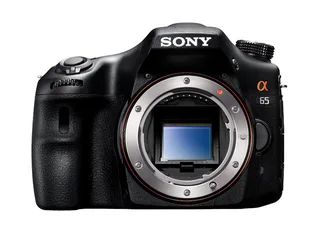
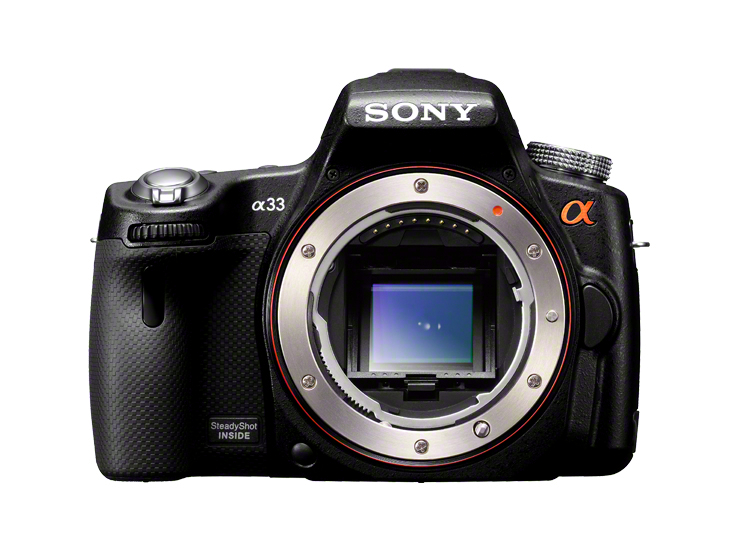
Model | Type | Sensor | Megapixels | Lens | Video | Body weight | Released |
|---|---|---|---|---|---|---|---|
| Translucent mirror | APS-C | 16.2 | Sony A-mount | 1920 × 1080 at 29.97 fps | 441 g | Sept 2010 | |
| Translucent mirror | APS-C | 16.2 | Sony A-mount | 1920 × 1080 at 25 fps | 415 g | Jul 2011 | |
| Translucent mirror | APS-C | 24.3 | Sony A-mount | 1920 × 1080 at 60 fps | 543 g | Sept 2011 |

Sources
- sony.jp/ichigan/products/archive/SLT-A33/spec.html
- sony.jp/products/Consumer/dslr/manual_english/A55_manual.pdf
- sony.jp/CorporateCruise/Press/201008/10-0824
- sony.mediaroom.com/2010-08-24-DSLR-Redefined-Sony-Introduces-New-Cameras-Powere…
Photo: sony.jp
- Sony SLT-A33 rear product view with DT 18-55mm SAM kit lens.: sony.jp/products/picture/SLT-A33_rear.jpg