Photo 1 of 9
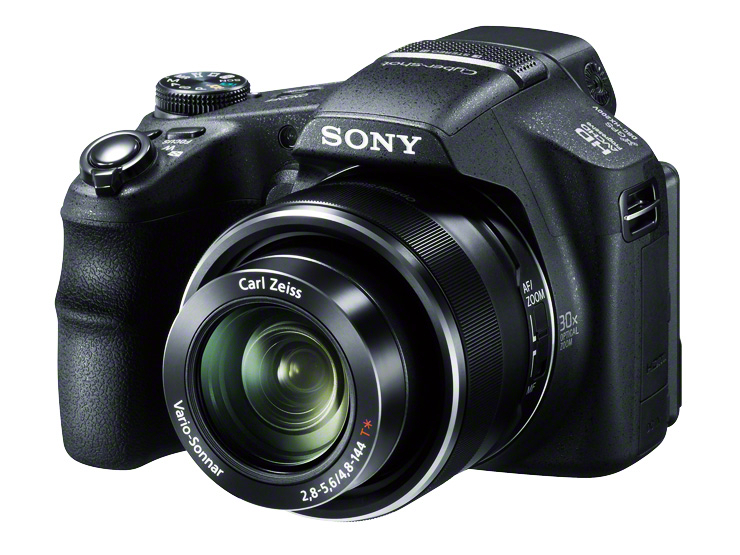
Sony Cyber-shot DSC-HX200V · Photo source
Sony · Cyber-shot
Cyber-shot DSC-HX200V
A bridge camera with a stabilised 30× Zeiss lens, GPS route logging, a tilting screen and progressive Full HD video.
- Type
- Bridge
- Sensor
- 1/2.3-type
- Megapixels
- 18.2
- Lens
- 27–810 mm equivalent
- Video
- 1920 × 1080 at 60 fps
- Body weight
- 531 g
What reviewers say
Photography Blog and ePHOTOzine praised the useful zoom, solid handling, tilting screen and image quality, but considered the launch price high. Photography Blog highlighted consistent handheld telephoto results while finding the jog dial fiddly and viewfinder easy to overlook. ePHOTOzine praised battery life but noted purple fringing and a lens cap that can obstruct startup.
From photographyblog.com and ephotozine.com
Specifications
Report a wrong or missing specImage and sensor
- Camera type
- Bridge
- Sensor format
- 1/2.3-type
- Sensor type
- Back-illuminated Exmor R CMOS
- Effective resolution
- 18.2 MP
- Largest image
- 4896 × 3672
- RAW recording
- No
- Standard ISO range
- 100–3200
- Sensor detail
- 1/2.3-type progressive-scan Exmor R CMOS; approximately 18.9 million total and 18.2 million effective photosites. Optical format is distinct from physical sensor dimensions
- Image formats
- JPEG still images and MPF 3D images; no RAW. High-resolution Sweep Panorama produces stitched 10480 × 4096 images, distinct from single-frame resolution
- ISO detail
- Ordinary single-frame range ISO 100–3200; ISO 4000–12800 uses Clear Image technology and multi-frame compositing, rather than ordinary single-frame sensitivity
- Image processor
- BIONZ
Lens and shooting
- Built-in lens
- 27–810 mm equivalent
- Maximum aperture
- f/2.8–5.6
- Optical zoom
- 30×
- Stabilisation
- Optical lens stabilisation
- Maximum continuous burst
- 10 fps
- Lens detail
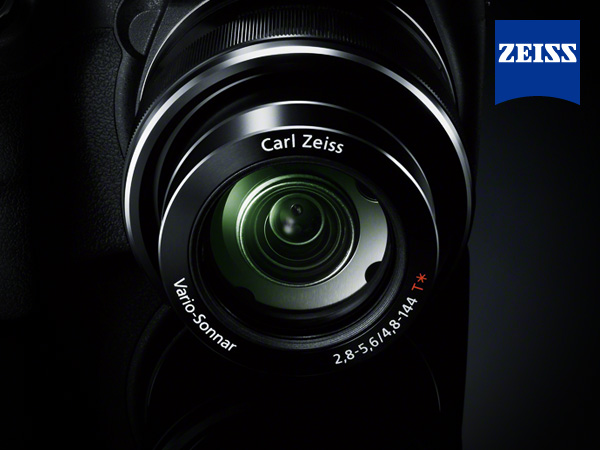
- Carl Zeiss Vario-Sonnar T*; actual 4.8–144 mm; 11 elements in 10 groups including 1 aspherical element. Equivalent range is 27–810 mm for 4:3 stills and 29–870 mm for 16:9 stills. Lens ring selects electronic zoom or manual focus; 60× Clear Image Zoom includes digital enlargement and is distinct from 30× optical zoom
- Autofocus
- Nine-area multi AF, centre AF, flexible spot, subject and face tracking, and manual focus; AF illuminator. Focus distance from lens front approximately 1 cm at wide angle and 200 cm at telephoto
- Shutter
- Mechanical shutter; Auto 4–1/4000 second, Program 1–1/4000, Manual and shutter priority 30–1/4000, aperture priority 8–1/2000
- Burst detail
- Up to ten full-resolution images at 10 fps, with a Low option. Focus, white balance and exposure are fixed from the first frame and flash is disabled. Internal-memory bursts are VGA; a compatible memory card is needed for full-resolution bursts
- Stabilisation detail
- Optical SteadyShot for stills; Active movie mode combines optical and electronic correction including rotational movement
- Flash
- Built-in pop-up flash; Auto, forced, off, slow-sync and rear slow-sync modes. ISO Auto range approximately 0.3–12.4 m wide and 2–5.9 m telephoto
- Exposure controls
- Intelligent Auto, Superior Auto, Program, aperture priority, shutter priority and Manual plus scene modes and picture effects. Internal ND filter; memory-recall settings. Multi-pattern, centre-weighted and spot metering; ±2 EV in 1/3 EV steps
Video
- Highest video resolution
- 1920 × 1080 at 60 fps
- Video detail
- AVCHD 2.0; region-dependent 1920 × 1080 at 60p or 50p, 28 Mbps; the main frame rate represents the 60p-compatible version. FX and FH record 1920 × 1080 at 60i or 50i, 24 or 17 Mbps; HQ records 1440 × 1080 interlaced at 9 Mbps. Interlaced rates count fields, not progressive frames. MP4 records 1440 × 1080, 1280 × 720 or VGA at 30 fps or 25 fps according to region; optical zoom available while filming; continuous clips approximately 29 minutes
- Audio
- Built-in stereo microphone and mono playback speaker; Dolby Digital audio for AVCHD and AAC for MP4
Screen and viewfinder
- Viewfinder
- Electronic
- Screen size
- 3″
- Screen dots
- 921,000
- Touchscreen
- No
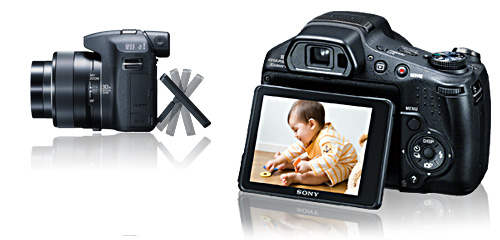
- Tilting screen
- Yes
- Display detail
- Xtra Fine TFT LCD with TruBlack and upward/downward tilt; approximately 921000 dots
- Viewfinder detail
- 0.2-type electronic viewfinder with approximately 201000-dot equivalent resolution; eye sensor switches automatically between finder and rear screen
Connections and design
- Wi-Fi
- No
- Battery life (maker's claim)
- 450 photographs
- Body weight
- 531 g
- Release detail
- Sony Japan's original 28 February 2012 announcement specifies sale on 9 March 2012. March precision is retained without treating that Japanese day as a confirmed international first day
- Recording media
- Approximately 105 MB internal memory; Memory Stick Duo, PRO Duo and PRO-HG Duo plus SD, SDHC and SDXC. Memory Stick Micro, microSD and microSDHC require separate adapters
- Ports
- Micro USB, Hi-Speed USB 2.0, mini HDMI and separate DC input
- Wireless connections
- GPS and digital compass record position and shooting direction; GPS Log records a route. No built-in Wi-Fi. TransferJet requires a compatible optional Memory Stick; Eye-Fi support uses a separate card
- Battery life detail
- NP-FH50 InfoLITHIUM battery. Maker CIPA claim approximately 450 photographs or 225 minutes with LCD, or 490 photographs or 245 minutes with EVF; continuous movie recording approximately 120 minutes with LCD or 130 minutes with EVF. Still-photo test has GPS off and Standard display resolution
- Charging
- Battery charges in the camera through the supplied AC-L200C/L200D adapter and DC input, approximately 100 minutes. A computer can also charge it over micro USB with the camera switched off; USB charging does not imply USB power supply
- Dimensions
- Approximately 121.6 × 86.6 × 93.3 mm (width × height × depth)
- Weight detail
- Approximately 531 g camera only, or 583 g including NP-FH50 and Memory Stick Duo
- Colours
- Black
- In the box
- NP-FH50 battery, AC-L200C/L200D adapter, mains lead, micro USB cable, shoulder strap, lens cap and cap strap, and instructions; mains fittings vary by region
Pros and cons
Pros
- 27–810 mm equivalent optical zoom with a focus or zoom ring
- Tilting screen, electronic viewfinder and manual exposure
- GPS geotagging, compass and route logging
Cons
- No RAW recording
- Full-speed bursts stop after ten photographs
- No built-in Wi-Fi
Closest rivals
Model | Type | Sensor | Megapixels | Lens | Video | Body weight | Released |
|---|---|---|---|---|---|---|---|
| Bridge | 1/2.3-type | 20.1 | 22.3–580 mm equivalent | 1280 × 720 at 30 fps | 430 g | 2013 | |
| Bridge | 1/2.3-type | 16.2 | 27–810 mm equivalent | 1920 × 1080 at 60 fps | 525 g | Apr 2011 | |
| Bridge | 1/2.3-type | 20.4 | 24–1200 mm equivalent | 1920 × 1080 at 60 fps | 623 g | Mar 2013 |


Sources
- sony.jp/cyber-shot/products/archive/DSC-HX200V/spec.html
- sony.jp/CorporateCruise/Press/201202/12-0228
- sony.com/electronics/support/res/manuals/4445/44457962M.pdf
- helpguide.sony.net/gbmig/44167591/v1/eng/contents/02/04/05/05.html
- helpguide.sony.net/gbmig/44167591/v1/eng/contents/04/02/19/19.html
- helpguide.sony.net/gbmig/44167591/v1/eng/contents/04/02/33/33.html
Photo: sony.jp
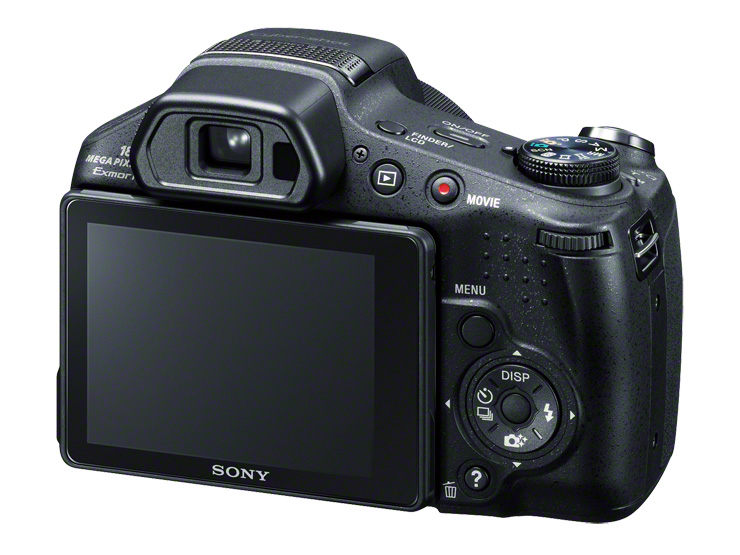
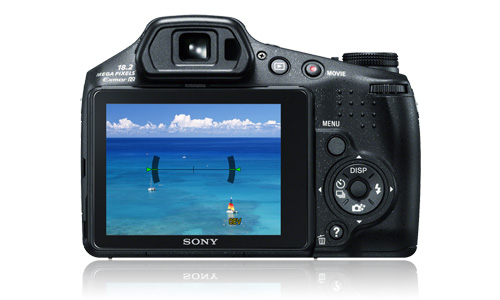
- Sony Cyber-shot DSC-HX200V, rear display and controls: Sony Japan exact-model published image-index rear original, 740×555
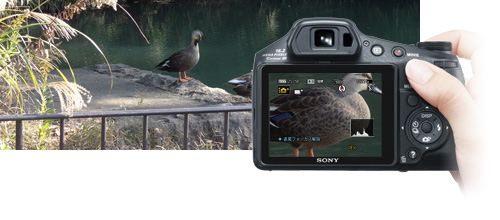
- Sony Cyber-shot DSC-HX200V held while photographing a duck, with rear screen visible: Sony official product photograph
- Sony Cyber-shot DSC-HX200V lens close-up with maker-supplied Zeiss identification: Sony official product photograph
- Sony Cyber-shot DSC-HX200V side and rear composition showing articulated screen: Sony official product photograph
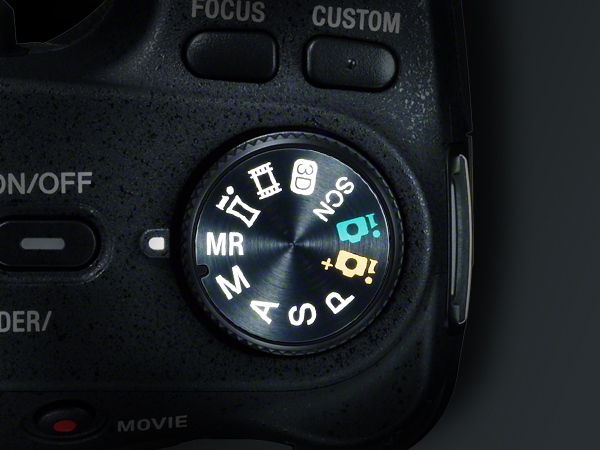
- Sony Cyber-shot DSC-HX200V mode dial close-up: Sony official product photograph
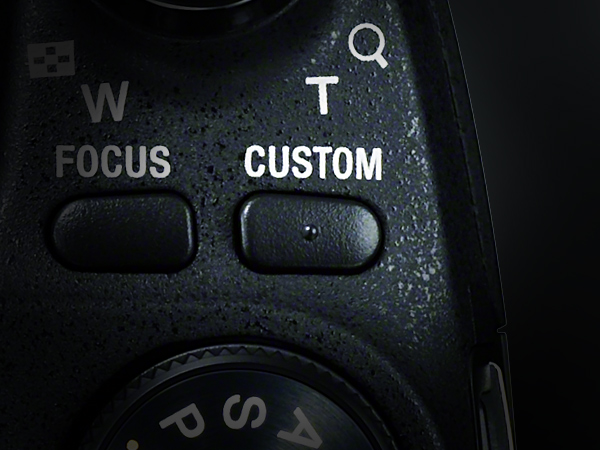
- Sony Cyber-shot DSC-HX200V zoom, focus and custom-button close-up: Sony official product photograph
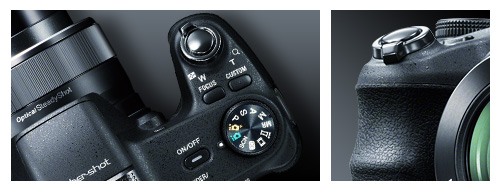
- Sony Cyber-shot DSC-HX200V top controls and grip detail composition: Sony official product photograph
- Sony Cyber-shot DSC-HX200V rear view with photograph displayed on screen: Sony official product photograph