Sony · Cyber-shot
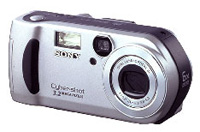
Cyber-shot DSC-P71
A 3.21-megapixel compact camera with a 3× optical zoom, optical finder and two rechargeable AA batteries.
- Type
- Compact
- Sensor
- 1/1.8-type
- Megapixels
- 3.21
- Lens
- 39–117 mm equivalent
- Video
- 320 × 240
- Body weight
- 226 g
What reviewers say
Both tests praised handling and colour reproduction. DPReview liked resolution, autofocus and supplied rechargeables, but found ISO 100 noise, wide-angle distortion and weak preset white balance. CNET France criticised JPEG compression and the small supplied card; its response-time assessment was less favourable than DPReview’s.
From dpreview.com and cnetfrance.fr
Product links
Specifications
Report a wrong or missing specImage and sensor
- Camera type
- Compact
- Sensor format
- 1/1.8-type
- Sensor type
- Super HAD CCD
- Effective resolution
- 3.21 MP
- Largest image
- 2048 × 1536
- RAW recording
- No
- Standard ISO range
- 100–400
- Sensor detail
- 1/1.8-type primary-colour interlaced Super HAD CCD; approximately 3.30 million total and 3.21 million effective photosites in exact manual, rounded 3.20 million effective in Japanese launch. Optical format is not physical sensor width
- Image formats
- JPEG stills with Fine/Standard compression; GIF Clip Motion and MPEG-1 movies. No RAW or TIFF recording
- ISO detail
- Auto or manually selected ISO 100, 200 or 400; no continuous ISO dial
- Image processor
- Clear Colour NR, Clear Luminance NR and NR Slow Shutter processing; chip identifier not published
Lens and shooting
- Built-in lens
- 39–117 mm equivalent
- Maximum aperture
- f/2.8–5.3
- Optical zoom
- 3×
- Lens detail
- Sony 3× optical zoom, actual 8–24 mm, 39–117 mm equivalent, F2.8–5.3; retracting barrel and automatic lens cover. Normal focus from 0.5 m, macro from 0.1 m wide or 0.5 m telephoto
- Autofocus
- Automatic three-area Multi AF or centre AF; AF-assist illuminator. Preset distances 0.5, 1, 3, 7 m and infinity, not continuous manual focusing
- Burst detail
- Multi Burst records sixteen 320×240 subframes at intervals 1/30, 1/15 or 1/7.5 second into one composite still, not sixteen full-resolution separate frames. Maker lists approximately 1.9 seconds between maximum-size single shots; this is not continuous-burst fps
- Flash
- Built-in flash with Auto, forced, off and red-eye reduction; ISO Auto recommended distance 0.5–3.8 m wide or 0.5–2.5 m telephoto
- Exposure controls
- Automatic exposure with ±2 EV in 1/3 EV steps, multi-pattern/spot metering and Twilight, Twilight Portrait or Landscape scenes; no aperture/shutter priority or manual exposure
Video
- Highest video resolution
- 320 × 240
- Video detail
- Silent MPEG-1 HQX 320×240, Presentation 320×240 or Video Mail 160×112; maker launch claims approximately 5 minutes 40 seconds HQX or 90 minutes mail with optional 128 MB Memory Stick. Frame rate omitted: maker recording rate not established and review introduction/spec table disagree
- Audio
- Movies record without sound; operational beep/shutter speaker is separate from audio recording
Screen and viewfinder
- Viewfinder
- Optical
- Screen size
- 1.5″
- Screen dots
- 123,200
- Touchscreen
- No
- Tilting screen
- No
- Display detail
- Fixed 1.5-type TFT with 123200 colour-subpixel dots (560×220); Japanese launch rounds to 123000 dots
- Viewfinder detail
- Optical zoom finder; no electronic finder
Connections and design
- Body weight
- 226 g
- Release detail
- Sony Japan announced on 12 March 2002 with planned Japanese availability 20 March 2002. Contemporary full production reviews in 2002 establish the generation; earliest actual worldwide first-sale month unresolved, so year precision retained. No direct successor claim established
- Recording media
- Memory Stick; 16 MB supplied, 128 MB in maker recording table. Later PRO compatibility not established
- Ports
- USB mini-B with normal mass-storage or PTP setting, separate NTSC/PAL VIDEO OUT minijack without audio and DC IN for optional AC-LS1
- Battery life detail
- Two supplied NH-AA-DI Ni-MH AA cells. Exact manual average-use test at 25°C: approximately 230 images/115 minutes at 2048×1536 Fine, LCD on, one shot every 30 seconds, alternating zoom endpoints, flash every second shot, restart every 10 shots. Not labelled CIPA. Separate continuous Standard/no-flash/3-second-interval test: approximately 2000 images/100 minutes LCD on or 2400/120 off
- Charging
- Supplied external BC-CS1 charger: approximately 13 hours for fully depleted supplied Ni-MH cells at 25°C. Cells removed from camera for charging; optional faster kit available. Optional AC-LS1 supplies camera power
- Dimensions
- 124.9×58×43.6 mm width×height×depth; manual excludes protruding portions, Japanese launch labels maximum dimensions
- Weight detail
- Approximately226 g body only in exact Sony Japan launch table; approximately 284 g with two batteries, Memory Stick and wrist strap in manual and launch table
- In the box
- Two rechargeable AA Ni-MH batteries, BC-CS1 charger and mains lead, 16 MB Memory Stick, USB and video cables, wrist strap, software CD and operating instructions; AC-LS1 optional
Pros and cons
Pros
- 3× optical zoom and optical viewfinder
- Supplied rechargeable AA batteries and charger
- Three-area autofocus with AF illuminator
Cons
- Silent low-resolution movies
- No RAW or manual exposure
Closest rivals
Model | Type | Sensor | Megapixels | Lens | Video | Body weight | Released |
|---|---|---|---|---|---|---|---|
| Compact | 1/1.8-type | 3.2 | 39–117 mm equivalent | 320 × 240 at 16.6 fps | 176.5 g | 2002 | |
| Compact | 1/1.8-type | 4 | 39–117 mm equivalent | 320 × 240 at 16.6 fps | 176.5 g | 2002 | |
| Compact | 1/1.8-type | 5 | 38–114 mm equivalent | 640 × 480 at 16.6 fps | 172 g | 2003 |