Photo 1 of 3
Sony Cyber-shot DSC-RX1 · Photo source
Sony · Cyber-shot RX1
Cyber-shot DSC-RX1
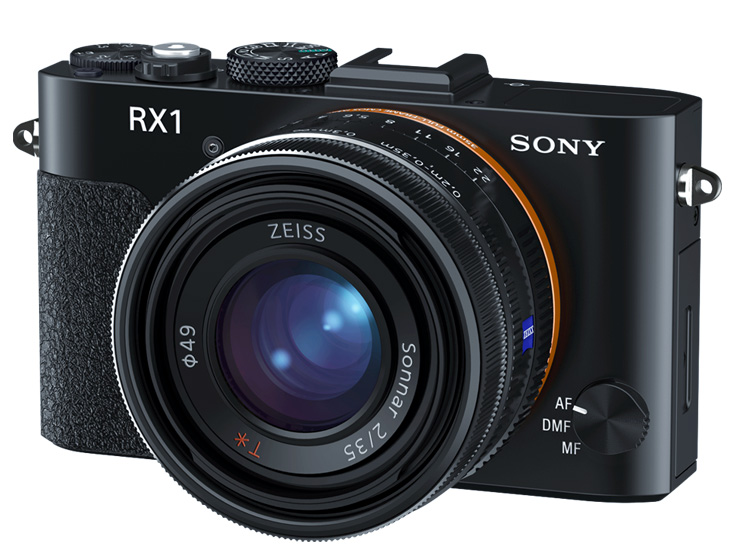
Sony's original RX1 combines a full-frame 24.3 MP sensor with a fixed 35 mm f/2 lens in a compact body.
- Type
- Compact
- Sensor
- Full frame
- Megapixels
- 24.3
- Lens
- 35 mm equivalent
- Video
- 1920 × 1080 at 60 fps
- Body weight
- 453 g
What reviewers say
Both reviews praised the sharp lens, full-frame image quality and manual controls. Amateur Photographer found handling comfortable and autofocus sufficient for travel and street photography. PhotographyBlog found the grip less secure and autofocus sluggish, while criticising short battery life. Both considered the optional viewfinders expensive.
Specifications
Report a wrong or missing specImage and sensor
- Camera type
- Compact
- Sensor format
- Full frame
- Sensor type
- Exmor CMOS
- Sensor dimensions
- 35.8 × 23.9 mm
- Effective resolution
- 24.3 MP
- Largest image
- 6000 × 4000
- RAW recording
- Yes
- Standard ISO range
- 100–25600
- Image formats
- JPEG and 14-bit RAW (Sony ARW 2.3); AVCHD 2.0 or MP4 movies
- ISO detail
- Standard single-frame ISO 100–25600; extended ISO 50/64/80. Multi-frame noise reduction reaches ISO 102400 by combining six exposures; it is not standard single-frame sensitivity.
- Image processor
- BIONZ
Lens and shooting
- Built-in lens
- 35 mm equivalent
- Maximum aperture
- f/2
- Stabilisation
- Electronic only
- Maximum continuous burst
- 5 fps
- Lens detail
- ZEISS Sonnar T* 35 mm f/2 fixed prime; eight elements in seven groups, nine aperture blades and 49 mm filter thread. Macro mode focuses from 20 cm measured from the sensor plane, or 14 cm from the lens front.
- Autofocus
- Contrast-detection AF with 25 points; AF, direct manual focus and manual focus. The original launch specification was revised before release to remove separate still-image continuous AF.
- Shutter
- Leaf shutter; 30 seconds to 1/4000 second and Bulb. The 1/4000 limit requires f/5.6 or a smaller aperture; the fastest speed at f/2 is 1/2000 second.
- Burst detail
- Up to 5 fps in speed-priority mode with initial focus fixed; the Japanese maker table lists normal continuous shooting at 2.5 fps, rather than PhotographyBlog's rounded 3 fps.
- Stabilisation detail
- Electronic stabilisation applies only to movies and crops the field of view; no optical lens or sensor-shift still-image stabilisation
- Flash
- Built-in manually raised flash and Multi Interface Shoe for optional external flashes or viewfinders
- Exposure controls
- Program, aperture priority, shutter priority and manual exposure; dedicated aperture and exposure-compensation rings/dials, three memory recalls, DRO and three-frame automatic HDR
Video
- Highest video resolution
- 1920 × 1080 at 60 fps
- Video detail
- Full HD AVCHD at up to 60p in NTSC mode or 50p in PAL mode, at 28 Mbit/s; NTSC also supports 24p and PAL 25p. Continuous clips are limited to approximately 29 minutes; MP4 12M recording ends around 15 minutes or 2 GB.
Screen and viewfinder
- Viewfinder
- None
- Screen size
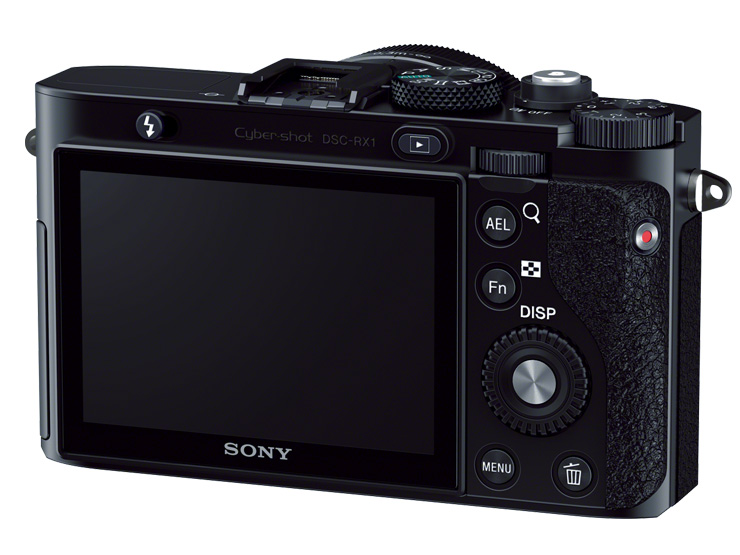
- 3″
- Screen dots
- 1,228,800
- Tilting screen
- No
- Display detail
- Fixed WhiteMagic TFT LCD; the maker's dots count colour subpixels rather than that many image pixels
- Viewfinder detail
- No built-in viewfinder; optional FDA-EV1MK electronic or FDA-V1K optical viewfinder uses the accessory shoe
Connections and design
- Wi-Fi
- No
- Battery life (maker's claim)
- 220 photographs
- Body weight
- 453 g
- Release detail
- Sony's Japanese announcement gives 16 November 2012 for first sale; Hong Kong followed in December 2012
- Recording media
- SD, SDHC, SDXC and Memory Stick Duo variants; Micro and microSD formats require adaptors
- Ports
- Micro USB (USB 2.0), Micro HDMI, 3.5 mm microphone input and Multi Interface Shoe
- Wireless connections
- No built-in Wi-Fi; compatible Eye-Fi cards provide a separate wireless-transfer option
- Battery life detail
- NP-BX1 rechargeable battery. UK support claims 220 CIPA photographs; Japan specifies 220 with high-quality display mode or 270 with standard display mode. PhotographyBlog obtained around 150 shots in its usage, fewer with the optional electronic viewfinder.
- Charging
- In-camera USB charging and USB power with the supplied AC adaptor
- Dimensions
- Approximately 113.3 × 65.4 × 69.6 mm (width × height × depth)
- Weight detail
- 453 g body only, including the integral fixed lens; 482 g with battery and recording media
- Materials
- Magnesium-alloy body according to Sony's launch announcement; PhotographyBlog describes it as aluminium
- Colours
- Black
- In the box
- NP-BX1 battery, AC adaptor, Micro USB cable, shoulder strap, lens cap, shoe cap, cleaning cloth and instructions; adaptor model varies by region
Pros and cons
Pros
- Full-frame sensor and 14-bit RAW recording
- Dedicated aperture, focus and exposure-compensation controls
- Built-in pop-up flash and accessory shoe
Cons
- No built-in viewfinder or Wi-Fi
- Fixed focal length and no optical still-image stabilisation
Closest rivals
Model | Type | Sensor | Megapixels | Lens | Video | Body weight | Released |
|---|---|---|---|---|---|---|---|
| Compact | Full frame | 24.3 | 35 mm equivalent | 1920 × 1080 at 60 fps | 453 g | Jul 2013 | |
| Compact | Full frame | 42.4 | 35 mm equivalent | 1920 × 1080 at 60 fps | 480 g | Nov 2015 | |
| Compact | 1/2.3-type | 16.1 | 24–384 mm equivalent | 1280 × 720 at 30 fps | 192 g | 2012 |


Sources
- sony.co.uk/electronics/support/compact-cameras-dsc-rx-series/dsc-rx1/specificat…
- sony.jp/cyber-shot/products/DSC-RX1/spec.html
- sony.jp/CorporateCruise/Press/201209/12-0912C
- sony.com.hk/press/pdf/2012091204_e.pdf
- photographyblog.com/reviews/sony_cybershot_dsc_rx1_review
- amateurphotographer.com/review/sony-cyber-shot-dsc-rx1-review
Photo: sony.jp
- Sony RX1, rear view: Sony, official Japan product gallery; shared rear body photograph explicitly published in both RX1 and RX1R exact product galleries
- Sony RX1, front view with optional optical viewfinder, thumb grip and lens hood: Sony, official exact-model launch press photograph; FDA-V1K optical viewfinder, TGA-1 thumb grip and LHP-1 lens hood shown, all sold separately