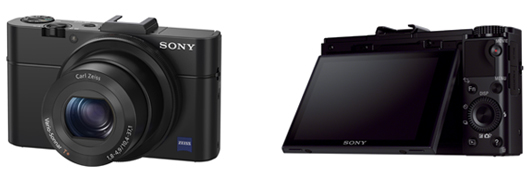
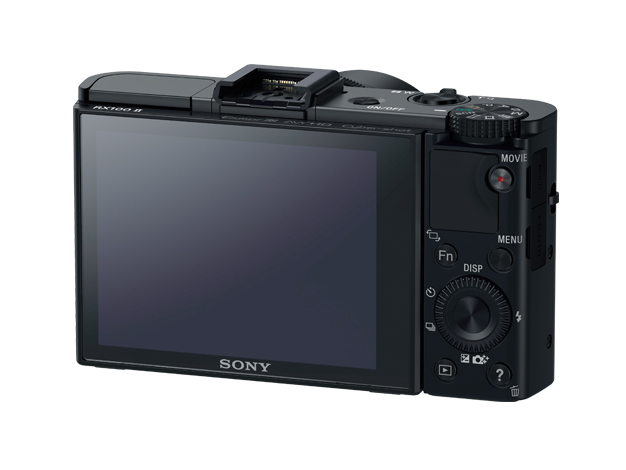
Both reviews praised image detail, improved low-light results and the tilting screen, while criticising the price and lack of touch controls. Photography Blog found the smooth body difficult to grip and the optional viewfinder expensive. TechRadar liked quick focusing but found remote phone controls limited and some RAW restrictions awkward.
1.0-type optical format; physical dimensions 13.2 × 8.8 mm
Image formats
JPEG and RAW (Sony ARW 2.3); AVCHD 2.0 and MP4 movies
ISO detail
Standard single-frame ISO 160–12800; extended ISO 100/125; multi-frame noise reduction reaches ISO 25600
Image processor
BIONZ
Lens and shooting
Built-in lens
28–100 mm equivalent
Maximum aperture
f/1.8–4.9
Optical zoom
3.6×
Stabilisation
Optical lens stabilisation
Maximum continuous burst
10 fps
Lens detail
Carl Zeiss Vario-Sonnar T*; actual 10.4–37.1 mm; quoted equivalent range applies to 3:2 still photographs; seven elements in six groups
Autofocus
Single-shot AF, continuous AF, direct manual focus and manual focus; tracking focus and face tracking
Shutter
Manual and shutter-priority modes permit 30 seconds to 1/2000 second; other modes have different limits
Burst detail
Speed Priority Continuous reaches approximately 10 fps with focus and exposure fixed at the first frame (Photography Blog). Normal continuous shooting is approximately 2.5 fps with AF-S (Sony).
Stabilisation detail
Optical still-image stabilisation; movie Active mode combines optical and electronic correction
Exposure controls
Program, aperture priority, shutter priority and manual exposure; assignable lens control ring, step zoom and memory recall
Video
Highest video resolution
1920 × 1080 at 50 fps
Video detail
PAL AVCHD up to 1920 × 1080 at 50p, including 25p; NTSC up to 60p, including 24p. MP4 up to 1440 × 1080 at 25p PAL or 30p NTSC.
Screen and viewfinder
Viewfinder
None
Screen size
3″
Screen dots
1,228,800
Touchscreen
No
Tilting screen
Yes
Display detail
WhiteMagic TFT LCD tilts approximately 84° upwards and 45° downwards; screen dots are subpixels, not image pixels; no touchscreen (TechRadar)
Viewfinder detail
No built-in viewfinder; optional electronic viewfinder attaches to the Multi Interface Shoe
Connections and design
Wi-Fi
Yes
Battery life (maker's claim)
350 photographs
Body weight
254 g
Release detail
Sony Japan specifies 5 July 2013 retail availability; Hong Kong's release specifies the end of July
Recording media
SD, SDHC, SDXC and Memory Stick variants; micro cards require an adaptor
Ports
Multi/Micro USB with USB 2.0, Micro HDMI and Multi Interface Shoe
Wireless connections
Wi-Fi and NFC One-touch remote and sharing
Battery life detail
NP-BX1; maker claim up to 350 photographs under CIPA conditions
Dimensions
Approximately 101.6 × 58.1 × 38.3 mm (width × height × depth)
Weight detail
Approximately 254 g body only; 281 g with battery and Memory Stick Duo. Photography Blog's loaded-weight description conflicts with the maker's figures.
Materials
Aluminium body
Colours
Black
Pros and cons
Pros
+RAW recording and manual exposure controls
+Tilting screen and accessory shoe
+Wi-Fi and NFC connection
Cons
−Viewfinder sold separately
−Maximum aperture falls to f/4.9 at the telephoto end