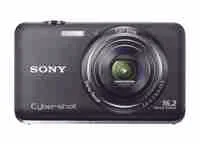
Sony · Cyber-shot
Cyber-shot DSC-WX9
A sixteen-megapixel pocket compact with a five-times Carl Zeiss zoom, a three-inch screen and interlaced Full HD video.
- Type
- Compact
- Sensor
- 1/2.3-type
- Megapixels
- 16.2
- Lens
- 25–125 mm equivalent
- Video
- 1920 × 1080 at 30 fps
- Body weight
- 123 g
What reviewers say
Both reviews liked the compact body, detailed screen and automatic panoramas. Digital Trends praised stills and video, while Imaging Resource found persistent lens softness on two samples and criticised small controls and slow composite processing. Both identified high-ISO limitations; Imaging Resource also noted audible zoom noise and camera movement during video zooming.
From imaging-resource.com and digitaltrends.com
Specifications
Report a wrong or missing specImage and sensor
- Camera type
- Compact
- Sensor format
- 1/2.3-type
- Sensor type
- Exmor R CMOS
- Effective resolution
- 16.2 MP
- Largest image
- 4608 × 3456
- RAW recording
- No
- Standard ISO range
- 100–3200
- Sensor detail
- 1/2.3-type back-illuminated Exmor R CMOS; approximately 16.8 million total photosites. Optical format is not physical dimensions
- Image formats
- JPEG photographs, maximum 4608 × 3456 in 4:3 or 4608 × 2592 in 16:9; MPF 3D photographs, 2D/3D Sweep Panorama and Sweep Multi Angle. Normal panoramas reach 7152 × 1080 or 4912 × 1920; this model does not offer the WX7 high-resolution panorama mode
- Image processor
- BIONZ
Lens and shooting
- Built-in lens
- 25–125 mm equivalent
- Maximum aperture
- f/2.6–6.3
- Optical zoom
- 5×
- Stabilisation
- Optical lens stabilisation
- Lens detail
- Carl Zeiss Vario-Tessar five-times optical zoom, six elements in five groups including three aspherical elements; actual 4.5–22.5 mm. Equivalent 25–125 mm for 4:3 photographs, 28–140 mm for 16:9, 29–145 mm for 16:9 movies or 35–175 mm for 4:3 movies. Optical zoom operates during movies
- Autofocus
- Nine-point multipoint, centre-weighted or spot AF with illuminator and tracking focus; approximately 5 cm minimum focus wide or 100 cm telephoto. No manual focus
- Shutter
- Auto 2–1/1600 second; Program Auto 1–1/1600 second
- Burst detail
- Approximately 10 fps at maximum resolution for up to ten frames; this is a brief buffered burst rather than sustained continuous shooting. Flash reduces speed and some modes do not permit bursts
- Stabilisation detail
- Optical SteadyShot
- Flash
- Built-in front flash, Auto, forced, slow-sync or off; ISO Auto range approximately 0.05–5.3 m wide or 1–2.2 m telephoto
- Exposure controls
- Intelligent Auto, Superior Auto, Program Auto, Easy, scenes, Background Defocus, Intelligent Sweep Panorama, 3D stills, 3D Sweep Panorama, Sweep Multi Angle and movies; ±2 EV in 1/3 EV steps. Wide-angle F2.6/F8 two-step ND-filter settings; no aperture/shutter priority or manual exposure
Video
- Highest video resolution
- 1920 × 1080 at 30 fps
- Video detail
- AVCHD MPEG-4 AVC/H.264, 1920 × 1080 up to 24 Mbps or 1440 × 1080 at 9 Mbps. NTSC 60i means approximately 60 interlaced fields per second and 30 frame pairs; PAL 50i means 50 fields and 25 frame pairs. MP4 records 1440 × 1080 at 12 Mbps, 1280 × 720 at 6 Mbps or VGA at 3 Mbps, approximately 30 fps NTSC. Approximately 29-minute clip limit
- Audio
- Built-in stereo microphone and mono speaker; wind-noise reduction
Screen and viewfinder
- Viewfinder
- None
- Screen size
- 3″
- Screen dots
- 921,600
- Touchscreen
- No
- Tilting screen
- No
- Display detail
- Fixed 3-type Xtra Fine LCD TFT with 921600 dots, brightness adjustment and automatic bright monitoring; no touchscreen or viewfinder
Connections and design
- Battery life (maker's claim)
- 210 photographs
- Body weight
- 123 g
- Release detail
- Released in 2011. Sony’s US launch announcement scheduled March availability; that prospective statement does not establish the actual first worldwide on-sale day or month
- Recording media
- Approximately 19 MB internal memory; Memory Stick Duo, PRO Duo and PRO-HG Duo, SD, SDHC and SDXC. Movies require recommended Class 4 or faster SD cards or Memory Stick PRO Duo Mark2/PRO-HG Duo
- Ports
- Proprietary Type 3b multi terminal for composite AV output, USB and DC input; USB 2.0 Hi-Speed and mini-HDMI for 2D/3D viewing
- Wireless connections
- TransferJet send/receive with a compatible TransferJet Memory Stick and receiving equipment
- Battery life detail
- Supplied NP-BN1; approximately 210 photographs or 105 minutes of still shooting under CIPA conditions. Approximately 50 minutes total movie recording under Sony’s test conditions, distinct from per-clip limits
- Charging
- In-camera USB charging with supplied AC-UB10/UB10B or a computer; external USB power supports playback, not shooting
- Dimensions
- 94.6 × 56.3 × 19.8 mm (width × height × depth), CIPA compliant
- Weight detail
- Approximately 123 g body-only; approximately 139 g including NP-BN1 and Memory Stick Duo
- Colours
- Black; available colours differ by market
- In the box
- NP-BN1, AC adapter, proprietary USB cable, wrist strap and software CD; regional contents differ
Pros and cons
Pros
- 25–125 mm equivalent optical zoom
- 921600-dot screen
- SD-card support, USB charging and mini-HDMI
Cons
- No RAW or manual exposure modes
- Fixed screen and no viewfinder
- Fast shooting limited to ten frames
Closest rivals
Model | Type | Sensor | Megapixels | Lens | Video | Body weight | Released |
|---|---|---|---|---|---|---|---|
| Compact | 1/2.3-type | 16.2 | 24–384 mm equivalent | 1920 × 1080 at 60 fps | 215 g | Mar 2011 | |
| Compact | 1/2.3-type | 16.1 | 25–125 mm equivalent | 1280 × 720 at 30 fps | 100 g | 2011 | |
| Compact | 1/2.3-type | 16.2 | 24–168 mm equivalent | 1920 × 1080 at 30 fps | 132 g | 2011 |


Sources
- sony.co.uk/electronics/support/compact-cameras-dscw-series/dsc-wx9/specificatio…
- sony-asia.com/electronics/support/compact-cameras-dscw-series/dsc-wx9/specifica…
- sony.jp/cyber-shot/emdown/data/WX7_im.pdf
- 2cameraguys.com/pdf/Sony-Cyber-shot-DCS-WX9-camera-spec.pdf
- dpreview.com/articles/8335923384/sonycmoscameras