AMD Radeon RX 6800 XT vs NVIDIA GeForce RTX 4070
Better figure, where one is clearly better
| AMDRadeon RX 6800 XT | NVIDIAGeForce RTX 4070 | |
|---|---|---|
| Overview | ||
| Released | November 2020 | April 2023 |
| Performance | ||
| Chip maker | AMD | NVIDIA |
| Architecture | RDNA 2 | Ada Lovelace |
| Shader cores | 4,608 | 5,888 |
| Boost clock | 2,250 MHz | 2,475 MHz (better) |
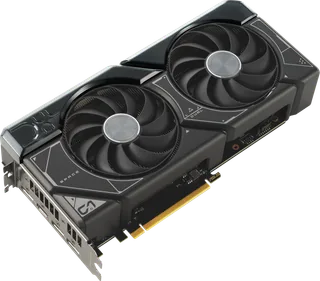
| Architecture | AMD reference specification; 72 compute units and 26.8 billion transistors | AD104 GPU; 46 SMs. NVIDIA reference specifications; photo illustrates an ASUS DUAL partner cooler without establishing its memory type or factory overclock. |
| Manufacturing process | 7 nm | TSMC 4N NVIDIA custom process; 35.8 billion transistors; 294.5 mm² die |
| Ray tracing | 72 Ray Accelerators; DirectX Raytracing support | 46 third-generation RT Cores; 67 RT TFLOPS |
| AI cores | – | 184 fourth-generation Tensor Cores; 466 AI TOPS |
| Upscaling and frame generation | AMD FidelityFX Super Resolution (FSR); AMD Radeon Super Resolution | DLSS 3.5 with Super Resolution, DLAA, Ray Reconstruction and Frame Generation |
| Base clock | 2015 MHz game frequency; up to 2250 MHz boost, which AMD defines for bursty workloads rather than sustained gaming | 1.92 GHz; stock PNY and Gainward cards confirm 2,475 MHz boost, while NVIDIA rounds it to 2.48 GHz |
| Cache | 128 MB AMD Infinity Cache | 36 MB L2 |
| Memory | ||
| Video memory | 16 GB GDDR6 (better) | 12 GB GDDR6X or 12 GB GDDR6 |
| Memory bus | 256-bit (better) | 192-bit |
| Memory bandwidth | 512 GB/s | 504 GB/s or 480 GB/s |
| Memory detail | Up to 16 Gbps GDDR6; 512 GB/s physical memory bandwidth | GDDR6X at 21 Gbps and 504 GB/s (stock PNY); later GDDR6 at 20 Gbps and 480 GB/s (stock Gainward). Both have 12 GB on a 192-bit bus |
| Connections and power | ||
| Board power | 300 W | 200 W (better) |
| Interface | PCIe 4.0 | PCIe 4.0 |
| Display outputs | DisplayPort 1.4a, HDMI 2.1 with VRR and FRL, and USB-C (AMD reference) | 3 × DisplayPort 1.4a, 1 × HDMI 2.1a; up to 4 displays; HDCP 2.3 |
| Maximum resolution | – | 4K at 240 Hz or 8K at 60 Hz with DSC, HDR |
| Power connector | 2 × PCIe 8-pin | 1 × 300 W or greater PCIe Gen 5 cable, or 2 × PCIe 8-pin cables with the adapter in the box; some partner cards use 1 × 8-pin |
| Recommended power supply | 750 W | 650 W |
| Slot width | 2.5-slot (AMD reference) | 2-slot (original GDDR6X Founders Edition) |
| Size (reference card) | 267 mm long (AMD reference); no reference width or height verified | 244 × 112 mm, 2-slot (original GDDR6X Founders Edition) |
| Video encode and decode | Hardware AV1 decoding; H.264 and H.265/HEVC encode and decode | 1 × eighth-generation NVENC, 1 × fifth-generation NVDEC; AV1 encode and decode |

More comparisons
- NVIDIA GeForce RTX 4070 vs NVIDIA GeForce RTX 5050
- AMD Radeon RX 6800 XT vs AMD Radeon RX 9060 XT
- AMD Radeon RX 6800 XT vs AMD Radeon RX 9060 XT (8GB)
- NVIDIA GeForce RTX 4070 vs NVIDIA GeForce RTX 5060
- NVIDIA GeForce RTX 4070 vs NVIDIA GeForce RTX 5060 Ti
- AMD Radeon RX 6800 XT vs AMD Radeon RX 9070
- AMD Radeon RX 6800 XT vs AMD Radeon RX 9070 XT
- NVIDIA GeForce RTX 4070 vs NVIDIA GeForce RTX 5070
- NVIDIA GeForce RTX 4070 vs NVIDIA GeForce RTX 5070 Ti
- NVIDIA GeForce RTX 4070 vs NVIDIA GeForce RTX 5080
- NVIDIA GeForce RTX 4070 vs NVIDIA GeForce RTX 5090
- NVIDIA GeForce RTX 4070 vs NVIDIA GeForce RTX 4080 SUPER
- NVIDIA GeForce RTX 4070 vs NVIDIA GeForce RTX 4070 SUPER
- AMD Radeon RX 6800 XT vs AMD Radeon RX 7800 XT
- AMD Radeon RX 7700 XT vs NVIDIA GeForce RTX 4070
- AMD Radeon RX 6800 XT vs AMD Radeon RX 7700 XT