Apple Watch (1st generation) vs Garmin Forerunner 920XT
Better figure, where one is clearly better
| AppleWatch (1st generation) | GarminForerunner 920XT | |
|---|---|---|
| Overview | ||
| Released | April 2015 | October 2014 |
| Display | ||
| Case sizes | 38 mm or 42 mm | 48 mm |
| Panel | OLED | Memory-in-pixel |
| Always-on display | No | Yes |
| Display detail | Retina display with Force Touch; OLED panel, 272 x 340 pixels on 38mm or 312 x 390 pixels on 42mm (iFixit) | 1.1 x 0.8-inch (29 x 21 mm) rectangular colour MIP display, 205 x 148 pixels, with button controls. |
| Screen protection | Ion-X glass on Sport; sapphire crystal on stainless steel, Hermès and Edition | – |
| Health and fitness | ||
| ECG | No | No |
| Blood oxygen | No | No |
| Skin temperature | No | No |
| Sleep apnoea alerts | No | No |
| High blood pressure alerts | No | No |
| Body composition | No | No |
| Fall detection | No | No |
| Crash detection | No | No |
| GPS | None | Single-band |
| Water resistance | – | 50 m |
| Sensors | Optical heart-rate sensor, accelerometer, gyroscope and ambient light sensor; Digital Crown, Taptic Engine, speaker and microphone | GPS, GLONASS, barometric altimeter and accelerometer. Heart rate requires an optional ANT+ sensor. |
| Health features | Heart-rate monitoring and Activity rings | Steps, distance, calories and sleep tracking; no wrist optical heart-rate sensor. |
| Fitness features | Workout tracking; route and distance measurements use the paired iPhone's GPS (TechRadar) | Running, cycling, pool and open-water swimming, and multisport activities; swim stroke and SWOLF metrics, race predictor and VO2 max with an external heart-rate sensor. Running dynamics require an HRM-Run strap. |
| Battery and connections | ||
| Battery life (maker's claim) | Up to 18 hours | Up to 24 hours |
| Mobile data option | No | No |
| Works with | iPhone | iPhone and Android |
| Chip | S1 | – |
| Storage | 8 GB | – |
| Battery life detail | Rechargeable battery; maker's up-to-18-hour rating varies with use and configuration | Up to 24 hours using GPS alone, 20 hours with GPS and GLONASS or 40 hours in UltraTrac. Garmin's manual also says up to one month in watch mode with activity tracking and over four months in watch-only mode; the main battery figure uses the exact 24-hour GPS claim because a month has no fixed hour count. |
| Charging | Magnetic charging cable | Rechargeable lithium-ion battery with charging/data cradle. |
| Connectivity | Wi-Fi 802.11b/g/n at 2.4GHz; Bluetooth 4.0; Apple Pay; requires iPhone 5 or later | Bluetooth, ANT+ and Wi-Fi; smart notifications, Garmin Connect automatic uploads, LiveTrack through a paired phone and VIRB camera control. Connect IQ support arrived in a later software update. |
| Storage | 8 GB onboard storage and S1 system-in-package identified by iFixit | Stores 100 hours of activity history and up to 100 waypoints. |
| Design | ||
| Weight (lightest version) | 25 g (better) | 61 g |
| Software | watchOS | Garmin |
| Case materials | Anodised aluminium with composite back (Sport), stainless steel with ceramic back (including Hermès), or 18-carat yellow/rose gold with ceramic back (Edition); IPX7 splash and water resistance under IEC 60529, not for submersion | Hinged band and 5 ATM water rating. |
| Size | 38mm case is 38.6 x 33.3 x 10.5 mm; 42mm is 42.0 x 35.9 x 10.5 mm. Case weights are 25/30 g (Sport), 40/50 g (stainless steel), 55/69 g (yellow-gold Edition) or 54/67 g (rose-gold Edition), for 38/42mm respectively | 48 x 55 x 12.7 mm; 61 g. |
| Bands | Sport Band, leather straps, Link Bracelet and Milanese Loop; Hermès Single Tour, Double Tour and Cuff joined the range in 2015 | – |
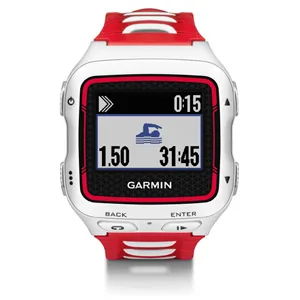
| Colours | Sport in Silver, Space Grey, Gold or Rose Gold; stainless steel in polished steel or Space Black; Edition in yellow or rose gold | White case with red band. |
| In the box | Watch, band, 2 m magnetic charging cable, 5W USB power adapter and quick start guide; Edition also includes a magnetic charging case and Lightning to USB cable | – |

More comparisons
- Apple Watch (1st generation) vs Apple Watch Series 12
- Apple Watch (1st generation) vs Apple Watch Ultra 4
- Garmin Forerunner 170 vs Garmin Forerunner 920XT
- Garmin Forerunner 170 Music vs Garmin Forerunner 920XT
- Garmin Forerunner 70 vs Garmin Forerunner 920XT
- Apple Watch (1st generation) vs Apple Watch SE 3
- Apple Watch (1st generation) vs Apple Watch Series 11
- Apple Watch (1st generation) vs Apple Watch Ultra 3
- Garmin Forerunner 570 vs Garmin Forerunner 920XT
- Garmin Forerunner 920XT vs Garmin Forerunner 970
- Apple Watch (1st generation) vs Apple Watch Series 10
- Garmin Forerunner 165 vs Garmin Forerunner 920XT
- Garmin Forerunner 165 Music vs Garmin Forerunner 920XT
- Apple Watch (1st generation) vs Apple Watch Series 9
- Apple Watch (1st generation) vs Apple Watch Ultra 2
- Garmin Forerunner 265 vs Garmin Forerunner 920XT