Garmin Forerunner 170 vs Garmin Forerunner 920XT
Better figure, where one is clearly better
| GarminForerunner 170 | GarminForerunner 920XT | |
|---|---|---|
| Overview | ||
| Released | May 2026 | October 2014 |
| Display | ||
| Case sizes | 42.6 mm | 48 mm |
| Panel | OLED | Memory-in-pixel |
| Always-on display | Yes | Yes |
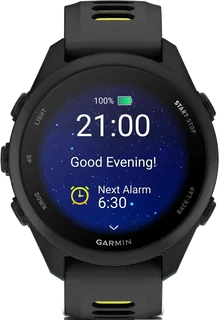
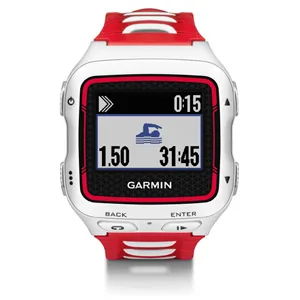
| Display detail | 1.2-inch (30.4 mm diameter) colour AMOLED touchscreen, 390 x 390 pixels; optional always-on display and large-font setting; five physical buttons | 1.1 x 0.8-inch (29 x 21 mm) rectangular colour MIP display, 205 x 148 pixels, with button controls. |
| Screen protection | Chemically strengthened glass | – |
| Health and fitness | ||
| ECG | No | No |
| Blood oxygen | Yes | No |
| Skin temperature | No | No |
| Sleep apnoea alerts | No | No |
| High blood pressure alerts | No | No |
| Body composition | No | No |
| Fall detection | No | No |
| Crash detection | No | No |
| GPS | Single-band | Single-band |
| Water resistance | 50 m | 50 m |
| Sensors | Garmin Elevate wrist heart rate; Pulse Ox; barometric altimeter; compass; gyroscope; accelerometer; thermometer; ambient light sensor; thermometer measures activity/ambient temperature, not overnight skin temperature | GPS, GLONASS, barometric altimeter and accelerometer. Heart rate requires an optional ANT+ sensor. |
| Health features | Continuous heart rate with high/low alerts; HRV status; Body Battery; stress and respiration; advanced sleep, sleep coach, breathing variations and nap detection; smart wake alarm; Health Snapshot; lifestyle logging; Health Status; women's health tracking via Garmin Connect; no ECG app | Steps, distance, calories and sleep tracking; no wrist optical heart-rate sensor. |
| Fitness features | More than 80 sports apps; training readiness, status, load, load focus and recovery time; Garmin running, cycling and strength coaching; daily suggested running workouts and quick workouts; wrist-based running dynamics and running power; ground-contact balance requires a compatible accessory; PacePro and grade-adjusted pace; VO2 max and race predictions; cycling power-meter and Varia radar/light support; pool and open-water swimming; no dedicated triathlon mode; Breadcrumb course navigation, point-to-point navigation, back-to-start and TracBack; elevation profile, future elevation plot and Up Ahead; no full routable offline maps | Running, cycling, pool and open-water swimming, and multisport activities; swim stroke and SWOLF metrics, race predictor and VO2 max with an external heart-rate sensor. Running dynamics require an HRM-Run strap. |
| Safety features | Incident detection during selected activities, assistance and LiveTrack require a paired compatible smartphone; live event sharing is Android-only; screen flashlight, not a separate LED torch | – |
| Battery and connections | ||
| Battery life (maker's claim) | Up to 10 days | Up to 24 hours |
| In low-power mode | Up to 19 days | – |
| Mobile data option | No | No |
| Works with | iPhone and Android | iPhone and Android |
| Storage | 4 GB | – |
| Battery life detail | Smartwatch up to 10 days, or 4 days with display always on; battery saver smartwatch up to 19 days; GPS-only GNSS up to 20 hours; all-systems GNSS up to 14 hours; actual life depends on enabled features and usage | Up to 24 hours using GPS alone, 20 hours with GPS and GLONASS or 40 hours in UltraTrac. Garmin's manual also says up to one month in watch mode with activity tracking and over four months in watch-only mode; the main battery figure uses the exact 24-hour GPS claim because a month has no fixed hour count. |
| Charging | Garmin proprietary plug charging/data cable; rechargeable built-in lithium-ion battery; USB charging temperature 0–45 °C | Rechargeable lithium-ion battery with charging/data cradle. |
| Connectivity | Bluetooth and ANT+; GPS, GLONASS and Galileo; no multi-band GNSS; Garmin Pay contactless payments; Android-only text responses and notification images; Connect IQ apps/watch faces/data fields; Garmin Share; controls smartphone music without offline playback; no Wi-Fi, speaker/microphone calls or cellular connection | Bluetooth, ANT+ and Wi-Fi; smart notifications, Garmin Connect automatic uploads, LiveTrack through a paired phone and VIRB camera control. Connect IQ support arrived in a later software update. |
| Storage | 4 GB memory/history; standard Forerunner 170 does not support offline music playback | Stores 100 hours of activity history and up to 100 waypoints. |
| Design | ||
| Weight (lightest version) | 41 g (better) | 61 g |
| Software | Garmin | Garmin |
| Case materials | Fibre-reinforced polymer bezel; silicone band; chemically strengthened glass; 5 ATM water rating; operating/storage temperature –20–60 °C | Hinged band and 5 ATM water rating. |
| Size | 42.6 x 42.6 x 11.9 mm; Garmin lists 41 g without a separate body-only weight | 48 x 55 x 12.7 mm; 61 g. |
| Bands | Standard 20 mm quick-release two-tone silicone band; fits 126–203 mm wrists | – |
| Colours | Black with Black/Amp Yellow band; Whitestone with Whitestone/Cloud Blue band; Teal Green and Red Pink belong to the separate Music model | White case with red band. |
| In the box | Forerunner 170; charging cable; documentation | – |
More comparisons
- Fitbit Edge vs Garmin Forerunner 170
- Garmin Forerunner 170 vs Garmin Forerunner 170 Music
- Garmin Approach J1 vs Garmin Forerunner 170
- Garmin Forerunner 170 vs Garmin Forerunner 70
- Garmin Forerunner 170 vs Garmin Forerunner 570
- Garmin Forerunner 170 vs Garmin Forerunner 970
- Garmin Forerunner 165 vs Garmin Forerunner 170
- Garmin Forerunner 165 Music vs Garmin Forerunner 170
- Garmin Forerunner 170 vs Garmin Forerunner 265
- Garmin Forerunner 170 vs Garmin Forerunner 965
- Garmin Forerunner 170 vs Garmin Forerunner 255
- Garmin Forerunner 170 vs Garmin Forerunner 955
- Garmin Forerunner 170 vs Garmin Forerunner 55
- Garmin Forerunner 170 vs Garmin Forerunner 745
- Garmin Forerunner 170 vs Garmin Forerunner 45
- Garmin Forerunner 170 vs Garmin Forerunner 45S