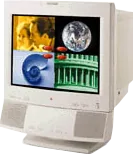
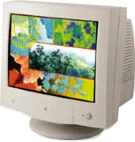
Apple AppleVision 1710AV vs Apple Multiple Scan 720 Display
Better figure, where one is clearly better
| AppleAppleVision 1710AV | AppleMultiple Scan 720 Display | |
|---|---|---|
| Overview | ||
| Released | August 1995 | 1997 |
| Display | ||
| Screen size | 16.1″ | 16″ |
| Panel | CRT (Nominal 17-inch Trinitron CRT, 16.1-inch viewable image, 0.26 mm stripe pitch; no fixed native pixel matrix) | CRT (Nominal 17-inch flat-square shadow-mask CRT with 16-inch viewable image and 0.28 mm dot pitch; no fixed native pixel matrix) |
| Colour modes | DigitalColor feedback and automatic calibration against factory measurements, with ambient-light and phosphor-age compensation; ColorSync 2.0 support. Selectable colour temperature 4100–9300 K in Apple's Japanese specification. | – |
| Supported signal modes | Apple lists 640 × 480 at 60 or 66.67 Hz; 800 × 600 at 60.31 or 75 Hz; 832 × 624 at 74.55 Hz; 1024 × 768 at 60 or 74.93 Hz; 1152 × 870 at 75 Hz; and 1280 × 1024 at 60 or 75.03 Hz. Horizontal scan range 30–80 kHz and vertical range 50–120 Hz. Supported signal modes depend on the computer/video card, not a native matrix or native refresh rate. | Apple's support sheet lists 640 × 480 at 60, 66.7 or 85 Hz; 800 × 600 at 60 or 85 Hz; 832 × 624 at 75 Hz; 1024 × 768 at 60 or 75 Hz; 1152 × 870 at 70 Hz; and 1280 × 1024 at 60 Hz. Service Source additionally lists 800 × 600 at 72 Hz, 1024 × 768 at 70 or 85 Hz, and 1152 × 870 at 75 Hz rather than the support sheet's 70 Hz. Maker timing conflict retained. Horizontal range 30–70 kHz and vertical range 48–160 Hz in Service Source are scan ranges, not a native refresh rate. |
| Screen coating | Antiglare and antistatic treatment | Antiglare and antistatic surface treatment |
| Connections | ||
| Video inputs | DA-15 | DA-15 |
| USB-C charging | None | None |
| Speakers | Yes | – |
| Other connections | Macintosh 15-pin DA-15 analogue RGB connector, supplied PC VGA adaptor, ADB input and two pass-through device connections. Front headphone output mutes the internal speakers; audio input/output and microphone connections are described in Service Source. No second independent video input inferred from secondary wording. | Macintosh 15-pin DA-15 analogue RGB video cable with separate sync; Windows and MS-DOS VGA computers require an adaptor |
| Speaker detail | Built-in bass-reflex stereo speakers and directional microphone. Service Source states 70 Hz–20 kHz ±6 dB audio response and 92 dB SPL at 1 kHz, measured at 0.5 m; these are maker audio claims, not reviewer measurements. | – |
| Design | ||
| Stand adjusts | Tilt, swivel | Tilt, swivel |
| Weight with stand | 27 kg | 17 kg |
| Size with stand | Service Source and October 1995 Apple Facts give 507 × 405 × 452 mm (height × width × depth); Apple's Japanese specification instead gives 507 × 410 × 484 mm, retained as a regional source difference | Maker support gives 17 × 16.2 × 16.9 inches (height × width × depth); Service Source also gives 431 × 412 × 428.5 mm |
| Weight detail | Service Source and Apple Facts publish 27 kg (60 lb); Japanese specification approximately 27 kg | Service Source publishes 17 kg (37.5 lb) |
| Controls | Power, brightness, contrast, geometry, convergence, colour temperature, bass, treble, volume, microphone on/off and speaker mute. AppleVision Macintosh software provides screen controls; PC operation uses on-screen controls. Automatic power-on degauss. | Front power, brightness, contrast, on-screen display select/adjust and enter controls for geometry adjustments |
| Power and support | ||
| Power use | Service Source and English support archive state 130 W maximum; Japanese specification instead gives 150 W operating maximum, 11 W or less standby and 0 W energy-saving mode | Maximum 120 W |
| Power supply | Service Source and Japanese specification 100–240 V AC, 50–60 Hz; English archive instead lists 100–120/220–240 V bands. Mains frequency is not screen refresh. | Service Source specifies 100–120 or 220–240 V AC, 50–60 Hz; later Apple support lists 90–134 or 198–260 V, 47–63 Hz. Source difference retained; mains frequencies are not display refresh rates. |
| Software | System 7.1 or later. Contemporary 7 August 1995 TidBITS reports Apple announcing availability; Apple's later English support archive dates introduction 8 August 1995. August retail month retained rather than inferring an exact day. Japanese regional dimensions and power differ from Service Source; figures remain qualified. Brightness and contrast ratio are unpublished. | Mac OS 7.5 or later, Power Macintosh, Performa and Quadra with 68040 or later processor; Windows and MS-DOS VGA systems with adaptor. Maker support lists introduction on 8 October 1997, while TidBITS on 10 November 1997 describes that day's announcement and EveryMac flags the conflict. First retail month is not established, so year precision is retained. Maker brightness and contrast ratio are unpublished. |
| Certifications | EPA Energy Star, VESA DPMS and MPR-2; additional regional approvals listed in Apple's Japanese specification | TCO 95 and US EPA Energy Star |
More comparisons
- Apple Multiple Scan 720 Display vs Apple Studio Display (2026)
- Apple Multiple Scan 720 Display vs Apple Studio Display XDR
- Apple AppleVision 1710AV vs Apple Studio Display (2026)
- Apple AppleVision 1710AV vs Apple Studio Display XDR
- Apple AppleVision 1710AV vs Apple Studio Display (17-inch CRT ADC, 2000)
- Apple Multiple Scan 720 Display vs Apple Studio Display (17-inch CRT, 1999)
- Apple AppleVision 1710AV vs Apple Studio Display (17-inch CRT, 1999)
- Apple AppleVision 1710AV vs Apple AppleVision 750 Display
- Apple AppleVision 750 Display vs Apple Multiple Scan 720 Display
- Apple AppleVision 1710AV vs Apple AppleVision 850
- Apple AppleVision 1710AV vs Apple AppleVision 850AV
- Apple Multiple Scan 17 Display vs Apple Multiple Scan 720 Display
- Apple Multiple Scan 14 Display vs Apple Multiple Scan 720 Display
- Apple Multiple Scan 1705 Display vs Apple Multiple Scan 720 Display
- Apple Multiple Scan 15 Display vs Apple Multiple Scan 720 Display
- Apple Multiple Scan 20 Display vs Apple Multiple Scan 720 Display