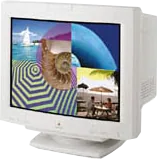
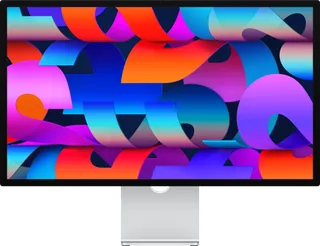
Apple AppleVision 850 vs Apple Studio Display (2026)
Better figure, where one is clearly better
| AppleAppleVision 850 | AppleStudio Display (2026) | |
|---|---|---|
| Overview | ||
| Released | May 1997 | March 2026 |
| Display | ||
| Screen size | 19″ | 27″ |
| Resolution | – | 5120 × 2880 (5K) |
| Sharpness | – | 218 pixels per inch |
| Panel | CRT (Nominal 20-inch Trinitron CRT, 19-inch viewable image, 0.26 mm stripe pitch and 0.25 mm grille pitch per Service Source; no fixed native pixel matrix) | IPS (5K Retina) |
| Refresh rate | – | 60 Hz |
| Brightness (typical) | – | 600 nits |
| Colour range | – | Wide colour (P3) |
| Screen finish | – | Glossy |
| Shape | – | Flat |
| Colour depth | – | 1 billion colours |
| Colour modes | DigitalColor calibration to original factory measurements, with ambient-light and phosphor-age adjustments; ColorSync support for screen-to-print matching. Brochure white-point selection 4100–9300 K and gamma controls. | Apple Display (P3-600 nits), HDTV Video (BT.709–BT.1886), NTSC Video (BT.601 SMPTE-C), PAL and SECAM Video (BT.601 EBU), Digital Cinema (P3-DCI), Digital Cinema (P3-D65), Design and Print (P3-D50), Photography (P3-D65), Internet and Web (sRGB) |
| Supported signal modes | Service Source lists 640 × 480 at 60, 67, 72, 75 or 85 Hz; 800 × 600 at 56, 60, 72, 75 or 85 Hz; 832 × 624 at 75 Hz; 1024 × 768 at 60, 70, 75 or 85 Hz, plus 87 Hz interlaced; 1152 × 870 at 75 Hz; 1280 × 1024 at 75 or 85 Hz; and 1600 × 1200 at 75 Hz. Horizontal scan range 30–94 kHz and vertical range 48–120 Hz. These are supported CRT signal modes, not native resolution or native refresh. November 1997 brochure instead prints 55 Hz for the two lowest modes; Service Source's detailed timing tables are retained. | – |
| Screen coating | Multilayer antireflection panel and antistatic coating | – |
| Connections | ||
| Video inputs | DA-15 | Thunderbolt 5 |
| USB-C charging | None | Up to 96 W (better) |
| USB ports | – | Thunderbolt 5, 2 × USB-C |
| Ethernet | – | No |
| Speakers | No | Yes |
| Webcam | – | 12MP Center Stage with Desk View |
| USB-C detail | – | Upstream Thunderbolt 5 (up to 120 Gb/s) with 96 W host charging |
| Daisy chaining | – | Downstream Thunderbolt 5 port daisy-chains more displays; up to four Studio Display models with a MacBook Pro with M5 Max |
| USB hub detail | – | 1 × Thunderbolt 5 downstream (up to 120 Gb/s), 2 × USB-C (up to 10 Gb/s) for peripherals, storage and networking |
| Speaker detail | – | Six speakers with force-cancelling woofers; wide stereo; Spatial Audio with Dolby Atmos |
| Webcam detail | – | Three-mic array with directional beamforming; camera features and firmware updates need a Mac |
| Other connections | Captive Macintosh DA-15 analogue RGB video cable with integrated ADB connection; supplied PC VGA adaptor. Two ADB pass-through output ports. Non-AV 850 has neither integrated speakers nor microphone; AV connections and audio specifications are not copied. | – |
| Design | ||
| Stand adjusts | Tilt, swivel (better) | Tilt |
| VESA mount | – | Yes |
| Weight with stand | 30 kg | 6.3 kg |
| Height adjustment | – | 105 mm with the optional tilt- and height-adjustable stand |
| Tilt | −5° to +15° | −5° to +25° |
| Pivot | – | Landscape only on either stand; portrait with the VESA mount adapter |
| VESA pattern | – | 100 × 100 mm (VESA mount adapter option) |
| Swivel | At least ±45° | – |
| Size with stand | Service Source gives 474 × 484 × 515 mm, each ±3 mm (height × width × depth); November 1997 brochure gives 47.5 × 48.5 × 51.5 cm | Tilt stand 62.3 × 16.8 × 47.8 cm; tilt- and height-adjustable stand 62.3 × 20.7 × 47.9–58.3 cm and 7.6 kg (W × D × H) |
| Size without stand | – | 62.3 × 3.1 × 36.2 cm with VESA mount adapter (W × D × H) |
| Weight without stand | – | 5.4 kg with VESA mount adapter |
| Weight detail | Service Source publishes 30 kg (67 lb); November 1997 maker brochure instead gives 30.6 kg (67.4 lb), distinct from 35.7 kg fully boxed. Main field retains Service Source's monitor weight. | – |
| Controls | Front power, brightness, contrast and five buttons for on-screen controls. Additional geometry, colour and gamma controls through Mac Monitors & Sound control panel or Windows on-screen controls; automatic power-on degauss. | – |
| Power and support | ||
| Power use | Service Source and November 1997 maker brochure 150 W maximum; brochure less than 30 W standby and less than 5 W suspend/CPU energy-saving. EveryMac's secondary 180 W figure is not substituted. | – |
| Power supply | 90–264 V AC, 47–63 Hz; these mains ratings are not screen refresh rates | 100–240 V AC, 50–60 Hz, single phase |
| Software | System 7.1 or later and 68040 or later Macintosh processors for AppleVision software; Windows 95 compatibility with supplied adaptor. Maker 5 May 1997 press release says non-AV850 available immediately worldwide while 850AV was expected in June; no AV date substituted. Service Source explicitly describes the November 1997 ColorSync Display rename as the only product change at that point; no duplicate renamed model or unsupported successor link. Brightness and contrast ratio are unpublished. | Needs an Apple silicon Mac with macOS Tahoe 26.3.1 or later, or an iPad with iPadOS 26.3.1 or later |
| Certifications | Original TCO 92, MPR II, EPA Energy Star and VESA DPMS. Service Source identifies later TCO 95 replacement plastics from January 1998 only for non-AV ColorSync units carrying the rear TCO 95 mark. | ENERGY STAR |
| Warranty | – | 1-year limited warranty and 90 days of complimentary technical support from Apple |
| In the box | – | Studio Display, Thunderbolt 5 Pro cable (1 m) |
More comparisons
- Apple Studio Display (2026) vs Samsung ViewFinity S8 (S80HF)
- Apple Multiple Scan 1705 Display vs Apple Studio Display (2026)
- Apple AppleVision 750 Display vs Apple Studio Display (2026)
- Apple AppleColor High-Resolution RGB Monitor vs Apple Studio Display (2026)
- Apple Macintosh Portrait Display vs Apple Studio Display (2026)
- Apple Apple Color Plus 14-inch Display vs Apple Studio Display (2026)
- Apple AppleVision 850 vs Apple Studio Display XDR
- Apple AppleVision 850AV vs Apple Studio Display (2026)
- Apple Multiple Scan 15 Display vs Apple Studio Display (2026)
- Apple Multiple Scan 17 Display vs Apple Studio Display (2026)
- Apple Multiple Scan 20 Display vs Apple Studio Display (2026)
- Apple Multiple Scan 720 Display vs Apple Studio Display (2026)
- Apple AppleVision 1710AV vs Apple Studio Display (2026)
- Apple Studio Display (17-inch LCD, 2001) vs Apple Studio Display (2026)
- Apple Studio Display (17-inch CRT, 1999) vs Apple Studio Display (2026)
- Apple Studio Display (2026) vs Apple Studio Display (21-inch CRT, 1999)