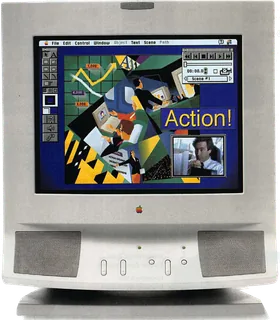
Apple Apple AudioVision 14 Display vs Apple Macintosh Portrait Display
Better figure, where one is clearly better
| AppleApple AudioVision 14 Display | AppleMacintosh Portrait Display | |
|---|---|---|
| Overview | ||
| Released | 1993 | 1989 |
| Display | ||
| Screen size | 13″ | 14.2″ |
| Panel | CRT (Nominal 14-inch Trinitron tube with 13-inch viewable diagonal and 0.26 mm aperture-grille stripe pitch. Analogue CRT has no fixed native pixel matrix.) | CRT (Nominal 15-inch monochrome CRT; Apple support gives 14.2-inch viewable diagonal and calls the tube shadow mask, while Service Source describes white P4 phosphor and a flat square screen. No fixed native pixel matrix.) |
| Colour depth | – | Service Source supports 1-, 2-, 4- or 8-bit analogue levels, with up to 256 greys at 8 bits per pixel; actual grey levels depend on video hardware. The original March 1989 launch notice lists lower video-card configurations and is not treated as a later display limit. |
| Pixel pitch | 0.26 mm aperture-grille stripe pitch | – |
| Supported signal modes | Apple specifies a 640 × 480 analogue signal at 66.7 Hz vertical and 35 kHz horizontal scan. Factory-adjusted active video area is 235 × 176 mm. These signal figures are not a fixed native pixel matrix or native panel refresh. | Supported 640 horizontal × 870 vertical analogue image at 75 Hz, 68.85 kHz horizontal scan and 80 dpi per maker documents; not a native fixed matrix. Owner guide specifies 57.2832 MHz dot clock, whereas Service Source gives 52 MHz. Factory active area 203.2 × 276.1 mm in owner guide (203 × 276 mm in Service Source). |
| Screen coating | – | Maker's high-contrast, antiglare, flat square screen with white phosphor |
| Connections | ||
| Video inputs | – | 13W3 |
| USB-C charging | None | None |
| Speakers | Yes | No |
| Other connections | Integrated high-density monitor cable carries RGB video, audio and Apple Desktop Bus signals. AudioVision Adapter Kit M1243LL/A breaks it out for Macintosh computers with separate connectors; Apple required this adapter for all modular Macintosh models available on 1 August 1993. Two ADB ports and a stereo line/microphone input are on the display. The S-Video socket was reserved for future use; Apple later corrected the owner guide and confirms that pass-through through the monitor is unsupported, including with Quadra 660AV/840AV and Power Macintosh AV. Use the computer AV card input instead. No native DA-15 socket is inferred from the optional adapter. | Physical 13W3 video socket, identified by EveryMac's exact-model cable specification and Low End Mac; owner's guide shows three coaxial and ten signal positions with separate negative-going TTL sync. Compatible Macintosh video card or an appropriate cable is required; the socket itself is not DA-15 or VGA. Three ADB sockets allow one computer uplink and two remaining peripheral connections; no integrated audio. |
| Audio out | Stereo headphone/external-speaker output. AudioVision software selects headphone or external-speaker behaviour. | – |
| Speaker detail | Two full-range speakers in a tuned-port bass-reflex chamber; maker frequency response is 100 Hz–15 kHz ±3 dB. TIL12724 calls 90 dB SPL at 1 kHz at 0.5 m maximum loudness, while Service Source calls it minimum loudness; the conflicting condition is retained rather than presented as a measured output. | – |
| Webcam detail | No integrated camera. Directional microphone above the display is intended for voice and speech-recognition applications. Software and compatible computer hardware provide those functions. | – |
| Design | ||
| Weight with stand | – | 16 kg |
| Tilt | – | Apple Universal Monitor Stand provides adjustable viewing angle but is optional, not included |
| Size without stand | – | Service Source gives 332 × 292 × 379 mm (height × width × depth); Apple support gives 13.1 × 11.5 × 14.9 inches. Optional stand dimensions not substituted. |
| Stand adjusts | Tilt, swivel | – |
| Size with stand | Current Apple support gives 15.2 × 13.4 × 16.6 inches (height × width × depth); original TIL12724 also gives 38.5 × 34 × 42 cm. Service Source instead gives 330 × 344 × 394 mm; no undocumented enclosure revision or stand-exclusion explanation is assumed. | – |
| Weight detail | Current Apple support gives 25 lb; original TIL12724 and Service Source instead give 33 lb (15 kg). Main weight is omitted because this exact-model maker conflict remains unresolved. | Owner guide and Service Source publish 16 kg (35 lb); no conversion inferred |
| Controls | Front brightness, contrast and volume controls, speaker mute and microphone control; rear on/off switch. AudioVision control panels offer software picture and sound settings. | Rear power switch; right-side brightness with centre detent and contrast controls. Maker specifies 20-minute warm-up to meet all specifications. |
| Power and support | ||
| Power use | 37 W normal operation and 55 W maximum (TIL12724); current Apple support agrees on 55 W maximum. Energy Saver operation requires a supported Macintosh and software configuration. | Maker 75 W maximum |
| Power supply | 100–240 V AC, 47–63 Hz in current support and TIL12724. Service Source instead gives 100–240 V AC ±10%, 50–60 Hz ±3%. These are mains ratings, not display refresh. | Domestic Service Source and owner guide specify self-configuring 90–270 V AC, 47–63 Hz; these are mains ratings, not display refresh rates |
| Software | AudioVision software requires System 7.0.1 or later. Version 1.0.2 Read Me qualifies Energy Saver support as Power Macintosh, Quadra, Centris or LC III, 2 MB available RAM and System 7.1 or later. Install AudioVision software after Apple Adjustable Keyboard software to preserve the monitor Sound control panel. The original Apple Microphone does not work in the external microphone input; Apple specifies the PlainTalk microphone. Apple support dates introduction 1 August 1993; September 1993 Apple Directions says the display is shipping, and the Fall 1993 catalogue offers overnight orders. Actual first-sale month remains unresolved, so release precision is year 1993. | Intended for compatible Macintosh video hardware. Service Source explicitly covers the domestic version; international Series B repair documentation is separate, so regional hardware is not silently combined. Apple support and contemporary TIL date introduction March 1989; April 1989 Mini'app'les launch coverage explicitly says Portrait Display M0404 available in May 1989. Actual first retail month remains unconfirmed, so year 1989 is retained. Optional stand, unpublished brightness and unknown direct successor are not inferred. |
| Certifications | Maker states SWEDAC MPR-2 low-frequency emissions compliance and EPA Energy Star operation with certain Macintosh models. | – |
| In the box | M5814LL/A display; B1247LL/A bundle lists display, high-density cable, AudioVision adapter cable, software installer, user guide and limited warranty. M1243LL/A adapter kit is also offered separately. No keyboard, mouse or computer is included. | – |
More comparisons
- Apple Macintosh Portrait Display vs Apple Studio Display (2026)
- Apple Macintosh Portrait Display vs Apple Studio Display XDR
- Apple Apple AudioVision 14 Display vs Apple Multiple Scan 14 Display
- Apple Apple AudioVision 14 Display vs Apple Multiple Scan 15 Display
- Apple Macintosh Portrait Display vs Apple Multiple Scan 15 Display
- Apple Apple Color Plus 14-inch Display vs Apple Macintosh Portrait Display
- Apple AppleColor High-Resolution RGB Monitor vs Apple Apple AudioVision 14 Display
- Apple Apple AudioVision 14 Display vs Apple Apple Color Plus 14-inch Display
- Apple AppleColor High-Resolution RGB Monitor vs Apple Macintosh Portrait Display