Apple Cinema HD Display (23-inch, DVI) vs Apple LED Cinema Display (27-inch)
Better figure, where one is clearly better
| AppleCinema HD Display (23-inch, DVI) | AppleLED Cinema Display (27-inch) | |
|---|---|---|
| Overview | ||
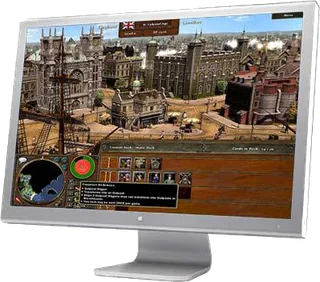
| Released | July 2004 | September 2010 |
| Display | ||
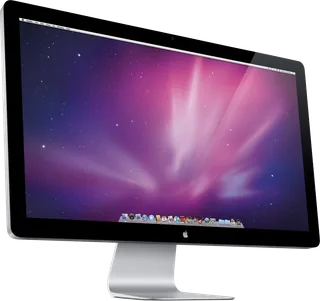
| Screen size | 23″ | 27″ |
| Resolution | 1920 × 1200 (WUXGA) | 2560 × 1440 (QHD) (better) |
| Sharpness | 98 pixels per inch | 109 pixels per inch (better) |
| Panel | IPS (TFT active-matrix LCD (Apple); S-IPS identification from PRAD’s exact aluminium 23-inch datasheet, which lists later panel specifications) | IPS |
| Refresh rate | 60 Hz | 60 Hz |
| Brightness (typical) | 270 nits | 375 nits (better) |
| Contrast ratio | 400:1 | 1,000:1 |
| Screen finish | Matte | Glossy |
| Shape | Flat | Flat |
| Colour depth | Up to 16.7 million colours; Apple does not specify panel bit depth | Up to 16.7 million colours; panel bit depth is not specified |
| Response time detail | Apple specifies typical 16 ms without identifying grey-to-grey transitions; not entered in the grey-to-grey row. Its later Japanese sheet lists 14 ms. | Typical 12 ms without a specified transition; omitted from the grey-to-grey row |
| Viewing angles | Original archived Apple specifications give 170° horizontally and vertically; a later Japanese sheet gives 178°. | 178° horizontally and vertically |
| Eye care | – | Ambient light sensor adjusts brightness automatically |
| Pixel pitch | 0.258 mm | – |
| Connections | ||
| Video inputs | DVI | Mini DisplayPort |
| USB-C charging | None | None |
| USB ports | 2 × USB-A | 3 × USB-A |
| Speakers | – | Yes |
| Webcam | – | iSight camera with microphone |
| DisplayPort detail | – | Captive Mini DisplayPort cable; audio support depends on the host Mac |
| Other connections | Captive DVI, USB 2.0, FireWire 400 and DC power cables; two downstream FireWire 400 ports and Kensington security slot | – |
| USB hub detail | Two-port self-powered USB 2.0 hub; upstream USB cable must connect to computer | Three powered USB 2.0 Type-A ports; upstream USB cable required for data, camera, microphone and speakers. Device charging works without a host connected. |
| Speaker detail | – | Built-in 2.1 system with 49 W output |
| Webcam detail | – | Built-in iSight; maker specifications do not publish a megapixel figure |
| Design | ||
| Stand adjusts | Tilt | Tilt |
| VESA mount | Yes | Yes |
| Weight with stand | 7.03 kg | 10.7 kg |
| VESA pattern | Optional Cinema Display VESA Mount Adapter Kit; VESA FDMI MIS-D 100 C | Requires the separately sold Apple VESA Mount Adapter Kit |
| Size with stand | 536 × 450 × 187 mm (width × height × depth), from Apple's archived technical specifications | Current UK specifications give 650 × 491 × 207 mm (width × height × depth). Original manual gives 651.7 × 488.1 × 208.13 mm; both give 10.7 kg. |
| Controls | Side power and brightness buttons; resolution and colour settings through Mac OS X Displays preferences | Brightness, colour profile and calibration through Mac OS X Displays preferences; no physical image controls (Macworld) |
| Colours | Aluminium enclosure | Aluminium enclosure with black glass bezel |
| Power and support | ||
| Power use | Maximum 90 W; energy saver mode 3 W or less | Maximum 250 W while charging a MacBook Pro; energy saver 1 W or less |
| Power supply | External A1097 90 W adaptor; 100–240 V AC, 50–60 Hz; 24.5 V DC output | Internal power supply; 100–240 V AC, 50–60 Hz |
| Laptop charging | – | Separate captive universal MagSafe connector supplies up to 85 W; no USB-C power delivery |
| Software | Apple's UK announcement specifies July 2004 availability. Original manual supports Mac OS X 10.2.8 or later on listed DVI Macs, with compatible DVI-equipped Windows PCs also possible. Original manual explicitly specifies 1920 × 1200 at 60 Hz. Main weight follows archived maker specs (7.03 kg); original manual gives 6.75 kg without explaining the discrepancy. | Original requirement Mac with Mini DisplayPort and Mac OS X 10.6.4 or later. July 2010 announcement specifies September availability. |
| Certifications | – | ENERGY STAR 5.0; EPEAT Gold in the US, Canada, France, Germany and UK |
| In the box | Display with captive connection cables, power adaptor, AC cord and cleaning cloth | Display, AC power cord and printed documentation |
More comparisons
- Apple Cinema HD Display (23-inch, DVI) vs Apple Studio Display (2026)
- Apple Cinema HD Display (23-inch, DVI) vs Apple Studio Display XDR
- Apple LED Cinema Display (27-inch) vs Apple Studio Display (2026)
- Apple LED Cinema Display (27-inch) vs Apple Studio Display XDR
- Apple Cinema HD Display (23-inch, DVI) vs Apple Studio Display (2022)
- Apple LED Cinema Display (27-inch) vs Apple Studio Display (2022)
- Apple LED Cinema Display (27-inch) vs Dell UltraSharp 27 Monitor (U2722D)
- Apple LED Cinema Display (27-inch) vs Dell UltraSharp 27 USB-C Hub Monitor (U2722DE)
- Apple LED Cinema Display (27-inch) vs Dell UltraSharp 27 USB-C Hub Monitor (U2721DE)
- Apple LED Cinema Display (27-inch) vs Dell UltraSharp 27 USB-C Monitor (U2719DC)
- Apple LED Cinema Display (27-inch) vs Dell UltraSharp U2719D
- Apple LED Cinema Display (27-inch) vs Dell UltraSharp U2717D
- Apple LED Cinema Display (27-inch) vs Dell UltraSharp 27 Monitor with PremierColor (UP2716D)
- Apple LED Cinema Display (27-inch) vs Dell UltraSharp U2715H
- Apple Cinema HD Display (23-inch, DVI) vs Dell UltraSharp U2414H
- Apple LED Cinema Display (27-inch) vs Dell UltraSharp U2713H