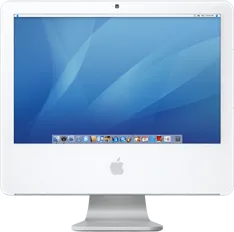
Apple iMac (17-inch, Mid 2006) vs Apple iMac 24″ (M3)
Better figure, where one is clearly better
| AppleiMac (17-inch, Mid 2006) | AppleiMac 24″ (M3) | |
|---|---|---|
| Overview | ||
| Released | July 2006 | November 2023 |
| Performance | ||
| Processor | Intel Core Duo T2400 | Apple M3 |
| CPU cores | 2 | 8 |
| Graphics | Intel GMA950 | 8-core GPU or 10-core GPU |
| Memory | 512 MB, 1 GB or 2 GB | 8 GB or 24 GB (better) |
| Storage | 80 GB to 160 GB | 256 GB to 2 TB (better) |
| CPU | 1.83 GHz Intel Core Duo; exact T2400 identity cross-checked with EveryMac. Existing chip record is reused; no sibling processor figures are borrowed. | 8-core CPU with 4 performance cores and 4 efficiency cores |
| GPU | Intel GMA950 integrated graphics, sharing system memory. | 8-core GPU (two-port model) or 10-core GPU (four-port models); hardware-accelerated ray tracing |
| AI engine | – | 16-core Neural Engine |
| Memory bandwidth | – | 100GB/s |
| Memory type | 667 MHz DDR2; 512 MB standard, configurable to 1 or 2 GB. The exact maker manual specifies matched pairs of 512 MB or 1 GB modules for the upgrades. | – |
| Storage type | 80 GB 7200 rpm Serial ATA hard drive, configurable to 160 GB; 24x Combo drive reads DVDs and reads/writes CDs, rather than burning DVDs. | SSD |
| Media engine | – | Hardware-accelerated H.264, HEVC, ProRes and ProRes RAW; video decode engine; video encode engine; ProRes encode and decode engine; AV1 decode |
| Display | ||
| Screen size | 17″ | 24″ |
| Resolution | 1440 × 900 | 4480 × 2520 (better) |
| Panel | – | IPS LCD |
| Refresh rate | – | 60 Hz |
| Brightness | 250 nits | 500 nits (better) |
| Display type | EveryMac specifies 1440 × 900 pixels, typical brightness 250 cd/m², contrast 500:1 and viewing angles of 140 degrees horizontal/120 degrees vertical. Exact model panel technology and refresh rate remain unpublished. | 4.5K Retina display; actual diagonal 23.5 inches |
| Pixel density | – | 218 ppi |
| Display features | – | 1 billion colours; wide colour (P3); True Tone |
| Connections | ||
| Ports | 3 × USB-A, Ethernet, headphone jack | 2 × USB4, headphone jack |
| External displays | – | Up to 1 |
| Ethernet | 1 Gb/s | – |
| Wi-Fi | 802.11g | Wi-Fi 6E |
| Bluetooth | – | 5.3 |
| Camera | iSight camera | 1080p FaceTime HD |
| Back ports | Three USB 2.0 ports on the computer, plus two on the keyboard; two FireWire 400 ports, Mini-DVI video output, Gigabit Ethernet and audio input/output. External-display resolution is omitted because the secondary figure explicitly refers to a different later model. | Two-port model: 2 × Thunderbolt / USB 4 with DisplayPort, Thunderbolt 3 (up to 40Gb/s), USB 4 (up to 40Gb/s) and USB 3.1 Gen 2 (up to 10Gb/s), Gigabit Ethernet optional; four-port models add 2 × USB 3 (up to 10Gb/s) and Gigabit Ethernet as standard; 3.5 mm headphone jack with advanced support for high-impedance headphones |
| External displays | – | One at up to 6K 60Hz |
| Camera | – | 1080p FaceTime HD camera; advanced image signal processor with computational video |
| Speakers | Built-in stereo speakers and microphone. | High-fidelity six-speaker system with force-cancelling woofers; wide stereo sound; Spatial Audio with Dolby Atmos |
| Microphones | – | Studio-quality three-mic array with high signal-to-noise ratio and directional beamforming |
| Keyboard and mouse | Apple Keyboard and Mighty Mouse; Apple Remote is optional. Macworld confirms Bluetooth is not included. | Magic Keyboard (two-port model) or Magic Keyboard with Touch ID (four-port models), and Magic Mouse; Magic Trackpad or Magic Keyboard with Touch ID and Numeric Keypad available instead |
| Design and power | ||
| Type | All-in-one | All-in-one |
| Weight | – | 4.43 kg |
| Width × depth × height | – | 547 × 147 × 461 mm |
| Operating system | macOS | macOS |
| Power supply | – | 143W external power adapter; power lead (2 m) |
| Colours | – | Two-port model: Blue, Green, Pink, Silver; four-port models also Yellow, Orange, Purple |
| In the box | Institution-only education configuration; Mac OS X Tiger 10.4.6 and iLife ’06. Later secondary OS version 10.4.7 does not replace the maker launch wording. | iMac, Magic Keyboard (with Touch ID on four-port models), Magic Mouse, 143W power adapter, power lead (2 m), USB-C to Lightning Cable |

More comparisons
- Apple iMac (17-inch, Mid 2006) vs Apple iMac 24″ (M4)
- Apple iMac 24″ (M3) vs Apple iMac 24″ (M4)
- Apple iMac 24″ (M3) vs HP OmniStudio X 31.5″ All-in-One
- Apple iMac 24″ (M1) vs Apple iMac 24″ (M3)
- Apple iMac 24″ (M3) vs Apple iMac (Retina 5K, 27-inch, 2020)
- Apple iMac 24″ (M3) vs Apple iMac (Retina 4K, 21.5-inch, 2019)
- Apple iMac 24″ (M3) vs Apple iMac (Retina 5K, 27-inch, 2019)
- Apple iMac 24″ (M3) vs Apple iMac Pro (2017)
- Apple iMac (21.5-inch, 2017) vs Apple iMac 24″ (M3)
- Apple iMac 24″ (M3) vs Apple iMac (Retina 4K, 21.5-inch, 2017)
- Apple iMac 24″ (M3) vs Apple Mac mini (M2 or M2 Pro)
- Apple iMac 24″ (M3) vs Apple iMac (Retina 5K, 27-inch, 2017)
- Apple iMac (21.5-inch, Late 2015) vs Apple iMac 24″ (M3)
- Apple iMac 24″ (M3) vs Apple iMac (Retina 4K, 21.5-inch, Late 2015)
- Apple iMac 24″ (M3) vs Apple iMac (Retina 5K, 27-inch, Late 2015)
- Apple iMac 24″ (M3) vs Apple iMac (Retina 5K, 27-inch, Mid 2015)