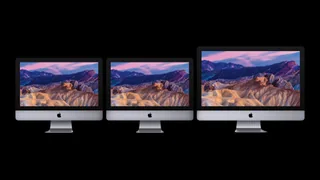
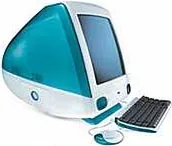
Apple iMac (21.5-inch, 2017) vs Apple iMac G3 (1998)
Better figure, where one is clearly better
| AppleiMac (21.5-inch, 2017) | AppleiMac G3 (1998) | |
|---|---|---|
| Overview | ||
| Released | June 2017 | August 1998 |
| Performance | ||
| Processor | Intel Core i5-7360U | PowerPC G3 233 MHz (iMac) |
| CPU cores | 2 | 1 |
| CPU threads | 4 | – |
| Graphics | Intel Iris Plus Graphics 640 | ATI RAGE IIc (2 MB) |
| Memory | 8 GB or 16 GB (better) | 32 MB or 128 MB |
| Storage | 256 GB to 1 TB (better) | 4 GB |
| CPU | 2.3 GHz dual-core Intel Core i5 with Turbo Boost up to 3.6 GHz; Geekbench identifies the exact processor as Core i5-7360U | 233 MHz PowerPC G3 processor with 66 MHz system bus and 512 KB backside L2 cache at 117 MHz. The exact silicon supplier is not established by the maker sheet; generic clock-only chip record. |
| GPU | Intel Iris Plus Graphics 640; no discrete graphics option | ATI RAGE IIc with 2 MB SGRAM standard; maker options increase video memory to 4 MB or 6 MB. Configurations retain the standard graphics allocation. |
| Memory type | 8 GB of 2133 MHz DDR4, configurable to 16 GB | 32 MB SDRAM standard in two SO-DIMM slots; original July 1998 Apple datasheet supports up to 128 MB. Do not substitute the Revision B maximum. |
| Storage type | 1 TB 5400-rpm hard drive, configurable to 1 TB Fusion Drive or 256 GB SSD | 4 GB IDE hard drive and tray-loading 24x CD-ROM drive. No floppy drive. |
| Display | ||
| Screen size | 21.5″ | 15″ |
| Resolution | 1920 × 1080 (better) | 1024 × 768 |
| Refresh rate | – | 75 Hz |
| Display type | 21.5-inch LED-backlit display; 1920 × 1080 with support for millions of colours. Apple does not identify the panel technology, native refresh rate or brightness in its specification sheet; Retina model display figures do not apply. | Nominal 15-inch shadow-mask CRT with 13.8-inch viewable diagonal and 0.28 mm dot pitch; it has no fixed LCD native resolution. |
| Display features | – | Maximum supported mode 1024 × 768 at 75 Hz; 800 × 600 at 95 Hz and 640 × 480 at 117 Hz. The scalar refresh rate describes the highest-resolution mode. |
| Connections | ||
| Ports | 2 × Thunderbolt 3, 4 × USB-A, SD card slot, Ethernet, headphone jack | 2 × USB-A, Ethernet, 2 × headphone jack |
| Ethernet | 1 Gb/s (better) | 0.1 Gb/s |
| External displays | Up to 2 | – |
| Wi-Fi | 802.11ac | – |
| Bluetooth | 4.2 | – |
| Camera | FaceTime HD | – |
| Back ports | Four USB-A ports, two Thunderbolt 3 (USB-C) ports, SDXC card slot, Gigabit Ethernet, 3.5 mm headphone jack and Kensington lock slot. Thunderbolt 3 supports DisplayPort, up to 40 Gb/s Thunderbolt and up to 10 Gb/s USB 3.1 Gen 2; Thunderbolt 2, HDMI, DVI and VGA require adapters. | Two 12 Mbps USB ports on the computer, 10/100BASE-T Ethernet, 56K V.90/K56flex modem, 4 Mbps IrDA, audio line-in and line-out, plus two front headphone jacks. No FireWire or external VGA output. |
| External displays | Built-in display at native resolution alongside one 5120 × 2880 display at 60 Hz with one billion colours, two 3840 × 2160 displays at 60 Hz with one billion colours, or two 4096 × 2304 displays at 60 Hz with millions of colours | – |
| Speakers | Stereo speakers; supports Apple iPhone headset with microphone | Built-in stereo speakers with SRS surround processing and built-in microphone. |
| Microphones | Built-in microphone | – |
| Keyboard and mouse | Magic Keyboard, Magic Mouse, Lightning to USB cable and polishing cloth; configurable with Magic Keyboard with Numeric Keypad or Magic Trackpad | Apple USB Keyboard and round Apple USB Mouse. |
| Design and power | ||
| Type | All-in-one | All-in-one |
| Weight | 5.44 kg | – |
| Width × depth × height | 528 × 175 × 450 mm | – |
| Operating system | macOS | macOS |
| Size and weight detail | Dimensions include the stand; weight varies by configuration and manufacturing process. A built-in VESA mount version was available. | Current retained maker sheet: height 15.8, width 15.2 and depth 17.6 inches, weight 40 pounds. Original Apple July 1998 datasheet instead gives height 39.5, width 38 and depth 44 cm, weight 17.3 kg (38.1 pounds). Conflicting main metric values are omitted. |
| Power supply | 100–240 V AC, 50–60 Hz, single phase | Retained maker sheet lists 80 W maximum continuous power; the original Apple datasheet lists 200 W. This conflict is retained rather than selecting a scalar rating. |
| Noise | Apple reports operator-position sound pressure of 11 dB at idle and during wireless web, and 12 dB during hard-drive seek, tested on the Core i5 with 8 GB memory and 1 TB hard drive | – |
| Materials | Aluminium enclosure; arsenic-free display glass; mercury-, BFR- and beryllium-free with regional exceptions for PVC-free power leads | – |
| In the box | iMac, Magic Keyboard, Magic Mouse, Lightning to USB cable, polishing cloth and power lead. Apple's current support page describes the later macOS Big Sur release. | Mac OS 8.1. First on sale 15 August 1998, corroborated by Apple’s contemporary retrospective release and retained introduction date. |
More comparisons
- Apple iMac (21.5-inch, 2017) vs Apple iMac 24″ (M4)
- Apple iMac (21.5-inch, 2017) vs Apple Mac mini (M4 or M4 Pro)
- Apple iMac 24″ (M4) vs Apple iMac G3 (1998)
- Apple iMac (21.5-inch, 2017) vs Apple iMac 24″ (M3)
- Apple iMac 24″ (M3) vs Apple iMac G3 (1998)
- Apple iMac (21.5-inch, 2017) vs Apple iMac 24″ (M1)
- Apple iMac 24″ (M1) vs Apple iMac G3 (1998)
- Apple iMac (21.5-inch, 2017) vs Apple iMac (Retina 5K, 27-inch, 2020)
- Apple iMac G3 (1998) vs Apple iMac (Retina 5K, 27-inch, 2020)
- Apple iMac (21.5-inch, 2017) vs Apple iMac (Retina 4K, 21.5-inch, 2019)
- Apple iMac (21.5-inch, 2017) vs Apple iMac (Retina 5K, 27-inch, 2019)
- Apple iMac G3 (1998) vs Apple iMac (Retina 4K, 21.5-inch, 2019)
- Apple iMac G3 (1998) vs Apple iMac (Retina 5K, 27-inch, 2019)
- Apple iMac (21.5-inch, 2017) vs Apple iMac Pro (2017)
- Apple iMac G3 (1998) vs Apple iMac Pro (2017)
- Apple iMac (21.5-inch, 2017) vs Apple iMac (21.5-inch, Late 2015)