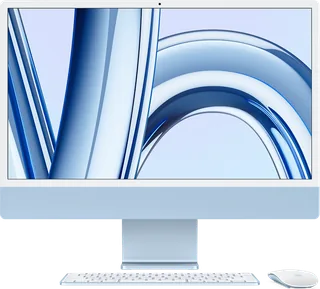
Apple iMac 24″ (M3) vs Apple iMac G3 (1998)
Better figure, where one is clearly better
| AppleiMac 24″ (M3) | AppleiMac G3 (1998) | |
|---|---|---|
| Overview | ||
| Released | November 2023 | August 1998 |
| Performance | ||
| Processor | Apple M3 | PowerPC G3 233 MHz (iMac) |
| CPU cores | 8 | 1 |
| Graphics | 8-core GPU or 10-core GPU | ATI RAGE IIc (2 MB) |
| Memory | 8 GB or 24 GB (better) | 32 MB or 128 MB |
| Storage | 256 GB to 2 TB (better) | 4 GB |
| CPU | 8-core CPU with 4 performance cores and 4 efficiency cores | 233 MHz PowerPC G3 processor with 66 MHz system bus and 512 KB backside L2 cache at 117 MHz. The exact silicon supplier is not established by the maker sheet; generic clock-only chip record. |
| GPU | 8-core GPU (two-port model) or 10-core GPU (four-port models); hardware-accelerated ray tracing | ATI RAGE IIc with 2 MB SGRAM standard; maker options increase video memory to 4 MB or 6 MB. Configurations retain the standard graphics allocation. |
| Memory type | – | 32 MB SDRAM standard in two SO-DIMM slots; original July 1998 Apple datasheet supports up to 128 MB. Do not substitute the Revision B maximum. |
| AI engine | 16-core Neural Engine | – |
| Memory bandwidth | 100GB/s | – |
| Storage type | SSD | 4 GB IDE hard drive and tray-loading 24x CD-ROM drive. No floppy drive. |
| Media engine | Hardware-accelerated H.264, HEVC, ProRes and ProRes RAW; video decode engine; video encode engine; ProRes encode and decode engine; AV1 decode | – |
| Display | ||
| Screen size | 24″ | 15″ |
| Resolution | 4480 × 2520 (better) | 1024 × 768 |
| Panel | IPS LCD | – |
| Refresh rate | 60 Hz | 75 Hz (better) |
| Brightness | 500 nits | – |
| Display type | 4.5K Retina display; actual diagonal 23.5 inches | Nominal 15-inch shadow-mask CRT with 13.8-inch viewable diagonal and 0.28 mm dot pitch; it has no fixed LCD native resolution. |
| Pixel density | 218 ppi | – |
| Display features | 1 billion colours; wide colour (P3); True Tone | Maximum supported mode 1024 × 768 at 75 Hz; 800 × 600 at 95 Hz and 640 × 480 at 117 Hz. The scalar refresh rate describes the highest-resolution mode. |
| Connections | ||
| Ports | 2 × USB4, headphone jack | 2 × USB-A, Ethernet, 2 × headphone jack |
| Ethernet | – | 0.1 Gb/s |
| External displays | Up to 1 | – |
| Wi-Fi | Wi-Fi 6E | – |
| Bluetooth | 5.3 | – |
| Camera | 1080p FaceTime HD | – |
| Back ports | Two-port model: 2 × Thunderbolt / USB 4 with DisplayPort, Thunderbolt 3 (up to 40Gb/s), USB 4 (up to 40Gb/s) and USB 3.1 Gen 2 (up to 10Gb/s), Gigabit Ethernet optional; four-port models add 2 × USB 3 (up to 10Gb/s) and Gigabit Ethernet as standard; 3.5 mm headphone jack with advanced support for high-impedance headphones | Two 12 Mbps USB ports on the computer, 10/100BASE-T Ethernet, 56K V.90/K56flex modem, 4 Mbps IrDA, audio line-in and line-out, plus two front headphone jacks. No FireWire or external VGA output. |
| External displays | One at up to 6K 60Hz | – |
| Camera | 1080p FaceTime HD camera; advanced image signal processor with computational video | – |
| Speakers | High-fidelity six-speaker system with force-cancelling woofers; wide stereo sound; Spatial Audio with Dolby Atmos | Built-in stereo speakers with SRS surround processing and built-in microphone. |
| Microphones | Studio-quality three-mic array with high signal-to-noise ratio and directional beamforming | – |
| Keyboard and mouse | Magic Keyboard (two-port model) or Magic Keyboard with Touch ID (four-port models), and Magic Mouse; Magic Trackpad or Magic Keyboard with Touch ID and Numeric Keypad available instead | Apple USB Keyboard and round Apple USB Mouse. |
| Design and power | ||
| Type | All-in-one | All-in-one |
| Weight | 4.43 kg | – |
| Width × depth × height | 547 × 147 × 461 mm | – |
| Operating system | macOS | macOS |
| Size and weight detail | – | Current retained maker sheet: height 15.8, width 15.2 and depth 17.6 inches, weight 40 pounds. Original Apple July 1998 datasheet instead gives height 39.5, width 38 and depth 44 cm, weight 17.3 kg (38.1 pounds). Conflicting main metric values are omitted. |
| Power supply | 143W external power adapter; power lead (2 m) | Retained maker sheet lists 80 W maximum continuous power; the original Apple datasheet lists 200 W. This conflict is retained rather than selecting a scalar rating. |
| Colours | Two-port model: Blue, Green, Pink, Silver; four-port models also Yellow, Orange, Purple | – |
| In the box | iMac, Magic Keyboard (with Touch ID on four-port models), Magic Mouse, 143W power adapter, power lead (2 m), USB-C to Lightning Cable | Mac OS 8.1. First on sale 15 August 1998, corroborated by Apple’s contemporary retrospective release and retained introduction date. |

More comparisons
- Apple iMac 24″ (M4) vs Apple iMac G3 (1998)
- Apple iMac 24″ (M3) vs Apple iMac 24″ (M4)
- Apple iMac 24″ (M3) vs HP OmniStudio X 31.5″ All-in-One
- Apple iMac 24″ (M1) vs Apple iMac 24″ (M3)
- Apple iMac 24″ (M3) vs Apple iMac (Retina 5K, 27-inch, 2020)
- Apple iMac 24″ (M3) vs Apple iMac (Retina 4K, 21.5-inch, 2019)
- Apple iMac 24″ (M3) vs Apple iMac (Retina 5K, 27-inch, 2019)
- Apple iMac 24″ (M3) vs Apple iMac Pro (2017)
- Apple iMac (21.5-inch, 2017) vs Apple iMac 24″ (M3)
- Apple iMac 24″ (M3) vs Apple iMac (Retina 4K, 21.5-inch, 2017)
- Apple iMac 24″ (M3) vs Apple Mac mini (M2 or M2 Pro)
- Apple iMac 24″ (M3) vs Apple iMac (Retina 5K, 27-inch, 2017)
- Apple iMac (21.5-inch, Late 2015) vs Apple iMac 24″ (M3)
- Apple iMac 24″ (M3) vs Apple iMac (Retina 4K, 21.5-inch, Late 2015)
- Apple iMac 24″ (M3) vs Apple iMac (Retina 5K, 27-inch, Late 2015)
- Apple iMac 24″ (M3) vs Apple iMac (Retina 5K, 27-inch, Mid 2015)