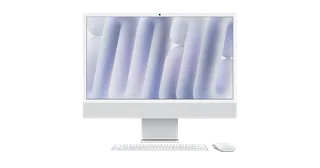
Apple iMac 24″ (M4) vs Apple Macintosh 512K
Better figure, where one is clearly better
| AppleiMac 24″ (M4) | AppleMacintosh 512K | |
|---|---|---|
| Overview | ||
| Released | November 2024 | September 1984 |
| Performance | ||
| Processor | Apple M4 | 68000 8 MHz (Macintosh 512K) |
| CPU cores | 8 or 10 | 1 |
| Graphics | 8-core GPU or 10-core GPU | – |
| AI engine (NPU) | 38 TOPS | – |
| Memory | 16 GB, 24 GB or 32 GB (better) | 512 KB |
| Storage | 256 GB to 2 TB | – |
| CPU | 8-core CPU with 4 performance cores and 4 efficiency cores (two-port model), or 10-core CPU with 4 performance cores and 6 efficiency cores (four-port models) | 8 MHz 68000 with a 16-bit data path; no PMMU, FPU, cache or second processor |
| Memory type | – | Fixed 0.5 MB onboard RAM, 64K ROM; no RAM slots or built-in memory expansion |
| GPU | Hardware-accelerated ray tracing | – |
| AI engine | 16-core Neural Engine | – |
| Memory bandwidth | 120GB/s | – |
| Storage type | SSD | 400K removable floppy drive with manual loading; no internal hard drive, hard-drive interface or internal CD drive |
| Expansion slots | – | None |
| Media engine | Hardware-accelerated H.264, HEVC, ProRes and ProRes RAW; video decode engine; video encode engine; ProRes encode and decode engine; AV1 decode | – |
| Display | ||
| Screen size | 24″ | 9″ |
| Resolution | 4480 × 2520 (better) | 512 × 342 |
| Panel | IPS LCD | CRT |
| Refresh rate | 60 Hz | – |
| Brightness | 500 nits | – |
| Display type | 4.5K Retina display; actual diagonal 23.5 inches | Built-in monochrome CRT with one-bit bitmap; 9-inch diagonal confirmed in Apple's original SE/30 owner manual, Macintosh product-line appendix. Apple explicitly notes 512 × 342 pixels, correcting its generic table's 512 × 384 |
| Pixel density | 218 ppi | – |
| Display features | 1 billion colours; wide colour (P3); True Tone; nano-texture glass option on four-port models | – |
| Connections | ||
| Ports | 2 × Thunderbolt 4, headphone jack | Headphone jack |
| External displays | Up to 1 | – |
| Wi-Fi | Wi-Fi 6E | – |
| Bluetooth | 5.3 | – |
| Camera | 12MP Center Stage | – |
| Back ports | 2 × Thunderbolt / USB 4 (two-port model) or 4 × Thunderbolt 4 (four-port models), each with Thunderbolt 4 and USB 4 (up to 40Gb/s), USB 3.1 Gen 2 (up to 10Gb/s) and DisplayPort; Gigabit Ethernet on the power adapter, standard on four-port models and optional on the two-port model | External floppy DB-19, printer and modem serial ports and speaker/headphone output; no SCSI, Ethernet or external video. Serial ports do not support handshaking or synchronous modems |
| External displays | Two-port model: one at up to 6K 60Hz; four-port models: two at up to 6K 60Hz, or one at up to 8K 60Hz | – |
| Camera | 12MP Center Stage camera with Desk View; 1080p HD video recording; advanced image signal processor with computational video | – |
| Speakers | High-fidelity six-speaker system with force-cancelling woofers; wide stereo sound; Spatial Audio with Dolby Atmos | – |
| Microphones | Studio-quality three-mic array with high signal-to-noise ratio and directional beamforming | – |
| Keyboard and mouse | Magic Keyboard (two-port model) or Magic Keyboard with Touch ID (four-port models), and Magic Mouse; Magic Trackpad or Magic Keyboard with Touch ID and Numeric Keypad available instead | – |
| Design and power | ||
| Type | All-in-one | All-in-one |
| Weight | 4.42 kg | – |
| Width × depth × height | 547 × 147 × 461 mm | – |
| Operating system | macOS | macOS |
| Size and weight detail | – | Maker 16.5 lb; 13.6 in height × 9.6 in width × 10.9 in depth, retained in original units |
| Power supply | 143W external power adapter; power lead (2 m) | Maximum 60 W, 105–125 V, 50–60 Hz, 0.5 A; 4.5 V alkaline |
| Materials | 100% recycled aluminium in the stand; more than 15% recycled content overall | – |
| Colours | Blue, Purple, Pink, Orange, Yellow, Green, Silver | – |
| In the box | iMac, Magic Keyboard (with Touch ID on four-port models), Magic Mouse, 143W power adapter, power lead (2 m), USB-C Charge Cable, polishing cloth (nano-texture glass only) | Original system software 0.7; maker introduction 10 September 1984 and discontinuation 14 April 1986. Actual shipping month September 1984 comes from Macworld's historical timeline; no exact first-sale day adopted |
More comparisons
- Apple iMac 24″ (M1) vs Apple iMac 24″ (M4)
- Apple iMac 24″ (M4) vs Apple iMac (Retina 4K, 21.5-inch, Late 2015)
- Apple iMac 24″ (M4) vs Apple iMac (Retina 4K, 21.5-inch, 2017)
- Apple iMac 24″ (M4) vs Apple iMac (Retina 4K, 21.5-inch, 2019)
- Apple iMac 24″ (M4) vs Apple iMac (Retina 5K, 27-inch, Late 2015)
- Apple iMac 24″ (M4) vs Apple iMac (Retina 5K, 27-inch, 2017)
- Apple iMac 24″ (M4) vs Apple iMac (Retina 5K, 27-inch, 2019)
- Apple iMac 24″ (M4) vs Apple iMac (Retina 5K, 27-inch, 2020)
- Apple iMac 24″ (M4) vs Apple iMac Pro (2017)
- Apple iMac (21.5-inch, Late 2012) vs Apple iMac 24″ (M4)
- Apple iMac (21.5-inch, Late 2013) vs Apple iMac 24″ (M4)
- Apple iMac (21.5-inch, Mid 2014) vs Apple iMac 24″ (M4)
- Apple iMac (21.5-inch, Late 2015) vs Apple iMac 24″ (M4)
- Apple iMac (21.5-inch, 2017) vs Apple iMac 24″ (M4)
- Apple iMac 24″ (M4) vs Apple iMac (27-inch, Late 2012)
- Apple iMac 24″ (M4) vs Apple iMac (27-inch, Late 2013)