Apple Mac mini (2018) vs Apple Mac mini (Mid 2011)
Better figure, where one is clearly better
| AppleMac mini (2018) | AppleMac mini (Mid 2011) | |
|---|---|---|
| Overview | ||
| Released | November 2018 | July 2011 |
| Performance | ||
| Processor | Intel Core i3-8100B, Intel Core i5-8500B or Intel Core i7-8700B | Intel Core i5-2415M, Intel Core i5-2520M, Intel Core i7-2620M or Intel Core i7-2635QM |
| CPU cores | 4 or 6 | 2 or 4 |
| CPU threads | 4, 6 or 12 | 4 or 8 |
| Graphics | Intel UHD Graphics 630 | Intel HD Graphics 3000 or AMD Radeon HD 6630M (256 MB GDDR5) |
| Memory | 8 GB, 16 GB, 32 GB or 64 GB (better) | 2 GB, 4 GB or 8 GB |
| Storage | 128 GB to 2 TB (better) | 256 GB to 1.5 TB |
| CPU | 3.6 GHz quad-core Core i3 with 6 MB shared L3 cache; 3.0 GHz six-core Core i5 with Turbo Boost up to 4.1 GHz and 9 MB cache; configurable to 3.2 GHz six-core Core i7 with Turbo Boost up to 4.6 GHz and 12 MB cache | Consumer models have a 2.3 GHz dual-core Core i5-2415M or 2.5 GHz dual-core Core i5-2520M, with a 2.7 GHz dual-core Core i7-2620M option only on the 2.5 GHz model. The server has a 2.0 GHz quad-core Core i7-2635QM. Exact CPU identities are cross-checked with EveryMac; the i5-2415M's four threads come from its exact-model sheet because an individual current Intel sheet was unavailable. |
| GPU | Intel UHD Graphics 630; exact i3-8100B model identified by Tom’s Guide; i5-8500B and i7-8700B identified in Apple’s Common Criteria security target | The 2.3 GHz model has Intel HD Graphics 3000 with at least 288 MB shared memory; 2.5/2.7 GHz consumer configurations have AMD Radeon HD 6630M with 256 MB GDDR5. Server configurations have Intel HD Graphics 3000 with at least 384 MB shared memory. |
| Memory type | 2666 MHz DDR4 SO-DIMM; 8 GB, configurable to 16 GB, 32 GB or 64 GB | 1333 MHz DDR3 memory. The 2.3 GHz model has 2 GB, configurable to 4 or 8 GB; other configurations have 4 GB, configurable to 8 GB. The bottom cover provides access for memory replacement. |
| Storage type | PCIe-based SSD; launch Core i3 starts at 128 GB and Core i5 at 256 GB; configurable to 512 GB, 1 TB or 2 TB; 128 GB Core i7 combinations omitted because their configure-to-order availability is not independently verified | The 2.3 GHz consumer model offers a 500 GB 5400 rpm or 750 GB 7200 rpm hard drive. The 2.5/2.7 GHz consumer models additionally offer a 256 GB SSD or a separate 256 GB SSD plus 750 GB hard drive. Server choices are two 500 GB or two 750 GB 7200 rpm hard drives, a single or two 256 GB SSDs, or a separate 256 GB SSD and 750 GB hard drive. Server hard-drive capacities in configurations are the total of two drives (1000/1500 GB), and 512 GB SSD means two 256 GB drives. Mixed SSD/hard-drive combinations are described here rather than assigned one misleading storage type; they are not Fusion Drives. |
| Expansion slots | – | No internal PCI Express expansion slot or optical drive; removable bottom cover for memory access. Optional external MacBook Air SuperDrive or DVD/CD Sharing from another computer. |
| Display | ||
| Screen | None built in | None built in |
| Connections | ||
| Ports | 4 × Thunderbolt 3, 2 × USB-A, HDMI, Ethernet, headphone jack | Thunderbolt, 4 × USB-A, HDMI, Ethernet, SD card slot, headphone jack |
| Ethernet | 1 Gb/s | 1 Gb/s |
| External displays | Up to 3 (better) | Up to 2 |
| Wi-Fi | Wi-Fi 5 | 802.11n |
| Bluetooth | 5.0 | 4.0 |
| Back ports | Four Thunderbolt 3 USB-C ports with DisplayPort and Thunderbolt 3 up to 40 Gb/s and USB 3.1 Gen 2 up to 10 Gb/s; two USB-A ports up to 5 Gb/s; HDMI 2.0; Gigabit Ethernet, configurable to 10 Gb Ethernet with 1/2.5/5/10 Gb support; 3.5 mm headphone jack | Thunderbolt up to 10 Gb/s, FireWire 800 up to 800 Mb/s, four USB 2.0 up to 480 Mb/s, HDMI, SDXC, Gigabit Ethernet and separate digital/analogue audio input and output minijacks. FireWire and the audio input are described here because the main port list has no fields for them. |
| External displays | Two displays up to 4096 × 2304 at 60 Hz over Thunderbolt 3 plus one up to 4096 × 2160 at 60 Hz over HDMI 2.0; alternatively, one 5120 × 2880 display at 60 Hz over Thunderbolt 3 plus one 4096 × 2160 display at 60 Hz over HDMI 2.0 | Maker specifies dual display and mirroring; Thunderbolt up to 2560 × 1600 and HDMI up to 1920 × 1200. HDMI to DVI adapter included; Mini DisplayPort adapters optional. |
| Speakers | Built-in speaker; HDMI 2.0 supports multichannel audio output | Built-in speaker; digital/analogue headphone output, multichannel HDMI audio and support for an Apple iPhone headset with microphone |
| Keyboard and mouse | – | Display, keyboard and mouse are purchased separately; Apple Remote and external SuperDrive optional |
| Design and power | ||
| Type | Compact | Compact |
| Weight | 1.3 kg | – |
| Width × depth × height | 197 × 197 × 36 mm | 197 × 197 × 36 mm |
| Operating system | macOS | macOS |
| Size and weight detail | – | Consumer models weigh 1.22 kg; the server weighs 1.37 kg. Actual weight varies by configuration and manufacturing process; a shared weight is omitted. |
| Power supply | Built-in; 100–240 V AC, 50–60 Hz; maximum continuous power 150 W | Internal supply; AC input 100–240 V, 50–60 Hz single phase; maximum continuous power 85 W |
| Noise | – | The consumer page's headline gives 16 dBA idle, while its model-specific table gives 13 dB for 2.3 GHz and 15 dB for 2.5 GHz at idle, with 16 dB during hard-drive access. The server page gives 17 dBA idle. Figures depend on configuration and measurement position; no single value is selected. |
| Materials | 100% recycled aluminium enclosure | Recyclable aluminium enclosure; BFR-free. PVC-free except China mainland, Korea and South Africa, where only internal cables are PVC-free. |
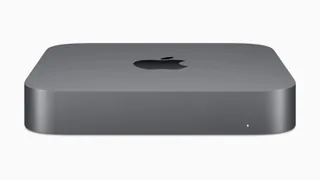
| Colours | Space Grey | – |
| In the box | Mac mini, power cord | Mac mini, HDMI to DVI adapter, power cord and documentation. OS X Lion and iLife included; server adds Lion Server with an unlimited-client licence. Lion Recovery and Internet Recovery support system restoration without a physical install disc. |

More comparisons
- Apple Mac mini (2018) vs Apple Mac mini (M6 or M5 Pro)
- Apple Mac mini (M6 or M5 Pro) vs Apple Mac mini (Mid 2011)
- Apple Mac mini (M4 or M4 Pro) vs Apple Mac mini (Mid 2011)
- Apple Mac mini (2018) vs Apple Mac mini (M4 or M4 Pro)
- Apple Mac mini (2018) vs Apple Mac mini (M2 or M2 Pro)
- Apple Mac mini (M2 or M2 Pro) vs Apple Mac mini (Mid 2011)
- Apple Mac mini (2018) vs Apple Mac mini (M1)
- Apple Mac mini (M1) vs Apple Mac mini (Mid 2011)
- Apple iMac (Retina 5K, 27-inch, 2019) vs Apple Mac mini (2018)
- Apple Mac mini (2018) vs Apple Mac mini (Late 2012)
- Apple Mac mini (2018) vs Apple Mac mini (Late 2014)
- Apple iMac (Retina 5K, 27-inch, 2017) vs Apple Mac mini (2018)
- Apple Mac mini (2018) vs Apple Mac Pro (Late 2013)
- Apple Mac mini (2018) vs Apple Mac mini (Mid 2010)
- Apple Mac mini (2018) vs Apple Mac mini (Late 2009)
- Apple Mac mini (2018) vs Apple Mac mini (Early 2009)