Apple Mac mini (M6 or M5 Pro) vs Apple Mac mini (Mid 2011)
Better figure, where one is clearly better
| AppleMac mini (M6 or M5 Pro) | AppleMac mini (Mid 2011) | |
|---|---|---|
| Overview | ||
| Released | September 2026 | July 2011 |
| Performance | ||
| Processor | Apple M6 or Apple M5 Pro | Intel Core i5-2415M, Intel Core i5-2520M, Intel Core i7-2620M or Intel Core i7-2635QM |
| CPU cores | 12, 15 or 18 | 2 or 4 |
| CPU threads | – | 4 or 8 |
| Graphics | 12-core GPU, 16-core GPU or 20-core GPU | Intel HD Graphics 3000 or AMD Radeon HD 6630M (256 MB GDDR5) |
| Memory | 16 GB, 24 GB, 32 GB, 48 GB or 64 GB (better) | 2 GB, 4 GB or 8 GB |
| Storage | 256 GB to 8 TB (better) | 256 GB to 1.5 TB |
| CPU | M6: 12-core CPU with 2 super cores, 4 performance cores and 6 efficiency cores; M5 Pro: 15-core CPU with 5 super cores and 10 performance cores, or 18-core CPU with 6 super cores and 12 performance cores | Consumer models have a 2.3 GHz dual-core Core i5-2415M or 2.5 GHz dual-core Core i5-2520M, with a 2.7 GHz dual-core Core i7-2620M option only on the 2.5 GHz model. The server has a 2.0 GHz quad-core Core i7-2635QM. Exact CPU identities are cross-checked with EveryMac; the i5-2415M's four threads come from its exact-model sheet because an individual current Intel sheet was unavailable. |
| GPU | Neural Accelerators; hardware-accelerated ray tracing | The 2.3 GHz model has Intel HD Graphics 3000 with at least 288 MB shared memory; 2.5/2.7 GHz consumer configurations have AMD Radeon HD 6630M with 256 MB GDDR5. Server configurations have Intel HD Graphics 3000 with at least 384 MB shared memory. |
| Memory type | – | 1333 MHz DDR3 memory. The 2.3 GHz model has 2 GB, configurable to 4 or 8 GB; other configurations have 4 GB, configurable to 8 GB. The bottom cover provides access for memory replacement. |
| AI engine | Dual 16-core Neural Engine (M6); 16-core Neural Engine (M5 Pro) | – |
| Memory bandwidth | M6: 153GB/s with 16GB, 170GB/s with 24GB or 32GB; M5 Pro: 307GB/s | – |
| Storage type | SSD | The 2.3 GHz consumer model offers a 500 GB 5400 rpm or 750 GB 7200 rpm hard drive. The 2.5/2.7 GHz consumer models additionally offer a 256 GB SSD or a separate 256 GB SSD plus 750 GB hard drive. Server choices are two 500 GB or two 750 GB 7200 rpm hard drives, a single or two 256 GB SSDs, or a separate 256 GB SSD and 750 GB hard drive. Server hard-drive capacities in configurations are the total of two drives (1000/1500 GB), and 512 GB SSD means two 256 GB drives. Mixed SSD/hard-drive combinations are described here rather than assigned one misleading storage type; they are not Fusion Drives. |
| Expansion slots | – | No internal PCI Express expansion slot or optical drive; removable bottom cover for memory access. Optional external MacBook Air SuperDrive or DVD/CD Sharing from another computer. |
| Media engine | Hardware-accelerated H.264, HEVC, ProRes and ProRes RAW; video decode engine; video encode engine; ProRes encode and decode engine; AV1 decode | – |
| Display | ||
| Screen | None built in | None built in |
| Connections | ||
| Ports | 3 × Thunderbolt 4, 2 × USB-C, HDMI, Ethernet, headphone jack | Thunderbolt, 4 × USB-A, HDMI, Ethernet, SD card slot, headphone jack |
| Ethernet | 2.5 Gb/s (better) | 1 Gb/s |
| External displays | Up to 3 (better) | Up to 2 |
| Wi-Fi | Wi-Fi 7 | 802.11n |
| Bluetooth | 6 | 4.0 |
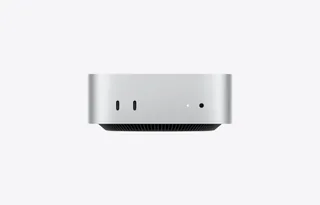
| Front ports | 2 × USB-C with USB 3 (up to 10Gb/s); 3.5 mm headphone jack with advanced support for high-impedance headphones | – |
| Back ports | M6: 3 × Thunderbolt 4 (USB-C) with Thunderbolt 4 and USB 4 (up to 40Gb/s) and DisplayPort; M5 Pro: 3 × Thunderbolt 5 (USB-C) with Thunderbolt 5 (up to 120Gb/s), USB 4 (up to 40Gb/s) and DisplayPort; HDMI with multichannel audio output; 2.5Gb Ethernet (RJ-45), configurable to 10Gb Ethernet | Thunderbolt up to 10 Gb/s, FireWire 800 up to 800 Mb/s, four USB 2.0 up to 480 Mb/s, HDMI, SDXC, Gigabit Ethernet and separate digital/analogue audio input and output minijacks. FireWire and the audio input are described here because the main port list has no fields for them. |
| External displays | M6: up to three (two at up to 6K 60Hz or 4K 165Hz, plus a third at up to 5K 60Hz over Thunderbolt or 4K 60Hz over HDMI), or two (one at up to 8K 60Hz, 5K 120Hz or 4K 240Hz, plus one at up to 5K 60Hz over Thunderbolt or 4K 60Hz over HDMI); M5 Pro: up to three at up to 6K 60Hz or 4K 165Hz, or two (one at up to 8K 60Hz, 5K 120Hz or 4K 240Hz, plus one at up to 5K 120Hz or 4K 200Hz); VRR and HDR supported | Maker specifies dual display and mirroring; Thunderbolt up to 2560 × 1600 and HDMI up to 1920 × 1200. HDMI to DVI adapter included; Mini DisplayPort adapters optional. |
| Speakers | Built-in speaker | Built-in speaker; digital/analogue headphone output, multichannel HDMI audio and support for an Apple iPhone headset with microphone |
| Keyboard and mouse | – | Display, keyboard and mouse are purchased separately; Apple Remote and external SuperDrive optional |
| Microphones | None built in; Apple says an external microphone or headset is needed for calls | – |
| Design and power | ||
| Type | Compact | Compact |
| Weight | 0.67 kg | – |
| Width × depth × height | 127 × 127 × 50 mm | 197 × 197 × 36 mm |
| Operating system | macOS | macOS |
| Size and weight detail | – | Consumer models weigh 1.22 kg; the server weighs 1.37 kg. Actual weight varies by configuration and manufacturing process; a shared weight is omitted. |
| Power supply | Built-in; 100–240V AC; 155W maximum continuous power | Internal supply; AC input 100–240 V, 50–60 Hz single phase; maximum continuous power 85 W |
| Power use | M6 with 16GB and 256GB: 4W idle, 70W maximum; M5 Pro with 64GB and 8TB: 6W idle, 145W maximum | – |
| Noise | 5 dBA sound pressure at idle (operator position); declared to ECMA-109 as 1.3 B sound power and 4 dB sound pressure at idle and wireless web (M5 Pro, 18-core CPU, 20-core GPU) | The consumer page's headline gives 16 dBA idle, while its model-specific table gives 13 dB for 2.3 GHz and 15 dB for 2.5 GHz at idle, with 16 dB during hard-drive access. The server page gives 17 dBA idle. Figures depend on configuration and measurement position; no single value is selected. |
| Materials | 100% recycled aluminium enclosure; 50% recycled content overall | Recyclable aluminium enclosure; BFR-free. PVC-free except China mainland, Korea and South Africa, where only internal cables are PVC-free. |
| Colours | Silver | – |
| In the box | Mac mini, power lead (1.8 m) | Mac mini, HDMI to DVI adapter, power cord and documentation. OS X Lion and iLife included; server adds Lion Server with an unlimited-client licence. Lion Recovery and Internet Recovery support system restoration without a physical install disc. |

More comparisons
- Apple Mac mini (M1) vs Apple Mac mini (M6 or M5 Pro)
- Apple Mac mini (2018) vs Apple Mac mini (M6 or M5 Pro)
- Apple Mac mini (Early 2009) vs Apple Mac mini (M6 or M5 Pro)
- Apple Mac mini (M6 or M5 Pro) vs Apple Mac mini (Mid 2010)
- Apple Mac mini (Early 2006) vs Apple Mac mini (M6 or M5 Pro)
- Apple Mac mini (2005) vs Apple Mac mini (M6 or M5 Pro)
- Apple Mac mini (M6 or M5 Pro) vs Apple Mac mini (Mid 2007)
- Apple Mac mini (M4 or M4 Pro) vs Apple Mac mini (M6 or M5 Pro)
- Apple Mac mini (M6 or M5 Pro) vs Framework Desktop (AMD Ryzen AI Max 300 Series)
- Apple Mac mini (M2 or M2 Pro) vs Apple Mac mini (M6 or M5 Pro)
- Apple Mac mini (Late 2014) vs Apple Mac mini (M6 or M5 Pro)
- Apple Mac mini (Late 2012) vs Apple Mac mini (M6 or M5 Pro)
- Apple Mac mini (M6 or M5 Pro) vs Apple Mac Studio (M5 Max or M5 Ultra)
- Apple Mac mini (Late 2009) vs Apple Mac mini (M6 or M5 Pro)
- Apple Mac mini (Late 2006) vs Apple Mac mini (M6 or M5 Pro)
- Apple Mac mini (M4 or M4 Pro) vs Apple Mac mini (Mid 2011)