Apple Mac mini (Early 2009) vs Apple Mac mini (Late 2014)
Better figure, where one is clearly better
| AppleMac mini (Early 2009) | AppleMac mini (Late 2014) | |
|---|---|---|
| Overview | ||
| Released | March 2009 | October 2014 |
| Performance | ||
| Processor | Intel Core 2 Duo P7350 or Intel Core 2 Duo P8400 | Intel Core i5-4260U, Intel Core i5-4278U, Intel Core i5-4308U or Intel Core i7-4578U |
| CPU cores | 2 | 2 |
| CPU threads | – | 4 |
| Graphics | NVIDIA GeForce 9400M (shared memory) | Intel HD Graphics 5000 or Intel Iris Graphics 5100 |
| Memory | 1 GB, 2 GB or 4 GB | 4 GB, 8 GB or 16 GB (better) |
| Storage | 120 GB to 320 GB | 256 GB to 2 TB (better) |
| CPU | 2.0 GHz dual-core Core 2 Duo P7350, configurable to 2.26 GHz P8400; 3 MB shared L2 cache and 1066 MHz frontside bus. Exact identities are cross-checked with EveryMac; optional unpublished chip thread and launch figures are omitted. | 1.4 GHz dual-core Core i5 (Turbo Boost up to 2.7 GHz), 2.6 GHz dual-core Core i5 (up to 3.1 GHz), or 2.8 GHz dual-core Core i5 (up to 3.3 GHz). The two higher models can be configured with a 3.0 GHz dual-core Core i7 (up to 3.5 GHz). Exact processor identities are recorded by Geekbench; Ars Technica tested the Core i5-4278U and Macworld tested the Core i5-4308U. |
| GPU | NVIDIA GeForce 9400M integrated graphics shares at least 128 MB DDR3 memory with a 1 GB system configuration, or at least 256 MB with 2 GB; available system memory varies with graphics use. | Intel HD Graphics 5000 in the 1.4 GHz model; Intel Iris Graphics 5100 in the 2.6 GHz, 2.8 GHz and optional Core i7 models |
| Memory type | Two SO-DIMM slots for 1066 MHz DDR3 SDRAM, with 1 or 2 GB standard and maker factory upgrades up to 4 GB | 1600 MHz LPDDR3 soldered to the logic board; 4 GB configurable to 8 GB or 16 GB on the 1.4 GHz model, and 8 GB configurable to 16 GB on the higher models. Memory cannot be upgraded after purchase (Ars Technica). |
| Storage type | 120, 250 or 320 GB 5400 rpm Serial ATA hard drive and slot-loading 8x SuperDrive with double-layer DVD support. The launch press release also mentions an 80 GB order option, which the current support sheet omits; that conflicting option is not listed in configurations. | 1.4 GHz model has a 500 GB 5400-rpm hard drive or 1 TB Fusion Drive. The 2.6 GHz model has a 1 TB hard drive, 1 TB Fusion Drive or 256 GB SSD. The 2.8 GHz model has a 1 TB Fusion Drive, later 2 TB Fusion Drive option, or 256 GB, 512 GB or 1 TB SSD. Core i7 configurations retain the storage choices of their original base model; deduplicated configurations combine these supported choices. Macworld reports the 2 TB Fusion Drive option was added after launch; it is included in Apple's current specification. |
| Expansion slots | No internal PCI Express expansion slot | – |
| Display | ||
| Screen | None built in | None built in |
| Connections | ||
| Ports | DisplayPort, 5 × USB-A, Ethernet, headphone jack | 2 × Thunderbolt 2, 4 × USB-A, HDMI, SD card slot, Ethernet, headphone jack |
| Ethernet | 1 Gb/s | 1 Gb/s |
| External displays | Up to 2 | Up to 2 |
| Wi-Fi | 802.11n | 802.11ac |
| Bluetooth | 2.1 + EDR | 4.0 |
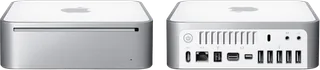
| Back ports | Five USB 2.0 ports up to 480 Mb/s, FireWire 800, Mini DisplayPort, Mini-DVI, Gigabit Ethernet and combined optical digital/analogue audio input and output minijacks. The main DisplayPort count represents Mini DisplayPort; Mini-DVI, FireWire and audio input are described here because the main port list has no fields for them. Optional external Apple USB Modem. | Two Thunderbolt 2 ports up to 20 Gb/s each, four USB 3 ports up to 5 Gb/s, HDMI, SDXC slot, Gigabit Ethernet, separate digital/analogue audio input and headphone/line output; IR receiver |
| External displays | Extended desktop and mirroring; Mini-DVI up to 1920 × 1200 for DVI/VGA, Mini DisplayPort up to 2560 × 1600 using an optional dual-link DVI adapter. Mini-DVI to DVI adapter included; VGA and Mini DisplayPort adapters optional. | Up to two displays at 2560 × 1600; native Mini DisplayPort output over Thunderbolt. HDMI supports 1080p at up to 60 Hz, 3840 × 2160 at 30 Hz or 4096 × 2160 at 24 Hz. DVI, VGA and dual-link DVI require the appropriate adapter. |
| Speakers | Built-in speaker; combined optical digital audio output/headphone minijack and optical digital audio input/line-in minijack | Built-in speaker; HDMI supports multichannel audio; supports Apple iPhone headset with microphone |
| Keyboard and mouse | Display, keyboard and mouse purchased separately; Apple Remote optional | Power lead; monitor, keyboard and mouse sold separately |
| Design and power | ||
| Type | Compact | Compact |
| Weight | 1.31 kg | – |
| Width × depth × height | 165.1 × 165.1 × 50.8 mm | 197 × 197 × 36 mm |
| Operating system | macOS | macOS |
| Size and weight detail | – | 197 × 197 × 36 mm; 1.19 kg for the 1.4 GHz model, 1.20 kg for the 2.6 GHz model and 1.22 kg for the 2.8 GHz model. Weight varies by configuration and manufacturing process; no common weight is assigned. |
| Power supply | External 110 W adapter; AC input 100–240 V, 50–60 Hz single phase; maximum continuous power 110 W | Integrated power supply; 100–240 V AC, 50–60 Hz; maximum continuous power 85 W |
| Noise | – | Apple specifies 12 dBA sound pressure at idle; its acoustic test configuration is the 2.8 GHz Core i5 with 8 GB memory and 1 TB Fusion Drive |
| Materials | Recyclable aluminium and polycarbonate enclosure; BFR-free and PVC-free internal cables | Recyclable aluminium enclosure; BFR-free and PVC-free with regional power-lead exceptions |
| In the box | Mac mini, Mini-DVI to DVI adapter, 110 W power adapter and cord, install/restore DVDs and documentation. Mac OS X Leopard and iLife '09 included. | Mac mini and power lead; shipped with OS X Yosemite at launch. The current support sheet's macOS Mojave wording reflects a later software update. |

More comparisons
- Apple Mac mini (Early 2009) vs Apple Mac mini (M6 or M5 Pro)
- Apple Mac mini (Late 2014) vs Apple Mac mini (M6 or M5 Pro)
- Apple Mac mini (Late 2014) vs Apple Mac mini (M4 or M4 Pro)
- Apple Mac mini (Early 2009) vs Apple Mac mini (M4 or M4 Pro)
- Apple Mac mini (Late 2014) vs Apple Mac mini (M2 or M2 Pro)
- Apple Mac mini (Early 2009) vs Apple Mac mini (M2 or M2 Pro)
- Apple Mac mini (Late 2014) vs Apple Mac mini (M1)
- Apple Mac mini (Early 2009) vs Apple Mac mini (M1)
- Apple Mac mini (2018) vs Apple Mac mini (Late 2014)
- Apple Mac mini (2018) vs Apple Mac mini (Early 2009)
- Apple iMac (21.5-inch, Late 2015) vs Apple Mac mini (Late 2014)
- Apple Mac mini (Late 2012) vs Apple Mac mini (Late 2014)
- Apple Mac mini (Late 2014) vs Apple Mac mini (Mid 2011)
- Apple iMac (21.5-inch, Late 2013) vs Apple Mac mini (Late 2014)
- Apple Mac mini (Late 2014) vs Apple Mac mini (Mid 2010)
- Apple Mac mini (Late 2014) vs Apple Mac Pro (Late 2013)