Apple Mac Pro (2019) vs Apple Mac Pro (Early 2008)
Better figure, where one is clearly better
| AppleMac Pro (2019) | AppleMac Pro (Early 2008) | |
|---|---|---|
| Overview | ||
| Released | December 2019 | January 2008 |
| Performance | ||
| Processor | Intel Xeon W-3223, Intel Xeon W-3235, Intel Xeon W-3245, Intel Xeon W-3265M or Intel Xeon W-3275M | Intel Xeon E5462, 2 × Intel Xeon E5462, 2 × Intel Xeon E5472 or 2 × Intel Xeon X5482 |
| CPU cores | 8, 12, 16, 24 or 28 | 4 or 8 |
| CPU threads | 16, 24, 32, 48 or 56 | – |
| Graphics | AMD Radeon Pro 580X (8 GB GDDR5), AMD Radeon Pro Vega II (32 GB HBM2), AMD Radeon Pro Vega II Duo (32 GB HBM2 per GPU), AMD Radeon Pro W5500X (8 GB GDDR6; later option), AMD Radeon Pro W5700X (16 GB GDDR6; later option), AMD Radeon Pro W6800X (32 GB GDDR6; later option), AMD Radeon Pro W6900X (32 GB GDDR6; later option), AMD Radeon Pro W6800X Duo (32 GB GDDR6 per GPU; later option) or AMD Radeon Pro W6600X (8 GB GDDR6; later option) | ATI Radeon HD 2600 XT, NVIDIA GeForce 8800 GT or NVIDIA Quadro FX 5600 |
| Memory | 32 GB, 48 GB, 96 GB, 192 GB, 384 GB, 768 GB or 1536 GB (better) | 2 GB, 4 GB, 8 GB, 16 GB or 32 GB |
| Storage | 256 GB to 8 TB (better) | 300 GB to 1 TB |
| CPU | Intel Xeon W with 8 cores at 3.5 GHz (Turbo Boost up to 4.0 GHz), 12 at 3.3 GHz, 16 at 3.2 GHz, 24 at 2.7 GHz or 28 at 2.5 GHz (all up to 4.4 GHz). Sound On Sound identifies the exact processors as W-3223, W-3235, W-3245, W-3265M and W-3275M; Intel confirms their specifications. Intel's separate Turbo Boost Max 3.0 figures are not asserted as Mac Pro system capabilities. | One 2.8 GHz quad-core Xeon or two 2.8, 3.0 or 3.2 GHz quad-core Xeons; four or eight total cores. Each processor has 12 MB L2 cache (6 MB shared by each pair of cores), SSE4 and 1600 MHz independent frontside bus. EveryMac identifies E5462, E5472 and X5482 respectively. |
| GPU | One MPX module per listed configuration. Launch options were Radeon Pro 580X (8 GB GDDR5), Vega II (32 GB HBM2) and Vega II Duo (two GPUs with 32 GB HBM2 each). Later maker-listed options include W5500X and W6600X (8 GB GDDR6), W5700X (16 GB GDDR6), W6800X and W6900X (32 GB GDDR6), and W6800X Duo (two GPUs with 32 GB GDDR6 each). Two MPX bays support up to four GPUs; Apple confirms upgrades to two Vega II or two Vega II Duo modules, and an Infinity Fabric Link between two W6800X Duo modules. GPU memory is not pooled into one GPU's capacity. | Radeon HD 2600 XT has 256 MB GDDR3, GeForce 8800 GT has 512 MB GDDR3 and Quadro FX 5600 has 1.5 GB GDDR3; each has two dual-link DVI ports. Quadro adds stereo 3D. Maker also confirms two, three or four Radeon HD 2600 XT cards; no unconfirmed mixed-card configurations expanded. |
| Memory type | Twelve user-accessible DIMM slots for DDR4 ECC memory; 32, 48, 96, 192, 384 or 768 GB. 1.5 TB requires the 24-core or 28-core processor. Memory runs at 2666 MHz with the 8-core CPU and 2933 MHz with the other CPUs. 768 GB uses six 128 GB or twelve 64 GB modules; 1.5 TB uses twelve 128 GB modules. | 800 MHz DDR2 ECC fully buffered DIMMs; eight slots on two removable risers, up to 32 GB; factory options 2, 4, 8, 16 or 32 GB |
| Storage type | T2-encrypted SSD storage; 256 GB, 512 GB, 1 TB, 2 TB, 4 TB or 8 TB. The 256 GB and 512 GB versions use one module; larger capacities use two modules of half the total capacity. Apple states up to 3.4 GB/s sequential reads and writes. The current 512 GB option was not listed in Sound On Sound's original configuration table. | Four independent SATA 3 Gb/s bays and up to 4 TB. Primary SATA drive options 320/500/750 GB or 1 TB at 7200 rpm; 300 GB 15,000 rpm SAS requires optional Mac Pro RAID Card. Configurations show one primary drive; additional independent drives, RAID arrangements and one or two 16x double-layer SuperDrives are separate options. |
| Expansion slots | Eight PCI Express Gen 3 slots; two MPX bays provide x16 graphics and x8 Thunderbolt bandwidth each, with up to 500 W for an MPX module. Three additional full-length slots provide one x16 and two x8 links; the half-length x4 slot holds the Apple I/O card. Optional Afterburner x16 card accelerates ProRes and ProRes RAW in supported applications; current maker tests report up to six 8K ProRes RAW or 23 4K ProRes RAW streams, compared with the lower figures in the initial announcement. | Four full-length PCI Express slots including two PCI Express 2.0 x16 slots (one double-wide) and two x4 slots; mechanical support for x16 cards, 300 W combined maximum. PCI/PCI-X incompatible. |
| Display | ||
| Screen | None built in | None built in |
| Connections | ||
| Ports | 4 × Thunderbolt 3, 2 × USB-A, 2 × Ethernet, headphone jack | 5 × USB-A, 2 × Ethernet, headphone jack |
| Ethernet | 10 Gb/s (better) | 1 Gb/s |
| External displays | – | Up to 8 |
| Wi-Fi | 802.11ac | Optional 802.11n |
| Bluetooth | 5.0 | 2.0 + EDR |
| Front ports | Two Thunderbolt 3 (USB-C) ports on top of the tower; up to 40 Gb/s Thunderbolt, up to 10 Gb/s USB-C and DisplayPort support | Two USB 2.0, FireWire 400, FireWire 800 and headphone output |
| Back ports | Apple I/O card has two Thunderbolt 3 ports, two USB-A ports at up to 5 Gb/s and a 3.5 mm headset jack. Two Ethernet ports support 1, 2.5, 5 and 10 Gb/s. Graphics ports vary by MPX module; 580X, W5500X and W6600X have two HDMI ports, while the other listed modules have four Thunderbolt 3 ports and one HDMI port. The chassis port counts above exclude graphics-module ports. TechRadar and The Verge describe an additional internal USB-A port for a software dongle. | Three USB 2.0, FireWire 400, FireWire 800, two Gigabit Ethernet, optical TOSLINK input/output and analogue line input/output. DVI outputs depend on graphics configuration; included keyboard ports excluded from chassis count. |
| External displays | Display limits depend on the graphics configuration. One 580X supports six 4K displays, two 5K displays or two Pro Display XDRs; W5500X supports four 4K, one 5K or one XDR, and W6600X four 4K, two 5K or two XDRs. W5700X, W6800X and W6900X support six 4K, three 5K or three XDRs per module. Vega II supports six 4K, three 5K or two XDRs; Vega II Duo eight 4K, four 5K or four XDRs. W6800X Duo supports eight 4K, four 5K or six XDRs. Apple's dedicated current Vega II Duo guide confirms two modules can drive twelve 4K, six 5K or six XDR displays; port and bus placement restrictions apply. | Up to eight 30-inch displays requires four Radeon HD 2600 XT cards. Digital resolutions up to 2560 × 1600, analogue up to 2048 × 1536 using included DVI-to-VGA adapter. |
| Speakers | Built-in speaker; 3.5 mm headphone jack supports a headset | Front-panel speaker |
| Keyboard and mouse | Magic Keyboard with Numeric Keypad and Magic Mouse in silver and black; optional matching Magic Trackpad | Apple Keyboard and Mighty Mouse; display sold separately |
| Design and power | ||
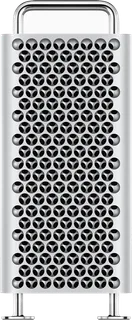
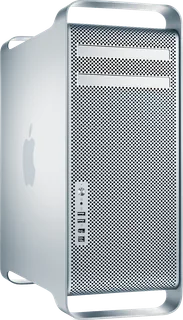
| Type | Tower | Tower |
| Width × depth × height | – | 206 × 475 × 511 mm |
| Weight | 18 kg | – |
| Operating system | macOS | macOS |
| Size and weight detail | Apple's UK and US sheets publish height 52.9 cm, width 45.0 cm and depth 21.8 cm for the tower with feet, but the width and depth labels appear transposed relative to the maker's front and side image. Main dimensions are omitted pending resolution. The US sheet gives 55.7 cm height with optional wheels. Weight varies by configuration and manufacturing process; rack enclosure specifications are separate. | Standard-configuration weight 19.2 kg; actual weight varies by configuration and manufacturing process, so shared scalar weight omitted |
| Power supply | 1.4 kW supply; maximum continuous output 1280 W at 108–125 V or 220–240 V, and 1180 W at 100–107 V. AC input 100–125 V at 12 A or 220–240 V at 6 A; 50–60 Hz. | 100–120 V or 200–240 V AC, 50–60 Hz single phase; maximum 12 A in low-voltage range or 6 A in high-voltage range |
| Noise | Regional maker acoustic tables differ; UK reports 2.5 B sound power at idle and during wireless web, while US reports 2.7 B and 11 dB operator-position sound pressure. Both describe a 12-core configuration with 48 GB memory, Vega II graphics and a 256 GB SSD. | – |
| Materials | Low-carbon aluminium housing on a stainless-steel frame; BFR-, PVC- and beryllium-free | – |
| In the box | Tower, Magic Keyboard with Numeric Keypad, Magic Mouse, 1 m USB-C to Lightning cable and 2 m power lead. Launched with macOS Catalina; the current support sheet describes the later macOS Ventura release. Graphics options added after launch remain part of this generation, with their timing distinguished above. | Mac Pro, keyboard and mouse, DVI-to-VGA adapter, USB keyboard extension cable, install/restore DVDs and documentation; Mac OS X Leopard and iLife '08 |
More comparisons
- Apple Mac Pro (2019) vs Apple Mac Studio (M4 Max or M3 Ultra)
- Apple Mac Pro (2019) vs Apple Mac Pro (M2 Ultra)
- Apple Mac Pro (Early 2008) vs Apple Mac Pro (M2 Ultra)
- Apple iMac (Retina 5K, 27-inch, 2020) vs Apple Mac Pro (2019)
- Apple Mac Pro (2019) vs Apple Mac Pro (Early 2009)
- Apple Mac Pro (2019) vs Apple Mac Pro (Mid 2010)
- Apple Mac Pro (2019) vs Apple Mac Pro (Mid 2012)
- Apple Mac Pro (2019) vs Apple Mac Pro (Late 2013)
- Apple iMac Pro (2017) vs Apple Mac Pro (2019)
- Apple Mac Pro (2006) vs Apple Mac Pro (2019)
- Apple Mac Pro (2019) vs Apple Power Mac G4 (QuickSilver 2001)
- Apple Mac Pro (2019) vs Apple Power Mac G4 (QuickSilver 2002)
- Apple Mac Pro (2019) vs Apple Power Mac G4 (Mirrored Drive Doors 2002)
- Apple Mac Pro (Early 2008) vs Apple Mac Pro (Late 2013)
- Apple Mac Pro (Early 2008) vs Apple Mac Pro (Mid 2012)
- Apple Mac Pro (Early 2008) vs Apple Mac Pro (Mid 2010)