Apple MacBook (Retina, 12-inch, 2017) vs Apple MacBook Air 13″ (M1)
Better figure, where one is clearly better
| AppleMacBook (Retina, 12-inch, 2017) | AppleMacBook Air 13″ (M1) | |
|---|---|---|
| Overview | ||
| Released | June 2017 | November 2020 |
| Display | ||
| Screen size | 12″ | 13.3″ |
| Resolution | 2304 × 1440 | 2560 × 1600 (better) |
| Panel | IPS LCD | IPS LCD |
| Refresh rate | – | 60 Hz |
| Brightness | – | 400 nits |
| Touchscreen | No | No |
| Display type | Retina display; LED-backlit IPS; 16:10 aspect ratio; millions of colours | Retina display; LED-backlit with IPS technology |
| Pixel density | 226 ppi | 227 ppi |
| Colour range | – | Wide colour (P3); millions of colours |
| Screen finish | – | Glossy (Notebookcheck) |
| Display features | Supported scaled resolutions of 1440 × 900, 1280 × 800 or 1024 × 640 | True Tone; 60 Hz refresh rate (Notebookcheck) |
| Performance | ||
| Processor | Intel Core m3-7Y32, Intel Core i5-7Y54 or Intel Core i7-7Y75 | Apple M1 |
| CPU cores | 2 | 8 |
| CPU threads | 4 | – |
| Graphics | Intel HD Graphics 615 | 7-core GPU or 8-core GPU |
| Memory | 8 GB or 16 GB | 8 GB or 16 GB |
| Storage | 256 GB to 512 GB | 128 GB to 2 TB (better) |
| CPU | Dual-core seventh-generation Intel Core m3 at Apple's specified 1.2 GHz with Turbo Boost up to 3.0 GHz, Core i5 at 1.3 GHz with up to 3.2 GHz, or Core i7 at 1.4 GHz with up to 3.6 GHz; all with 4 MB shared L3 cache. Exact m3-7Y32, i5-7Y54 and i7-7Y75 identifiers confirmed by TechRadar. Apple's configured clocks differ from Intel's nominal base frequencies of 1.1, 1.2 and 1.3 GHz respectively. | 8-core CPU with 4 performance cores and 4 efficiency cores |
| GPU | Intel HD Graphics 615 | 7-core or 8-core GPU |
| AI engine | – | 16-core Neural Engine |
| Memory type | 8 GB of 1866 MHz LPDDR3 onboard memory; configurable to 16 GB | Unified memory, configurable to 16 GB |
| Storage type | PCIe-based onboard SSD; 256 GB with the 1.2 GHz Core m3 base or 512 GB with the 1.3 GHz Core i5 base. The 256 GB base can be configured with Core i5 or i7; the 512 GB base can be configured with Core i7. | SSD; consumer models started at 256 GB, configurable to 512 GB, 1 TB or 2 TB. Apple's US education price list also lists an 8 GB / 128 GB model with a 7-core GPU. |
| Cooling | Fanless design (TechRadar) | Fanless |
| Battery and size | ||
| Battery life (maker's claim) | Up to 12 hours | Up to 18 hours |
| Battery capacity | 41.4 Wh | 49.9 Wh (better) |
| Weight | 0.92 kg (better) | 1.29 kg |
| Thickness | 13.1 mm (better) | 16.1 mm |
| Width × depth | 280.5 × 196.5 mm | 304.1 × 212.4 mm |
| Battery life detail | Lithium-polymer battery; up to 10 hours wireless web, 12 hours iTunes movie playback or 30 days standby. Apple's tests used the 1.3 GHz Core i5, 8 GB memory and 512 GB storage. Chassis tapers from 3.5 to 13.1 mm; weight varies by configuration and manufacturing process. | Up to 15 hours wireless web; lithium-polymer battery |
| Charger | 30 W USB-C Power Adapter, as listed in Apple's current technical specifications | 30 W USB-C Power Adapter |
| Materials | Aluminium enclosure | 100% recycled aluminium enclosure |
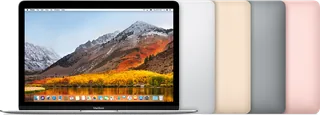
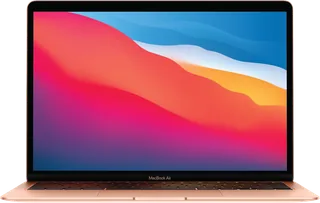
| Colours | Silver, Gold, Space Grey, Rose Gold | Gold, Silver, Space Grey |
| Connections | ||
| Ports | USB-C, headphone jack | 2 × Thunderbolt 3, headphone jack |
| Wi-Fi | Wi-Fi 5 | Wi-Fi 6 |
| Bluetooth | 4.2 | 5.0 |
| Webcam | 480p FaceTime | 720p FaceTime HD |
| Operating system | macOS | macOS |
| Port detail | One USB-C port supporting charging, USB 3.1 Gen 1 up to 5 Gb/s and native DisplayPort 1.2; VGA and HDMI through separate USB-C multiport adaptors. 3.5 mm headphone jack. | Two Thunderbolt / USB 4 ports with charging, DisplayPort, Thunderbolt 3 and USB 4 up to 40 Gb/s, and USB 3.1 Gen 2 up to 10 Gb/s; 3.5 mm headphone jack |
| External displays | One external display up to 4096 × 2304 at 60 Hz alongside the built-in screen, at millions of colours | One external display at up to 6K 60 Hz alongside the built-in display |
| Keyboard | Second-generation butterfly switches (TechRadar); full-size keyboard with 78 US or 79 ISO keys, individual LED backlighting, 12 function keys, four arrow keys and ambient light sensor | Backlit Magic Keyboard; 78 (US) or 79 (ISO) keys with 12 function keys and inverted-T arrow keys; ambient light sensor |
| Trackpad | Force Touch trackpad with pressure sensing, Force clicks and Multi-Touch gestures | Force Touch trackpad |
| Speakers | Stereo speakers | Stereo speakers; wide stereo sound; Dolby Atmos playback |
| Microphones | Dual microphones | Three-mic array with directional beamforming |
| Biometrics | – | Touch ID |
| In the box | MacBook; 30 W USB-C Power Adapter; USB-C Charge Cable (2 m), as listed in Apple's current technical specifications | MacBook Air, 30 W USB-C Power Adapter, USB-C Charge Cable (2 m) |
More comparisons
- Apple MacBook Air 13″ (M1) vs Apple MacBook Air 13″ (M5)
- Apple MacBook (Retina, 12-inch, 2017) vs Apple MacBook Air 13″ (M5)
- Apple MacBook Air 13″ (M1) vs Apple MacBook Air 15″ (M5)
- Apple MacBook Air 13″ (M1) vs Apple MacBook Neo
- Apple MacBook Air 13″ (M1) vs Apple MacBook Air 13″ (M4)
- Apple MacBook Air 13″ (M1) vs Apple MacBook Air 15″ (M4)
- Apple MacBook Air 13″ (M1) vs Apple MacBook Air 13″ (M3)
- Apple MacBook Air 13″ (M1) vs Apple MacBook Air 15″ (M3)
- Apple MacBook Air 13″ (M1) vs Apple MacBook Air 15″ (M2)
- Apple MacBook Air 13″ (M1) vs Apple MacBook Air 13″ (M2)
- Apple MacBook Air 13″ (M1) vs Apple MacBook Pro 13″ (M1)
- Apple MacBook Air 13″ (M1) vs Apple MacBook Air (Retina, 13-inch, 2018)
- Apple MacBook Air 13″ (M1) vs Apple MacBook Air (Retina, 13-inch, 2020)
- Apple MacBook (Retina, 12-inch, Early 2015) vs Apple MacBook Air 13″ (M1)
- Apple MacBook Air (13-inch, 2017) vs Apple MacBook Air 13″ (M1)
- Apple MacBook Air 13″ (M1) vs Apple MacBook Air (Retina, 13-inch, 2019)