Apple MacBook (Retina, 12-inch, Early 2015) vs Apple MacBook Air 13″ (M1)
Better figure, where one is clearly better
| AppleMacBook (Retina, 12-inch, Early 2015) | AppleMacBook Air 13″ (M1) | |
|---|---|---|
| Overview | ||
| Released | April 2015 | November 2020 |
| Display | ||
| Screen size | 12″ | 13.3″ |
| Resolution | 2304 × 1440 | 2560 × 1600 (better) |
| Panel | IPS LCD | IPS LCD |
| Refresh rate | – | 60 Hz |
| Brightness | – | 400 nits |
| Touchscreen | No | No |
| Display type | Retina display; LED-backlit IPS; 16:10 aspect ratio; millions of colours | Retina display; LED-backlit with IPS technology |
| Pixel density | 226 ppi | 227 ppi |
| Colour range | – | Wide colour (P3); millions of colours |
| Screen finish | – | Glossy (Notebookcheck) |
| Display features | Supported scaled resolutions of 1440 × 900, 1280 × 800 or 1024 × 640 | True Tone; 60 Hz refresh rate (Notebookcheck) |
| Performance | ||
| Processor | Intel Core M-5Y31, Intel Core M-5Y51 or Intel Core M-5Y71 | Apple M1 |
| CPU cores | 2 | 8 |
| CPU threads | 4 | – |
| Graphics | Intel HD Graphics 5300 | 7-core GPU or 8-core GPU |
| Memory | 8 GB | 8 GB or 16 GB (better) |
| Storage | 256 GB to 512 GB | 128 GB to 2 TB (better) |
| CPU | Dual-core Intel Core M at Apple's specified 1.1 GHz with Turbo Boost up to 2.4 GHz, 1.2 GHz with up to 2.6 GHz, or 1.3 GHz with up to 2.9 GHz; all with 4 MB shared L3 cache. Exact M-5Y31, M-5Y51 and M-5Y71 identifiers confirmed by Macworld. Apple's configured clocks differ from Intel's nominal base frequencies; the M-5Y31 supports a configurable TDP-up frequency of 1.1 GHz. | 8-core CPU with 4 performance cores and 4 efficiency cores |
| GPU | Intel HD Graphics 5300 | 7-core or 8-core GPU |
| AI engine | – | 16-core Neural Engine |
| Memory type | 8 GB of 1600 MHz LPDDR3 onboard memory | Unified memory, configurable to 16 GB |
| Storage type | PCIe-based onboard flash storage; 256 GB with the 1.1 GHz base or 512 GB with the 1.2 GHz base; either can be ordered with the 1.3 GHz processor | SSD; consumer models started at 256 GB, configurable to 512 GB, 1 TB or 2 TB. Apple's US education price list also lists an 8 GB / 128 GB model with a 7-core GPU. |
| Cooling | Fanless design with no moving parts or vents | Fanless |
| Battery and size | ||
| Battery life (maker's claim) | Up to 10 hours | Up to 18 hours |
| Battery capacity | 39.7 Wh | 49.9 Wh (better) |
| Weight | 0.92 kg (better) | 1.29 kg |
| Thickness | 13.1 mm (better) | 16.1 mm |
| Width × depth | 280.5 × 196.5 mm | 304.1 × 212.4 mm |
| Battery life detail | Terraced lithium-polymer battery; up to 9 hours wireless web, 10 hours iTunes movie playback or 30 days standby. Apple's web and video tests used the 1.2 GHz Core M, 8 GB memory and 512 GB storage. Chassis tapers from 3.5 to 13.1 mm; weight varies by configuration and manufacturing process. | Up to 15 hours wireless web; lithium-polymer battery |
| Charger | 29 W USB-C Power Adapter | 30 W USB-C Power Adapter |
| Materials | Precision-milled aluminium unibody; polished stainless steel Apple logo | 100% recycled aluminium enclosure |
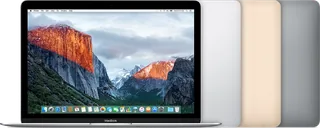
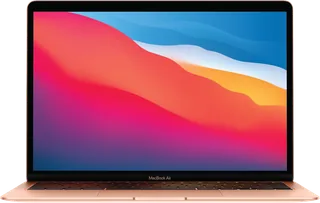
| Colours | Silver, Gold, Space Grey | Gold, Silver, Space Grey |
| Connections | ||
| Ports | USB-C, headphone jack | 2 × Thunderbolt 3, headphone jack |
| Wi-Fi | Wi-Fi 5 | Wi-Fi 6 |
| Bluetooth | 4.0 | 5.0 |
| Webcam | 480p FaceTime | 720p FaceTime HD |
| Operating system | macOS | macOS |
| Port detail | One USB-C port supporting charging, USB 3.1 Gen 1 up to 5 Gb/s and native DisplayPort 1.2; VGA and HDMI through separate USB-C multiport adaptors. 3.5 mm headphone jack supports iPhone headsets with remote and microphone. USB-C does not support Thunderbolt (Macworld). | Two Thunderbolt / USB 4 ports with charging, DisplayPort, Thunderbolt 3 and USB 4 up to 40 Gb/s, and USB 3.1 Gen 2 up to 10 Gb/s; 3.5 mm headphone jack |
| External displays | One external display up to 3840 × 2160 alongside the built-in screen, at millions of colours | One external display at up to 6K 60 Hz alongside the built-in display |
| Keyboard | First-generation butterfly mechanism; full-size keyboard with 78 US or 79 ISO keys, individual LED backlighting, 12 function keys, four arrow keys and ambient light sensor | Backlit Magic Keyboard; 78 (US) or 79 (ISO) keys with 12 function keys and inverted-T arrow keys; ambient light sensor |
| Trackpad | Force Touch trackpad with pressure sensing, Force clicks and Multi-Touch gestures | Force Touch trackpad |
| Speakers | Stereo speakers | Stereo speakers; wide stereo sound; Dolby Atmos playback |
| Microphones | Dual microphones | Three-mic array with directional beamforming |
| Biometrics | – | Touch ID |
| In the box | MacBook; 29 W USB-C Power Adapter; USB-C Charge Cable (2 m) | MacBook Air, 30 W USB-C Power Adapter, USB-C Charge Cable (2 m) |
More comparisons
- Apple MacBook Air 13″ (M1) vs Apple MacBook Air 13″ (M5)
- Apple MacBook Air 13″ (M1) vs Apple MacBook Air 15″ (M5)
- Apple MacBook Air 13″ (M1) vs Apple MacBook Neo
- Apple MacBook Air 13″ (M1) vs Apple MacBook Air 13″ (M4)
- Apple MacBook Air 13″ (M1) vs Apple MacBook Air 15″ (M4)
- Apple MacBook Air 13″ (M1) vs Apple MacBook Air 13″ (M3)
- Apple MacBook Air 13″ (M1) vs Apple MacBook Air 15″ (M3)
- Apple MacBook Air 13″ (M1) vs Apple MacBook Air 15″ (M2)
- Apple MacBook Air 13″ (M1) vs Apple MacBook Air 13″ (M2)
- Apple MacBook Air 13″ (M1) vs Apple MacBook Pro 13″ (M1)
- Apple MacBook Air 13″ (M1) vs Apple MacBook Air (Retina, 13-inch, 2018)
- Apple MacBook Air 13″ (M1) vs Apple MacBook Air (Retina, 13-inch, 2020)
- Apple MacBook (Retina, 12-inch, 2017) vs Apple MacBook Air 13″ (M1)
- Apple MacBook Air (13-inch, 2017) vs Apple MacBook Air 13″ (M1)
- Apple MacBook Air 13″ (M1) vs Apple MacBook Air (Retina, 13-inch, 2019)
- Apple MacBook (Retina, 12-inch, Early 2016) vs Apple MacBook Air 13″ (M1)