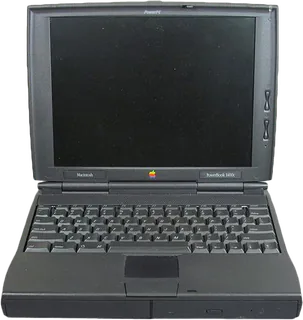
Apple MacBook Air 13″ (M5) vs Apple Macintosh PowerBook 1400c/117
Better figure, where one is clearly better
| AppleMacBook Air 13″ (M5) | AppleMacintosh PowerBook 1400c/117 | |
|---|---|---|
| Overview | ||
| Released | March 2026 | November 1996 |
| Display | ||
| Screen size | 13.6″ | 11.3″ |
| Resolution | 2560 × 1664 (better) | 800 × 600 |
| Panel | IPS LCD | – |
| Refresh rate | 60 Hz | – |
| Brightness | 500 nits | – |
| Touchscreen | No | No |
| Display type | Liquid Retina display; LED-backlit with IPS technology | 11.3-inch CCFL-backlit active-matrix TFT colour LCD with 800 × 600 resolution. Apple lists 16-bit colour in its service sheet. |
| Pixel density | 224 ppi | – |
| Colour range | Wide colour (P3); 1 billion colours | – |
| Display features | True Tone | – |
| Performance | ||
| Processor | Apple M5 | PowerPC 603e 117 MHz (PowerBook 1400) |
| CPU cores | 10 | 1 |
| Graphics | 8-core GPU or 10-core GPU | – |
| Memory | 16 GB, 24 GB or 32 GB (better) | 16 MB |
| Storage | 512 GB to 4 TB (better) | 1 GB |
| CPU | 10-core CPU with 4 super cores and 6 efficiency cores | 117 MHz PowerPC 603e on a 33.3 MHz bus; 32 KB L1 cache and no L2 cache in the original service configuration. |
| GPU | Neural Accelerators; hardware-accelerated ray tracing; Media Engine with H.264, HEVC, ProRes and ProRes RAW acceleration and AV1 decode | – |
| AI engine | 16-core Neural Engine | – |
| Memory type | Unified memory | 16 MB RAM in Apple's original 1996 developer-note configuration, expandable to 64 MB. Apple's later service sheet lists a 32 MB minimum, conflicting with the original developer note. |
| Memory bandwidth | 153 GB/s | – |
| Storage type | SSD, configurable up to 4 TB | 1 GB internal 2.5-inch IDE hard drive in Apple's original developer note. The expansion bay took a 1.4 MB floppy module or a 6× CD-ROM module, both supplied with this configuration. |
| Cooling | Fanless | – |
| Battery and size | ||
| Battery life (maker's claim) | Up to 18 hours | Up to 5 hours |
| Battery capacity | 53.8 Wh (better) | 30 Wh |
| Weight | 1.23 kg | – |
| Thickness | 11.3 mm | – |
| Width × depth | 304.1 × 215 mm | – |
| Battery life detail | Up to 15 hours wireless web; lithium-polymer battery | 30 Wh removable nickel-metal hydride battery; Apple claimed up to five hours. Its service sheet lists 6.6 lb weight with a note that installed modules affect it. |
| Charger | Sold separately in the UK (30 W, 35 W dual-port or 70 W Apple USB-C adapters offered); needs at least 30 W over USB PD | – |
| Fast charging | With a 70 W or higher USB PD power source | – |
| Materials | 100% recycled aluminium enclosure; 55% recycled content overall | – |
| Colours | Sky Blue, Silver, Starlight, Midnight | – |
| Connections | ||
| Ports | 2 × Thunderbolt 4, MagSafe 3, headphone jack | – |
| Wi-Fi | Wi-Fi 7 | – |
| Bluetooth | 6 | – |
| Webcam | 12MP Center Stage | – |
| Operating system | macOS | macOS |
| Port detail | 2 × Thunderbolt 4 (USB-C) with charging, DisplayPort, Thunderbolt 4 and USB 4 (up to 40 Gb/s); MagSafe 3; 3.5 mm headphone jack with high-impedance headphone support | ADB, HDI-30 SCSI, RS-422 serial/LocalTalk, audio input and output, infrared, and two Type II PC Card slots (or one Type III). Ethernet required an optional expansion or PC Card; external video required an optional mini-15 card. |
| External displays | Up to two at 6K 60 Hz or 4K 144 Hz, or one at up to 8K 60 Hz, 5K 120 Hz or 4K 240 Hz, alongside the built-in display | – |
| Keyboard | Backlit Magic Keyboard, 78 (ANSI) or 79 (ISO) keys including 12 full-height function keys | – |
| Trackpad | Force Touch trackpad | Built-in trackpad with tap, double-tap and drag support. |
| Speakers | Four-speaker sound system; Spatial Audio with Dolby Atmos | – |
| Microphones | Three-mic array with directional beamforming; Voice Isolation and Wide Spectrum modes | – |
| Biometrics | Touch ID | – |
| In the box | 13-inch MacBook Air, USB-C to MagSafe 3 Cable (2 m); power adapter sold separately | System 7.5.3, battery, floppy module and 6× CD-ROM module. Apple lists an October 1996 introduction; contemporary launch coverage says machines were expected in mid-November. |

More comparisons
- Apple MacBook Air 13″ (M5) vs Apple Macintosh PowerBook Duo 250
- Apple MacBook Air 13″ (M5) vs Apple Macintosh PowerBook Duo 280
- Apple MacBook Air 13″ (M2) vs Apple MacBook Air 13″ (M5)
- Apple MacBook Air 13″ (M3) vs Apple MacBook Air 13″ (M5)
- Apple MacBook Air 13″ (M5) vs Apple Macintosh PowerBook 150
- Apple MacBook Air 13″ (M5) vs Apple Macintosh PowerBook 520c
- Apple MacBook Air 13″ (M5) vs Apple Macintosh PowerBook 540
- Apple MacBook Air 13″ (M5) vs Apple Macintosh PowerBook 5300/100
- Apple MacBook Air 13″ (M5) vs Apple Macintosh PowerBook 5300cs/100
- Apple MacBook Air 13″ (M5) vs Apple Macintosh PowerBook Duo 280c
- Apple MacBook Air 13″ (M5) vs Sony VAIO P (VGN-P11Z)
- Apple MacBook Air 13″ (M5) vs Sony VAIO Z (VGN-Z11WN/B)
- Apple MacBook Air 13″ (M1) vs Apple MacBook Air 13″ (M5)
- Apple MacBook Air 13″ (M5) vs Apple MacBook Air (Retina, 13-inch, 2018)
- Apple MacBook Air 13″ (M5) vs Apple MacBook Air (Retina, 13-inch, 2020)
- Apple MacBook (Retina, 12-inch, 2017) vs Apple MacBook Air 13″ (M5)