Apple Macintosh 512Ke vs Apple Macintosh Performa 5400/160
Better figure, where one is clearly better
| AppleMacintosh 512Ke | AppleMacintosh Performa 5400/160 | |
|---|---|---|
| Overview | ||
| Released | – | 1996 |
| Performance | ||
| Processor | 68000 8 MHz (Macintosh 512Ke) | PowerPC 603e (160 MHz, Macintosh Performa 5400/160) |
| CPU cores | 1 | 1 |
| Memory | 512 KB | 16 MB (better) |
| Storage | – | 1.6 GB |
| CPU | Motorola MC68000, nominally 8 MHz with the exact 7.8336 MHz clock frequency published in the original owner guide and technical library; 32-bit internal architecture and 16-bit external data path. No PMMU, FPU, CPU cache or second processor. | 160 MHz PowerPC 603e with integrated floating-point and memory management units, 32 KB L1 cache and 64-bit memory bus. Optional High Performance Module adds 256 KB L2 cache; it is not standard. Current Apple support gives a 40 MHz data path clock. |
| GPU | – | 1 MB DRAM framebuffer independent of system RAM. Shared Service Source explicitly supports 640 × 480 at 60 or 67 Hz and 800 × 600 at 60 or 72 Hz with 16-bit colour; 832 × 624 at 75 Hz uses 8-bit colour and does not support video input. Current support additionally lists 1024 × 768, but the exact technical specification and shared service manual restrict the built-in CRT to 832 × 624; the higher database row is not adopted as the built-in display resolution. |
| Memory type | Fixed 512 KB RAM and 128 KB ROM; no RAM slots or built-in memory expansion. The enhanced model has the larger ROM and double-sided floppy drive, without the Macintosh Plus’s expandable memory or SCSI connector. | 16 MB standard, comprising 8 MB soldered RAM and one 8 MB DIMM. Two 168-pin 64-bit DIMM slots allow expansion to 136 MB with two 64 MB modules. Use 70 ns or faster fast-paged-mode DIMMs with 1K or 2K refresh. Modules can be installed individually. 4 MB ROM. |
| Storage type | One internal 800 KB double-sided 3.5-inch floppy drive, with optional external 400 KB or 800 KB drive. No fixed internal storage or internal CD-ROM. Apple Hard Disk 20 is an optional external device attached through the disk interface, not an internal or SCSI drive. | Exact 160 MHz maker specification, ordering description and Service Source configuration agree on a 1.6 GB IDE hard drive, Apple SuperDrive 1.44 MB floppy drive and internal 8× AppleCD CD-ROM drive. November 1996 Apple Facts gives a 1.2 GB drive for the broader 160/180 Performa family; that unqualified family figure is not transferred to the exact configuration. |
| Expansion slots | None; no standard internal memory expansion. A separately included programmer’s switch can be fitted for reset and interrupt functions by application developers. | One PCI slot for a 6.88-inch, 15 W card; communications slot occupied by the supplied modem; optional video-input card and TV/FM tuner bay. Optional Apple External Video Connector enables mirroring; optional Apple Presentation System provides NTSC/PAL output. NuBus cards cannot be used in the PCI slot. |
| Display | ||
| Screen size | 9″ | 12.8″ |
| Resolution | 512 × 342 | 832 × 624 (better) |
| Panel | CRT | CRT |
| Refresh rate | – | 75 Hz |
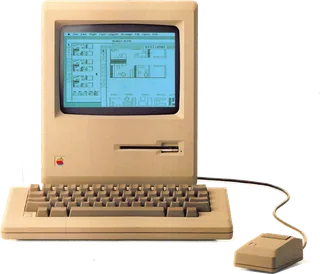
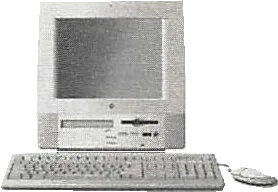
| Display type | Built-in 9-inch monochrome bit-mapped CRT, 512 × 342 pixels. Original owner guide and technical-library sheet agree; the current Apple table’s generic 512 × 384 entry is expressly corrected by its own screen-size note. Native refresh rate unpublished in these exact sources. | 15-inch nominal RGB CRT with 12.8-inch viewable diagonal and 0.28 mm dot pitch. Noninterlaced flat square tube. Base tilts from −5° to +15° and swivels 360°. Resolution can be changed without restarting. |
| Connections | ||
| Ports | Headphone jack | 2 × headphone jack |
| Front ports | – | Headphone output and volume controls; built-in infrared remote capability. Remote-control inclusion varies with regional configuration. |
| Back ports | DB-9 mouse connector, RJ11 synchronous serial keyboard bus, two DB-9 RS-232/RS-422 serial connectors, external floppy DB-19 and sound output for amplifier/headphones. No ADB, USB, FireWire, Ethernet, external video or SCSI connector. Current Apple support warns that the serial ports do not support handshaking or synchronous modems. | One ADB port; two GeoPort-compatible RS-232/422 serial ports, including LocalTalk support; DB-25 SCSI; stereo sound input and rear stereo sound output. Optional DB-15 external-video connector, not a standard fitted port. Built-in 28.8 Kbit/s V.34 data/fax/voice modem supports MNP4, V.42, MNP5 and V.42bis; optional Ethernet replaces the communications-slot modem. No USB or FireWire. |
| External displays | – | Optional external-video connector provides mirroring of the built-in screen. Connector kit, suitable cable and external display required; external video does not establish an independent second desktop. |
| Speakers | Built-in sound system; original maker guide specifies four-voice sound with 8-bit digital-to-analogue conversion at 22 kHz. No built-in microphone. | Built-in stereo speakers and 16-bit stereo sound with SRS 3D surround enhancement. Shared service manual identifies separate front and rear stereo output jacks. Headline jack count excludes the sound-input port. |
| Microphones | – | Built-in microphone and stereo sound-input port; the input also supports an external Apple PlainTalk microphone. Shared manual explicitly excludes the earlier Apple Omni microphone from this input. |
| Keyboard and mouse | Original guide describes a separate 58-key detachable keyboard, mouse, System Tools disk, Guided Tour disk and audio cassette, plus a programmer’s switch. Maker cover shows an extended keyboard with numeric keypad; gallery photos can include optional external drives, keyboards, printers and other separately supplied equipment. These are labelled rather than treated as standard computer hardware. | Exact maker ordering description includes keyboard, mouse and necessary cables; the CRT, microphone, speakers, modem, CD-ROM, floppy drive and hard drive are built into the computer. Optional TV/FM and video hardware varies by regional bundle. |
| Design and power | ||
| Type | All-in-one | All-in-one |
| Weight | 7.5 kg (better) | 21 kg |
| Width × depth × height | 246 × 276 × 346 mm | 383 × 406 × 445 mm |
| Operating system | macOS | macOS |
| Size and weight detail | Main figures use later exact Apple technical-library metric values: 346 mm high × 246 mm wide × 276 mm deep and 7.5 kg main-unit weight. Original 1986 owner guide instead gives 344 mm height; current support retains 13.6H × 9.6W × 10.9D inches. These small maker rounding differences are retained explicitly. Keyboard and mouse excluded; original guide separately lists 1.2 kg keyboard and 0.2 kg mouse. | Exact maker specification gives 445 × 383 × 406 mm (height × width × depth) and 21 kg. Its 17.5 × 15.1 × 16 inches and 47 lb are retained as maker-rounded equivalents. Apple Facts notes weight varies with installed internal devices; no shipping-package mass is used. |
| Power supply | Exact technical-library sheet specifies 105–125 V AC, 50–60 Hz and maximum 60 W for this documented voltage version; no universal-voltage claim. User-replaceable 4.5 V Eveready No. 523 or equivalent clock battery. | 220 W maximum continuous input, nominal 110–240 V AC at 50–60 Hz, single phase. Low-power sleep mode supported. Current maker table gives a 4.5 V alkaline clock battery; maximum input is not normal operating consumption. |
| In the box | Exact original guide is titled Macintosh 512K enhanced, the long name of Macintosh 512Ke. Current maker support lists introduction 14 April 1986 and discontinuation 1 September 1987; a distinct first retail-sale date has not been established, so released is omitted. The guide names Macintosh 512K enhanced System Tools; the current support table’s retrospective original-system-software entry is not adopted as a verified launch disk version. Photographs are original maker owner-guide images of this exact model, with scan colour casts and period screen contents retained. | System 7.5.3 with System Enabler 410, Apple Guide, QuickTime, Macintosh PC Exchange and QuickDraw 3D. Exact October 1996 ordering description and November Apple Facts dealer catalogue establish retail offering in 1996; precise first-sale month or day remains unestablished. Apple's recorded introduction is 5 August 1996. Service Source identifies sale in Japan, Australia and Europe; not sold in the US. This 160 MHz configuration is distinct from the existing Power Macintosh 5400/120, 5400/180 and 5400/200. No unsupported official predecessor link assigned. |
More comparisons
- Apple Macintosh Performa 5400/160 vs Apple Power Macintosh 5260/100
- Apple Macintosh Performa 5400/160 vs Apple Power Macintosh 5260/120
- Apple Macintosh Performa 5400/160 vs Apple Power Macintosh 5400/120
- Apple Macintosh Performa 5400/160 vs Apple Macintosh Performa 6360
- Apple Macintosh Performa 5400/160 vs Apple Macintosh Performa 6400/180
- Apple Macintosh Performa 5400/160 vs Apple Macintosh Performa 6400/200
- Apple Macintosh LC 580 vs Apple Macintosh Performa 5400/160
- Apple Macintosh Performa 5200CD vs Apple Macintosh Performa 5400/160
- Apple Macintosh Performa 5300CD vs Apple Macintosh Performa 5400/160
- Apple Macintosh Performa 5400/160 vs Apple Macintosh Performa 6300CD
- Apple Macintosh Performa 5400/160 vs Apple Power Macintosh 6200/75
- Apple Macintosh Performa 5400/160 vs Apple Power Macintosh 5400/180
- Apple Macintosh Performa 5400/160 vs Apple Macintosh Quadra 610 DOS Compatible
- Apple Macintosh LC 550 vs Apple Macintosh Performa 5400/160
- Apple Macintosh LC 575 vs Apple Macintosh Performa 5400/160
- Apple Macintosh LC 630 vs Apple Macintosh Performa 5400/160