Apple Macintosh Performa 6360 vs Apple Twentieth Anniversary Macintosh
Better figure, where one is clearly better
| AppleMacintosh Performa 6360 | AppleTwentieth Anniversary Macintosh | |
|---|---|---|
| Overview | ||
| Released | 1996 | – |
| Performance | ||
| Processor | PowerPC 603e 160 MHz (Macintosh Performa 6360) | PowerPC 603e 250 MHz (Power Macintosh 6500/250) |
| CPU cores | 1 | 1 |
| Graphics | – | ATI 3D RAGE II (2 MB SGRAM) |
| Memory | 16 MB | 32 MB (better) |
| Storage | 1.2 GB | 2 GB (better) |
| CPU | 160 MHz PowerPC 603e with integrated floating-point unit, 32 KB L1 cache, optional L2 cache and 64-bit data path at 40 MHz | 250 MHz PowerPC 603e with integrated floating-point unit, 50 MHz system bus, 32 KB L1 cache split into 16 KB data/instruction caches, and a 256 KB L2 High Performance Cache Module operating at 50 MHz. No processor supplier is assigned without exact maker evidence. |
| GPU | Built-in video with 1 MB DRAM supports 640 × 480 at 16-bit colour and 1024 × 768 at 8-bit colour | ATI 3D RAGE II with 2 MB SGRAM, with QuickDraw 2D/3D and video acceleration. The maker specifies thousands of colours at 800 × 600; application-window restrictions apply to accelerated 3D at that mode. |
| Memory type | 8 MB on the logic board, two 168-pin DIMM slots and 16–136 MB total supported by Apple | 32 MB EDO RAM supplied as one 32 MB DIMM or two 16 MB DIMMs; two 168-pin slots support up to 128 MB. Exact Apple TIL specifies 5 V EDO or fast-paged DIMMs, 60 ns or faster, with 2K refresh; 3.3 V or 4K-refresh DIMMs are incompatible. 4 MB ROM. |
| Storage type | 1.2 GB internal IDE hard drive, 1.44 MB floppy drive and 8× CD-ROM drive | 2 GB ATA/IDE hard disk, vertically mounted 4× CD-ROM and manual-insert 1.44 MB Apple SuperDrive floppy. Optical-drive output and the TV/FM tuner are controlled by the supplied infrared remote. |
| Expansion slots | PCI, communications, TV and video input/output expansion positions | One PCI 2.0 slot for a 6.88-inch card drawing up to 15 W, plus a Comm Slot II for a modem or Ethernet card. A separate video-input slot and TV/FM tuner card are fitted. Macintosh-specific PCI drivers are required; NuBus cards are incompatible. |
| Display | ||
| Screen | None built in | 12.1″ |
| Resolution | – | 800 × 600 |
| Refresh rate | – | 60 Hz |
| Display type | – | 12.1-inch backlit active-matrix colour LCD, 800 × 600 at 60 Hz; 6 bits per red/green/blue channel. Maker does not name the LCD subtype, so IPS or TN is not guessed. |
| Connections | ||
| Ports | Headphone jack | 2 × headphone jack |
| Back ports | DB-15 monitor output, Apple Desktop Bus, external DB-25 SCSI, two GeoPort serial connectors, PlainTalk microphone input and speaker output; front headphone jack | One ADB, external DB-25 SCSI for up to six devices, two GeoPort-compatible serial ports, rear stereo output, two separate stereo audio inputs, S-video input with a supplied composite-video adapter, TV aerial/cable connector and FM aerial connector. One front headphone output plus one rear headphone-compatible line output are counted. No built-in USB, FireWire or Ethernet. |
| External displays | – | No external monitor output specified |
| Speakers | – | Custom Bose Acoustimass system with integrated stereo speakers and a separate floor-standing bass unit. The power-supply ratings are not acoustic output ratings. |
| Microphones | – | Built-in omnidirectional electret microphone |
| Keyboard and mouse | – | Custom keyboard with Italian leather palm rests, removable/repositionable ADB trackpad, infrared remote, Bose bass unit and composite-to-S-video adapter. January1998 Apple catalogue lists a 33.6 Kbps GeoPort modem/Internet Connection Kit; older power-test conditions separately describe a 28.8 Kbps modem. |
| Design and power | ||
| Type | Compact | All-in-one |
| Weight | – | 6.8 kg |
| Width × depth × height | – | 419 × 254 × 438 mm |
| Operating system | macOS | macOS |
| Size and weight detail | Apple lists 4.3 × 12.6 × 16.5 inches (height × width × depth) and 17 lb | Headline size and 6.8 kg weight describe the main unit only. Separate bass unit weighs 4.8 kg and measures 270 × 211 × 298 mm (height × width × depth); keyboard is 0.84 kg and 25 × 292 × 207 mm. Main-unit metric dimensions follow the original maker table rather than converting its rounded inch values. |
| Power supply | Apple lists a 150 W maximum, 90–270 V AC at 47–63 Hz and a 4.5 V alkaline clock battery | Bass-unit voltage selector covers 90–130 or 180–264 V AC, 47–63 Hz, single phase; manually configured and factory preset |
| Power use | – | Maximum continuous AC input 140 W; maximum continuous DC output 70 W. Typical AC input 47 W is qualified to the maker test with 250 MHz 603e, 2 GB disk, 28.8 Kbps modem, L2 module and CD-ROM; sleep is below 30 W without PCI cards. |
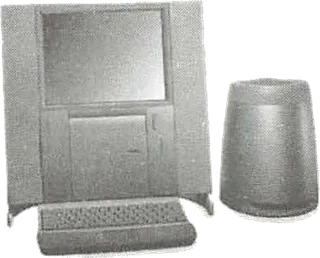
| In the box | Original System Software 7.5.3 with System Enabler 410. Apple lists 1 October 1996 as introduction; a distinct maker first-sale date was not established. | Mac OS 7.6.1 with System Enabler 704 originally. Apple support labels introduction as 1 June 1997; widely copied March dates describe announcements, and the accessible May order notice does not establish actual first delivery. Released is omitted pending exact first-sale evidence. Earlier preview articles describe a proposed 604e machine and are not used for this production 603e model. The primary picture is a grayscale original Apple catalogue image, retained without colour reconstruction; higher-quality original colour press imagery remains unavailable. |
More comparisons
- Apple Mac mini (M4 or M4 Pro) vs Apple Macintosh Performa 6360
- Apple Macintosh Performa 6360 vs Apple Power Macintosh 7300/166
- Apple Macintosh Performa 6360 vs Apple Power Macintosh 7300/180
- Apple Power Macintosh 5400/200 vs Apple Twentieth Anniversary Macintosh
- Apple Power Macintosh 5500/225 vs Apple Twentieth Anniversary Macintosh
- Apple Macintosh Performa 6360 vs Apple Power Macintosh 4400/160
- Apple Macintosh Performa 6360 vs Apple Power Macintosh 6300/120
- Apple Macintosh Performa 5400/160 vs Apple Macintosh Performa 6360
- Apple Macintosh Performa 6360 vs Apple Power Macintosh 7200/120
- Apple Macintosh Performa 6360 vs Apple Macintosh Performa 6400/180
- Apple Macintosh Performa 6360 vs Apple Macintosh Performa 6400/200
- Apple Macintosh LC 580 vs Apple Macintosh Performa 6360
- Apple Macintosh Performa 5200CD vs Apple Macintosh Performa 6360
- Apple Macintosh Performa 5300CD vs Apple Macintosh Performa 6360
- Apple Macintosh Performa 6300CD vs Apple Macintosh Performa 6360
- Apple Macintosh Performa 6360 vs Apple Power Macintosh 6200/75