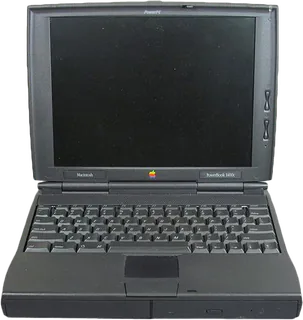
Apple Macintosh Portable (1989) vs Apple Macintosh PowerBook 1400c/117
Better figure, where one is clearly better
| AppleMacintosh Portable (1989) | AppleMacintosh PowerBook 1400c/117 | |
|---|---|---|
| Overview | ||
| Released | September 1989 | November 1996 |
| Display | ||
| Screen size | 10″ | 11.3″ |
| Resolution | 640 × 400 | 800 × 600 (better) |
| Touchscreen | No | No |
| Display type | Original reflective active-matrix monochrome LCD, 640 × 400 pixels and 1-bit colour. User guide gives a 10-inch diagonal, while the developer note gives 9.8 inches; this is the original unlit display, not the later backlit model | 11.3-inch CCFL-backlit active-matrix TFT colour LCD with 800 × 600 resolution. Apple lists 16-bit colour in its service sheet. |
| Performance | ||
| Processor | MC68HC000 16 MHz (Macintosh Portable) | PowerPC 603e 117 MHz (PowerBook 1400) |
| CPU cores | 1 | 1 |
| Memory | 1 MB | 16 MB (better) |
| Storage | 40 MB | 1 GB (better) |
| CPU | Motorola MC68HC000 CMOS processor at 16 MHz; no floating-point unit, MMU or CPU cache. Separate controllers handle keyboard and power management | 117 MHz PowerPC 603e on a 33.3 MHz bus; 32 KB L1 cache and no L2 cache in the original service configuration. |
| Memory type | 1 MB static RAM supplied; original Apple expansion cards give 2 MB or 5 MB total. Later combined support specifications list up to 8 MB; 256 KB ROM | 16 MB RAM in Apple's original 1996 developer-note configuration, expandable to 64 MB. Apple's later service sheet lists a 32 MB minimum, conflicting with the original developer note. |
| Storage type | Base machine has a 1.44 MB SuperDrive floppy and no fixed drive. Optional internal 40 MB SCSI hard disk or second internal floppy drive; hard-drive configuration shown separately | 1 GB internal 2.5-inch IDE hard drive in Apple's original developer note. The expansion bay took a 1.4 MB floppy module or a 6× CD-ROM module, both supplied with this configuration. |
| Battery and size | ||
| Battery life (maker's claim) | – | Up to 5 hours |
| Battery capacity | – | 30 Wh |
| Weight | 7.16 kg | – |
| Thickness | 102.87 mm | – |
| Width × depth | 387.35 × 365.25 mm | – |
| Battery life detail | Lead-acid main battery and 9 V backup battery. Apple claims 6–12 hours between charges depending on use and connected peripherals; no fixed headline runtime inferred. Weight is 7.16 kg with Apple hard disk and battery, or 6.25 kg without hard disk; rear closed height is 102.87 mm and front closed height 53.34 mm | 30 Wh removable nickel-metal hydride battery; Apple claimed up to five hours. Its service sheet lists 6.6 lb weight with a note that installed modules affect it. |
| Charger | Supplied charger recharges the main battery; the computer continues drawing power from the battery rather than directly from the charger. Recharge is slower during use | – |
| Connections | ||
| Operating system | macOS | macOS |
| Port detail | One ADB, DB-19 external floppy, DB-25 SCSI, two Mini-DIN-8 serial ports, external video connector and stereo sound output. No Ethernet or USB. Optional internal 300/1200/2400 bit/s modem | ADB, HDI-30 SCSI, RS-422 serial/LocalTalk, audio input and output, infrared, and two Type II PC Card slots (or one Type III). Ethernet required an optional expansion or PC Card; external video required an optional mini-15 card. |
| External displays | External video requires the Macintosh Portable Video Adapter, which Apple's launch release said would become available later; not an included launch accessory | – |
| Keyboard | Keyboard and trackball can exchange sides; optional numeric keypad replaces the trackball, requiring an external pointing device | – |
| Trackpad | Built-in trackball; no trackpad | Built-in trackpad with tap, double-tap and drag support. |
| In the box | Original System 6.0.4, HyperCard and documentation; user guide describes a supplied low-power ADB mouse, while the developer note describes it as optional. Apple's US launch release dated 20 September 1989 states immediate availability through authorised dealers and VARs; exact dates in other regions were not established. User guide's metric depth 365.25 mm conflicts with its imperial 14.83-inch figure; metric value retained | System 7.5.3, battery, floppy module and 6× CD-ROM module. Apple lists an October 1996 introduction; contemporary launch coverage says machines were expected in mid-November. |
More comparisons
- Apple MacBook Air 13″ (M5) vs Apple Macintosh PowerBook 1400c/117
- Apple Macintosh PowerBook 1400c/117 vs Apple PowerBook G4 (15-inch, Double-Layer SD)
- Apple Macintosh PowerBook 1400c/117 vs Apple PowerBook G4 (17-inch, Double-Layer SD)
- Apple Macintosh PowerBook 1400c/117 vs Apple PowerBook G4 (15-inch, 1.67/1.5GHz)
- Apple Macintosh PowerBook 1400c/117 vs Apple PowerBook G4 (17-inch, 1.67GHz)
- Apple Macintosh PowerBook 1400c/117 vs Apple PowerBook G4 (12-inch, 1.5GHz)
- Apple Macintosh PowerBook 1400c/117 vs Apple PowerBook G4 (12-inch, 1.33GHz)
- Apple Macintosh PowerBook 1400c/117 vs Apple PowerBook G4 (15-inch, 1.5/1.33GHz)
- Apple Macintosh PowerBook 1400c/117 vs Apple PowerBook G4 (17-inch, 1.5GHz)
- Apple Macintosh Portable (1989) vs Sony VAIO TR (PCG-TR1MP)
- Apple Macintosh PowerBook 1400c/117 vs Apple PowerBook G3 (Original, 1997)
- Apple Macintosh PowerBook 1400c/117 vs Apple Macintosh PowerBook 1400c/166
- Apple Macintosh PowerBook 1400c/117 vs Apple Macintosh PowerBook 1400c/133
- Apple Macintosh PowerBook 1400c/117 vs Apple Macintosh PowerBook 1400cs/133
- Apple Macintosh PowerBook 1400c/117 vs Apple Macintosh PowerBook 1400cs/166
- Apple Macintosh PowerBook 1400c/117 vs Apple Macintosh PowerBook 1400cs/117