Apple Macintosh Portable (Backlit, 1991) vs Apple Macintosh PowerBook Duo 2300c/100
Better figure, where one is clearly better
| AppleMacintosh Portable (Backlit, 1991) | AppleMacintosh PowerBook Duo 2300c/100 | |
|---|---|---|
| Overview | ||
| Released | 1991 | August 1995 |
| Display | ||
| Screen size | 9.8″ | 9.5″ |
| Resolution | 640 × 400 | 640 × 480 (better) |
| Touchscreen | No | No |
| Display type | Backlit active-matrix monochrome LCD, 640 × 400 pixels and 1-bit colour; 9.8-inch diagonal from EveryMac. Apple’s 1991 developer note confirms adjustable backlighting through its control panel, keyboard sequences and application software; no LCD subtype or native refresh published | 9.5-inch backlit active-matrix colour LCD; 256 colours at 640 × 480 or 32,768 colours at 640 × 400. |
| Performance | ||
| Processor | MC68HC000 16 MHz (Macintosh Portable) | PowerPC 603e 100 MHz (PowerBook Duo 2300c/100) |
| CPU cores | 1 | 1 |
| Memory | 2 MB or 4 MB | 20 MB (better) |
| Storage | 40 MB | 1.1 GB (better) |
| CPU | CMOS Motorola MC68HC000 at 16 MHz; no floating-point unit, MMU or CPU cache. The 1991 developer note specifies zero-wait-state expansion RAM access and slower timing in idle mode | 100 MHz PowerPC 603e with 32 KB L1 cache and 33 MHz data path. |
| Memory type | Pseudostatic RAM replaces the original machine’s SRAM; 2 MB or 4 MB retail configurations with 256 KB ROM. Apple’s developer note describes a keyed 50-pin RAM connector with changed pin assignments and expansion to 8 MB with timing qualifications; original cards are not universally interchangeable | Japanese 20 MB factory configuration, expandable to 56 MB; 8 MB on the logic board and one Duo RAM slot. |
| Storage type | 40 MB internal SCSI hard disk and one 1.44 MB FDHD SuperDrive floppy in the new retail configurations, according to contemporary TidBITS coverage and Apple’s March 1991 service guide. The 40 MB configuration is stored as 40/1024 GB for the site’s MB formatter | 1.1 GB internal hard drive in the Japanese configuration; external floppy drive and CD-ROM access require accessories or a dock. |
| Connections | ||
| Operating system | macOS | macOS |
| Port detail | One ADB port, external floppy port, DB-25 SCSI, two RS-232/RS-422 serial ports, stereo sound output, power connector and video output. Apple’s guide also lists optional ROM, RAM and 2400 bit/s modem expansion and a 96-pin processor-direct slot; no Ethernet or USB | RS-422 serial/LocalTalk, 152-pin Duo dock connector, power input and built-in 14.4 kbps Express modem in the Japanese configuration; no built-in Ethernet. |
| Speakers | – | Built-in mono speaker and microphone; stereo output through an optional Duo Dock. |
| Keyboard | Built-in Macintosh-layout keyboard and 1.3-inch trackball; 18-key numeric keypad can replace the trackball. The keyboard and trackball can be arranged for left-handed use | – |
| Trackpad | Built-in trackball; no trackpad | – |
| In the box | Exact first-sale day and month unconfirmed. Apple announced order availability on 11 February 1991, according to that day’s TidBITS; July recall coverage says certain adapters began shipping with the backlit model in March. Apple’s June 1991 support article confirms the control panel shipped with new computers, establishing retail delivery during 1991. The announcement is not used as a first-delivery date | Japanese 20 MB/1.1 GB configuration supplied with KanjiTalk 7.5.2, Express modem, Type III battery and power adapter. |
| Battery and size | ||
| Battery life (maker's claim) | – | Up to 4 hours |
| Weight | – | 2.2 kg |
| Thickness | – | 38 mm |
| Width × depth | – | 277 × 216 mm |
| Battery life detail | Lead-acid main battery. Contemporary TidBITS coverage gives 3–6 hours with backlighting, not a fixed maker runtime; no headline runtime inferred. Apple’s combined original/backlit support table lists 15.8 lb and closed dimensions of 4.05 × 15.25 × 14.83 inches (height × width × depth); exact revised-model metric figures were not established | Removable Type III nickel-metal hydride battery; Apple quoted two to four hours per charge. |
| Charger | Apple’s March 1991 service guide gives 85–270 V AC, 48–62 Hz and 15 W maximum, while its later combined support table gives 70–270 V and a 5 W figure; these are not treated as interchangeable claims | – |
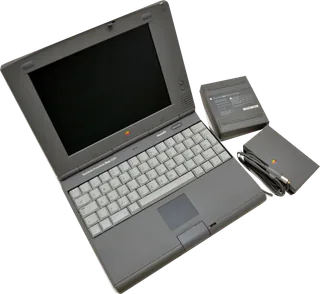
More comparisons
- Apple MacBook Air 13″ (M5) vs Apple Macintosh PowerBook Duo 2300c/100
- Apple Macintosh Portable (Backlit, 1991) vs Sony VAIO P (VPCP11S1E)
- Apple Macintosh Portable (Backlit, 1991) vs Sony VAIO P (VGN-P11Z)
- Apple Macintosh PowerBook Duo 2300c/100 vs Apple PowerBook G4 (15-inch, Double-Layer SD)
- Apple Macintosh PowerBook Duo 2300c/100 vs Apple PowerBook G4 (17-inch, Double-Layer SD)
- Apple Macintosh PowerBook Duo 2300c/100 vs Apple PowerBook G4 (15-inch, 1.67/1.5GHz)
- Apple Macintosh PowerBook Duo 2300c/100 vs Apple PowerBook G4 (17-inch, 1.67GHz)
- Apple Macintosh PowerBook Duo 2300c/100 vs Apple PowerBook G4 (12-inch, 1.5GHz)
- Apple Macintosh PowerBook Duo 2300c/100 vs Apple PowerBook G4 (12-inch, 1.33GHz)
- Apple Macintosh PowerBook Duo 2300c/100 vs Apple PowerBook G4 (15-inch, 1.5/1.33GHz)
- Apple Macintosh PowerBook Duo 2300c/100 vs Apple PowerBook G4 (17-inch, 1.5GHz)
- Apple Macintosh Portable (Backlit, 1991) vs Apple Macintosh PowerBook 2400c/240
- Apple Macintosh PowerBook 2400c/180 vs Apple Macintosh PowerBook Duo 2300c/100
- Apple Macintosh Portable (Backlit, 1991) vs Apple Macintosh PowerBook 2400c/180
- Apple Macintosh PowerBook Duo 2300c/100 vs Apple Macintosh PowerBook Duo 250
- Apple Macintosh PowerBook Duo 2300c/100 vs Apple Macintosh PowerBook Duo 280