Apple Macintosh Quadra 610 DOS Compatible vs Apple Macintosh Quadra 630
Better figure, where one is clearly better
| AppleMacintosh Quadra 610 DOS Compatible | AppleMacintosh Quadra 630 | |
|---|---|---|
| Overview | ||
| Released | March 1994 | 1994 |
| Performance | ||
| Processor | Motorola 68LC040 25 MHz (Macintosh Quadra 610 DOS Compatible) | 68040 33 MHz (Macintosh Quadra 650) |
| CPU cores | 1 | 1 |
| Memory | 8 MB | 4 MB or 8 MB |
| Storage | 160 MB | 250 MB (better) |
| CPU | Original Apple TIL 14670, 13884 and shared Service Source identify a 25 MHz Motorola 68LC040 for Macintosh applications and a separate 25 MHz Intel 486SX on the DOS card, both with 32-bit data paths. The 68LC040 has a built-in memory management unit and no FPU; neither processor is the full-FPU 68040 or 486DX. Current support uses generic 68040/optional-FPU wording; this factory configuration follows the exact original documentation. Main processor comparisons describe the Macintosh CPU, not two identical processors. | Motorola MC68040 with integrated floating-point unit, paged memory management and 8 KB cache. Apple gives nominal 33 MHz in its support table and October 1994 catalogue; its developer note explains the 33 MHz bus and 66 MHz internal clock. The LC 630 and Performa 630 use the FPU-less MC68LC040 instead |
| GPU | Macintosh video has 512 KB VRAM expandable to 1 MB; the DOS card has separate 512 KB video memory. At Macintosh 640 × 480, base VRAM gives 8-bit colour and expanded VRAM 16-bit; at 1152 × 870 these are 4-bit and 8-bit respectively. PC video supports compatible VGA/SVGA and Apple displays with its cable. | Built-in video with 1 MB dedicated DRAM, 16-bit colour at 640 × 480 or 512 × 384 and 8-bit at 800 × 600 or 832 × 624; video capture not supported at 832 × 624 |
| Memory type | Factory 8 MB Macintosh RAM, with 4 MB on the logic board and two 72-pin SIMM sockets; maximum supported Macintosh RAM 68 MB. DOS card can use shared Macintosh memory up to 64 MB or one 80 ns 72-pin SIMM up to 32 MB of PC-local memory. Current support and corrected TIL 14670 agree on 32 MB local maximum; the shared service manual says 64 MB and earlier descriptive TIL 13884 says 100 MB total, so those conflicting claims are not used as headline Macintosh capacity. | 4 MB on the logic board and one 72-pin SIMM slot; Apple catalogue offers 4 MB or 8 MB configurations and supports up to 36 MB using a 32 MB SIMM. Minimum SIMM speed is 80 ns; 1 MB ROM |
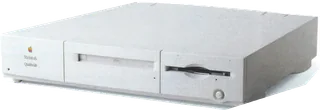
| Storage type | The May 1994 Apple Directions factory offering is 8 MB RAM and 160 MB internal hard disk; the generic current support range 160–230 MB does not establish another exact factory memory/storage pair. Built-in 1.44 MB Apple SuperDrive floppy and optional double-speed internal CD-ROM support Macintosh and DOS discs. The optional CD is shown in the shared-family maker photograph. | 250 MB internal IDE hard disk and 1.44 MB SuperDrive floppy. A double-speed internal SCSI CD-ROM drive is optional, not standard on the base Quadra. Other hard-disk capacities in the shared family developer note are not copied into these exact Quadra configurations |
| Expansion slots | Processor-direct slot occupied by DOS Compatibility Card, leaving no free PDS or NuBus position while retaining it. The card is also sold as an internal upgrade for existing Macintosh Quadra 610 and Centris 610 computers; it is distinct from the faster Power Macintosh 6100 DOS card. | LC-compatible processor-direct slot, communications slot for either Ethernet or modem, video-input slot and optional TV tuner. Apple Video and TV/Video kits add capture and television features; they are not built into the base configuration. Optional PowerPC processor upgrade |
| Display | ||
| Screen | None built in | None built in |
| Connections | ||
| Ports | Ethernet, headphone jack | 2 × headphone jack |
| External displays | Up to 2 | – |
| Back ports | Two ADB ports, DB-15 Macintosh video, DB-25 external SCSI supporting up to six peripherals, two RS-232/RS-422 serial mini-DIN-8 connections, AAUI Ethernet, monaural microphone input and stereo-capable sound output. PC game port also available through DOS hardware. | DB-15 video, DB-25 external SCSI, one ADB, two serial ports with LocalTalk, sound input and rear sound output. Front headphone jack and infrared receiver; no USB. Ethernet uses an optional communications card |
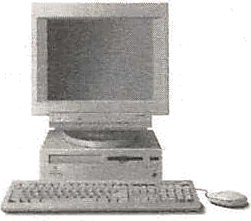
| External displays | One shared display switched between environments, or separate Macintosh and PC displays showing both simultaneously. The second display serves the PC environment; do not imply a two-screen Macintosh desktop. Compatible Apple 13-, 14- and 16-inch monitors and VGA/SVGA displays in DOS; Macintosh supports its own wider display list. Adapters may be required. | Requires a separate monitor; Apple lists Color Plus 14-inch, Macintosh Color Display, AudioVision 14 and Multiple Scan 15 plus compatible VGA/SVGA displays. The maker catalogue photo includes an external monitor, keyboard and mouse |
| Speakers | Built-in speaker with Macintosh stereo eight-bit output through the sound jack and eight-bit monophonic input at 11 or 22 kHz. The later Power Macintosh DOS card's Sound Blaster playback is not transferred to this earlier hardware. | Single internal speaker, stereo output and front/rear audio jacks. Apple developer note specifies 8-bit sampling; a contemporary MacUser review calls output 16-bit, so maker specification retained |
| Keyboard and mouse | Apple Directions states MS-DOS 6.2 and Apple PC Exchange are supplied. Separate monitor, keyboard and mouse in the shared-family catalogue photograph are labelled as illustrated accessories rather than a universal bundle. Original Windows software capability does not establish a bundled Windows licence. | – |
| Design and power | ||
| Type | Compact | Compact |
| Weight | – | 7.7 kg |
| Width × depth × height | 414 × 396 × 86 mm | 320 × 419 × 109 mm |
| Operating system | macOS | macOS |
| Size and weight detail | Exact original DOS-compatible TIL gives 86 × 414 × 396 mm (height × width × depth), used here, and 7.4 kg varying with installed devices. Current support gives 14 lb, and shared Service Source 6.4 kg; weight is omitted because this conflict is unresolved. Shared service depth 107 mm is inconsistent with the exact original 396 mm and current 15.6-inch depth. | October 1994 AppleFacts gives 10.9 cm high, 32.0 cm wide and 41.9 cm deep; metric values retained. Shared Service Source reverses width and depth (41.95 cm width, 32 cm depth), an unresolved documentation conflict. Base weight without CD-ROM is 7.7 kg; with CD-ROM is 8.6 kg, varying with options. AppleFacts' 8.6 kg reference does not identify its drive configuration |
| Power supply | Exact DOS specification gives automatically configured 100–240 V AC, 50–60 Hz and 210 W maximum excluding display power. Current support allows 47–63 Hz; shared-family Service Source gives 112 W excluding monitor. Conditions and maker disagreement remain qualified; neither is a measured normal consumption claim. 3.6 V lithium clock battery. | 100–240 V AC, 50–60 Hz; 45 W maximum excluding monitor, according to Service Source. 4.5 V alkaline clock battery |
| In the box | System 7.1 with System Enabler 040 v1.1 and preinstalled MS-DOS 6.2. Current support records introduction on 28 February 1994; May 1994 Apple Directions explicitly says the computer shipped in March in the United States and selected international markets, supporting March 1994 release rather than substituting the introduction date. Apple later explicitly calls this the predecessor to Power Macintosh 6100 DOS Compatible. | System 7.1.2P with System Enabler 405. Apple introduces the model on 18 July 1994; contemporary TidBITS states planned 2 August shipping for the Quadra, distinct from the education-market Performa. October 1994 maker buying catalogue confirms the Quadra was offered during 1994; exact first-delivery date remains unconfirmed, so release uses year precision |
More comparisons
- Apple Macintosh Performa 5400/160 vs Apple Macintosh Quadra 610 DOS Compatible
- Apple Macintosh Performa 6360 vs Apple Macintosh Quadra 610 DOS Compatible
- Apple Macintosh Performa 6400/180 vs Apple Macintosh Quadra 610 DOS Compatible
- Apple Macintosh Performa 6400/200 vs Apple Macintosh Quadra 610 DOS Compatible
- Apple Macintosh Performa 5400/160 vs Apple Macintosh Quadra 630
- Apple Macintosh Performa 6360 vs Apple Macintosh Quadra 630
- Apple Macintosh Performa 6400/180 vs Apple Macintosh Quadra 630
- Apple Macintosh Performa 6400/200 vs Apple Macintosh Quadra 630
- Apple Macintosh Quadra 610 DOS Compatible vs Apple Power Macintosh 6100/66 DOS Compatible
- Apple Macintosh LC 580 vs Apple Macintosh Quadra 610 DOS Compatible
- Apple Macintosh Performa 5200CD vs Apple Macintosh Quadra 610 DOS Compatible
- Apple Macintosh Performa 5300CD vs Apple Macintosh Quadra 610 DOS Compatible
- Apple Macintosh Performa 6300CD vs Apple Macintosh Quadra 610 DOS Compatible
- Apple Macintosh LC 580 vs Apple Macintosh Quadra 630
- Apple Macintosh Performa 5200CD vs Apple Macintosh Quadra 630
- Apple Macintosh Performa 5300CD vs Apple Macintosh Quadra 630