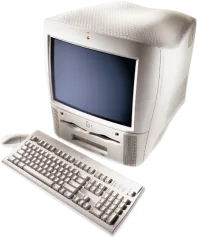
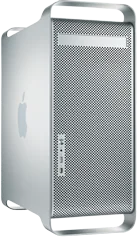
Apple Power Macintosh G3 All-In-One vs Apple Power Mac G5 (Late 2004)
Better figure, where one is clearly better
| ApplePower Macintosh G3 All-In-One | ApplePower Mac G5 (Late 2004) | |
|---|---|---|
| Overview | ||
| Released | – | October 2004 |
| Performance | ||
| Processor | PowerPC G3 233 MHz (Power Macintosh G3 Desktop) or PowerPC G3 266 MHz (Power Macintosh G3 Desktop) | PowerPC G5 1800 MHz (Power Mac Late 2004) |
| CPU cores | 1 | 1 |
| Graphics | Built-in graphics accelerator (2 MB SGRAM; revision unpublished) | NVIDIA GeForce FX 5200 Ultra (64 MB) |
| Memory | 32 MB | 256 MB or 4 GB (better) |
| Storage | 4 GB | 80 GB (better) |
| CPU | 233 or 266 MHz PowerPC G3 with 512 KB backside L2 cache at 117 or 133 MHz, a 66 MHz system bus and 64 KB L1 cache split equally between data and instructions. Supplier is not assigned without exact maker evidence. | One 1.8 GHz PowerPC G5 with 512 KB L2 cache and a 600 MHz front-side bus. This is the new single-processor model; the dual-processor models also listed on the retained sheet are June 2004 carryovers. |
| GPU | Built-in 2D/3D graphics accelerator with 2 MB SGRAM, expandable to 6 MB using the maker-supported 4 MB SGRAM module. Exact graphics-chip revision is unpublished in the read maker datasheet, so later RAGE Pro revisions are not assumed for every unit. | Stock NVIDIA GeForce FX 5200 Ultra with 64 MB DDR in AGP 8x Pro. Optional ATI Radeon 9600 XT 128 MB, Radeon 9800 XT 256 MB, NVIDIA GeForce 6800 GT DDL 256 MB or 6800 Ultra DDL 256 MB. The 9800 XT and 6800 cards also occupy the adjacent PCI slot. |
| Memory type | 32 MB SDRAM standard, up to 384 MB across three 168-pin DIMM slots. Apple Service Source specifies 3.3 V, 64-bit, 10 ns unbuffered SDRAM. Its prose about 64 MB DIMMs conflicts with its 384 MB/three 128 MB DIMM maximum; the explicit published maximum is retained. Factory BTO memory options included 64 or 96 MB. | Stock 256 MB PC3200 DDR400 in matched pairs; four DIMM slots support up to 4 GB. Configuration rows keep the stock graphics and drive at base and maximum supported memory. |
| Storage type | Both published 233 and 266 MHz base configurations have a 4 GB IDE disk, 24× maximum CD-ROM and 1.44 MB floppy drive. A 6 GB disk and 100 MB SCSI Zip drive were optional. Service Source also mentions a 2 GB disk in one table, unlike the exact base configuration datasheet; that unsupported base pairing is not assumed. | Stock 80 GB 7200 rpm Serial ATA drive. Two 3.5-inch bays, each with a 150 MB/s interface. Optional 160 or 250 GB drives, including two 250 GB drives. One optical bay with 8x DVD-R SuperDrive; Combo drive is optional. |
| Expansion slots | Three 7-inch PCI 2.1 slots with Macintosh drivers required; three memory slots and a PERCH I/O-card slot. Optional modem fits the I/O card. The chassis has a slide-out logic-board tray. PCI card power restrictions are three 15 W cards, two 25 W cards, or one 15 W and one 25 W card. | Three open full-length 64-bit 33 MHz PCI slots and occupied AGP 8x Pro graphics slot; no PCI-X on this single-processor model. |
| Display | ||
| Screen size | 15″ | None built in |
| Resolution | 1024 × 768 | – |
| Panel | CRT | – |
| Display type | 15-inch multiple-scan colour CRT with 13.8-inch viewable diagonal and 0.28 mm dot pitch; tilt and swivel. The supported 1024 × 768 mode is analogue, not a fixed pixel matrix. Maker advertises refresh up to 85 Hz without assigning that maximum to the highest resolution, so headline refresh is omitted. Service Source specifies 16-bit colour at 1024 × 768; the datasheet uses inconsistent colour-depth labels. | – |
| Connections | ||
| Ports | Ethernet, 3 × headphone jack | 3 × USB-A, Ethernet, headphone jack |
| Ethernet | 0.01 Gb/s | 1 Gb/s (better) |
| External displays | – | Up to 2 |
| Front ports | – | USB 2.0, FireWire 400 and headphone minijack. |
| Back ports | 10BASE-T Ethernet, one ADB, one external DB-25 SCSI, two GeoPort-compatible serial ports, rear stereo audio input/output and DB-15 monitor connector. Three headphone-compatible audio outputs total: two at the front and one at the rear. No built-in USB, FireWire or AirPort support. The optional Fast Ethernet PCI card does not change the standard network figure. | Two USB 2.0, FireWire 800, FireWire 400, Gigabit Ethernet, V.92 modem, optical Toslink input/output and analogue audio line-in/out. Three chassis USB ports in total, plus two keyboard USB 1.1 ports. AirPort Extreme 54 Mbps and Bluetooth 1.1 are optional. |
| External displays | DB-15 external monitor connector documented by the exact datasheet and rear service diagram; the current support summary instead labels video as none. Display mirroring is described by the contemporary Washington Apple Pi test, not an assumed extended desktop. | Stock ADC and DVI with included DVI-to-VGA adapter, supporting two displays. Optional 6800 GT/Ultra DDL cards have two dual-link DVI connectors and support two 30-inch Apple Cinema HD Displays; a second ADC display on the stock card needs an adapter. |
| Speakers | Built-in stereo speakers; 16-bit stereo audio input/output at 22.05 or 44.1 kHz | Built-in speaker; optical and analogue connections for external audio. |
| Microphones | Built-in microphone | – |
| Keyboard and mouse | AppleDesign Keyboard and ADB Mouse II | Apple Keyboard, Apple Mouse, USB extension cable, DVI-to-VGA adapter, modem cable and AirPort antenna. |
| Design and power | ||
| Type | All-in-one | Tower |
| Weight | 26.8 kg | 16.4 kg (better) |
| Width × depth × height | 409 × 457 × 505 mm | 206 × 475 × 511 mm |
| Operating system | macOS | macOS |
| Size and weight detail | Headline dimensions and 26.8 kg weight follow the exact May 1998 maker datasheet. Apple Service Source gives 498 × 402 × 450 mm and 27 kg with inconsistent inch conversions; the current support summary gives 19.92 × 16.08 × 18 inches and 59.5 lb. Weight varies with installed devices. | Maker height 51.1 cm, width 20.6 cm, depth 47.5 cm. Published reference weight for the single 1.8 GHz model is 16.4 kg, distinct from the carryover dual-processor models; weight varies with configuration. |
| Materials | – | Aluminium enclosure. |
| Power supply | Automatically configured 90–264 V AC, 50–60 Hz, single phase | – |
| Power use | Maximum continuous electrical input 300 W; Service Source separately lists 200 W peak output, which is not acoustic output | – |
| In the box | Mac OS 8.1 in the contemporary datasheet and Service Source; the current archived support summary instead gives original system software 8.0. The model was offered for the education market. Apple support labels introduction as 3 April 1998; the dated May 1998 datasheet describes currently available configurations and BTO ordering from 6 May. An exact first retail delivery date is not established, so released is omitted rather than substituting introduction or BTO dates. The 266 MHz base variant adds audio/video I/O plus Avid Cinema and QuickTime 3 Pro; the 233 MHz base is audio I/O only. Optional AV hardware supports composite and S-video inputs/outputs with mode restrictions in Service Source. | The October 2004 release includes Mac OS X Panther and iLife ’04. Apple’s retained specification sheet later lists iLife ’05; that later software listing does not change the hardware’s October 2004 first sale. |
More comparisons
- Apple Mac mini (M4 or M4 Pro) vs Apple Power Mac G5 (Late 2004)
- Apple Mac Pro (2006) vs Apple Power Mac G5 (Late 2004)
- Apple Power Mac G5 (Late 2004) vs Apple Power Mac G5 (Late 2005)
- Apple Power Macintosh G3 All-In-One vs Apple Power Mac G5 (Late 2005)
- Apple Power Mac G5 (Early 2005) vs Apple Power Mac G5 (Late 2004)
- Apple Power Macintosh G3 All-In-One vs Apple Power Mac G5 (Early 2005)
- Apple Mac mini (2005) vs Apple Power Mac G5 (Late 2004)
- Apple Power Mac G5 (2003) vs Apple Power Mac G5 (Late 2004)
- Apple Power Mac G5 (June 2004) vs Apple Power Mac G5 (Late 2004)
- Apple iMac G5 (17-inch, 2004) vs Apple Power Mac G5 (Late 2004)
- Apple Power Mac G4 (FW800) vs Apple Power Mac G5 (Late 2004)
- Apple Power Mac G4 (Mirrored Drive Doors 2003) vs Apple Power Mac G5 (Late 2004)
- Apple Power Mac G4 (Mirrored Drive Doors 2002) vs Apple Power Mac G5 (Late 2004)
- Apple Power Mac G4 (QuickSilver 2002) vs Apple Power Mac G5 (Late 2004)
- Apple Power Mac G4 (QuickSilver 2001) vs Apple Power Mac G5 (Late 2004)
- Apple Power Mac G4 (Digital Audio) vs Apple Power Mac G5 (Late 2004)