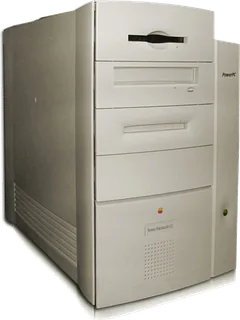
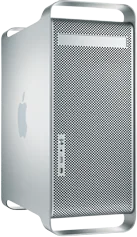
Apple Power Macintosh G3 Mini Tower vs Apple Power Mac G5 (June 2004)
Better figure, where one is clearly better
| ApplePower Macintosh G3 Mini Tower | ApplePower Mac G5 (June 2004) | |
|---|---|---|
| Overview | ||
| Released | November 1997 | June 2004 |
| Performance | ||
| Processor | PowerPC G3 233 MHz (Power Macintosh G3 Mini Tower), PowerPC G3 266 MHz (Power Macintosh G3 Mini Tower), PowerPC G3 300 MHz (Power Macintosh G3 Mini Tower) or PowerPC G3 333 MHz (Power Macintosh G3 Mini Tower) | 2 × PowerPC G5 1800 MHz (Power Mac June 2004), 2 × PowerPC G5 2000 MHz (Power Mac June 2004) or 2 × PowerPC G5 2500 MHz (Power Mac June 2004) |
| CPU cores | 1 | 2 |
| Graphics | ATI 3D RAGE II+ (2 MB), ATI 3D RAGE II+ (6 MB) and IX Micro 2D/3D PCI card (8 MB), Built-in graphics (6 MB SGRAM; factory revision varies), Built-in graphics (6 MB SGRAM) and IX Micro 2D/3D PCI card (8 MB) or ATI RAGE Pro Turbo (6 MB) | NVIDIA GeForce FX 5200 Ultra (64 MB) or ATI Radeon 9600 XT (128 MB) |
| Memory | 32 MB, 64 MB or 128 MB | 256 MB, 512 MB, 4 GB or 8 GB (better) |
| Storage | 4 GB to 9 GB | 80 GB to 160 GB (better) |
| CPU | 233 and 266 MHz PowerPC G 3 with 512 KB backside L 2 cache; later 300 and 333 MHz with 1 MB. Apple’s exact Mini Tower Service Source confirms all four clocks and the 66 MHz system architecture. The factory processor supplier is not identified per machine. | Two physical PowerPC G5 processors at 1.8, 2 or 2.5 GHz, each with 512 KB L2 cache. Per-processor front-side bus is 900 MHz, 1 GHz or 1.25 GHz respectively. Only the dual 2.5 GHz uses the maker’s liquid-cooling system. |
| GPU | Built-in 2D/3D accelerator with 2 MB SGRAM, expandable to 6 MB. Original maker sheet specifies ATI RAGE II+; later logic boards changed the accelerator. Optional IX Micro 128-bit PCI graphics card has 8 MB EDO VRAM. EveryMac identifies RAGE Pro Turbo in the later 333 MHz configuration. | Dual 1.8 and 2 GHz: NVIDIA GeForce FX 5200 Ultra with 64 MB DDR. Dual 2.5 GHz: ATI Radeon 9600 XT with 128 MB DDR. Optional ATI Radeon 9800 XT with 256 MB occupies the adjacent PCI slot as well as AGP. |
| Memory type | Three 168-pin 64-bit JEDEC-standard 3.3 V unbuffered SDRAM DIMM slots; maker-supported maximum 384 MB. Stock memory of 32, 64 or 128 MB is tied to the factory ordering table. Unofficial 768 MB upgrades are excluded. | DDR400 PC3200 in matched pairs. Dual 1.8 GHz starts with 256 MB and has four DIMM slots with a 4 GB maximum. Dual 2 and 2.5 GHz start with 512 MB and have eight slots with an 8 GB maximum. Base and maximum memory rows retain each model’s stock storage and graphics. |
| Storage type | May 1998 Apple factory pairs: 233 MHz/32 MB/4 GB IDE (M6431LL/A); 266 MHz/32 MB/6 GB IDE/Zip/audio-video (M6142LL/A); 266 MHz/128 MB/4 GB Ultra Wide SCSI/additional 8 MB PCI graphics (M6459LL/A); 300 MHz/64 MB/4 GB Ultra Wide SCSI (M6572LL/A); 300 MHz/128 MB/two 4 GB Ultra Wide SCSI drives/additional 8 MB PCI graphics (M6494LL/A). All have 24x CD-ROM. Later 333 MHz/128 MB/9 GB/Zip is from EveryMac’s exact record. Optional drive/RAM cross-products are omitted. Internal 1.44 MB floppy and optional 2x DVD-ROM. | Stock 80 GB on dual 1.8 GHz and 160 GB on dual 2/2.5 GHz; 7200 rpm Serial ATA. Two bays with 150 MB/s interfaces; optional 80, 160 or 250 GB drives, up to two 250 GB drives. One optical bay with 8x DVD-R SuperDrive; Combo drive is optional. |
| Expansion slots | Three PCI slots accept three 12-inch cards; PERCH I/O card connector and modem slot. Optional SCSI, Ethernet and graphics cards consume PCI slots. Free internal storage bays vary by configuration. | AGP 8x Pro graphics slot. Dual 1.8 GHz has three 64-bit 33 MHz PCI slots. Dual 2 and 2.5 GHz have PCI-X: two 100 MHz and one 133 MHz slots. |
| Display | ||
| Screen | None built in | None built in |
| Connections | ||
| Ports | Ethernet, headphone jack | 3 × USB-A, Ethernet, headphone jack |
| Ethernet | 0.01 Gb/s | 1 Gb/s (better) |
| External displays | – | Up to 2 |
| Front ports | – | USB 2.0, FireWire 400 and headphone minijack. |
| Back ports | One ADB, one DB-15 monitor, one DB-25 SCSI, two GeoPort-compatible serial ports, 10BASE-T Ethernet and stereo audio input/output. Optional 10/100BASE-T and FireWire cards are excluded from the standard count. | Two USB 2.0, FireWire 800, FireWire 400, Gigabit Ethernet, V.92 modem, optical Toslink input/output and analogue audio line-in/out. Three chassis USB ports in total, plus keyboard USB 1.1 ports. Optional 54 Mbps AirPort Extreme and Bluetooth 1.1. |
| External displays | Built-in video supports up to 1600 × 1200, with colour depth depending on SGRAM. Optional PCI graphics card connects a second monitor. | ADC and DVI with included DVI-to-VGA adapter; two displays in extended or mirrored modes. A second ADC display requires a separate adapter. |
| Speakers | – | Built-in speaker; analogue and optical connections for external audio. |
| Keyboard and mouse | – | Apple Keyboard, Apple Mouse, USB extension cable, DVI-to-VGA adapter, modem cable and AirPort antenna. |
| Design and power | ||
| Type | Tower | Tower |
| Weight | 15.015 kg (better) | 20.2 kg |
| Width × depth × height | 243.84 × 452.12 × 386.08 mm | 206 × 475 × 511 mm |
| Operating system | macOS | macOS |
| Size and weight detail | Maker gives 33.1 lb and 15.2 × 9.6 × 17.8 inches height × width × depth. Main fields are direct conversions using 25.4 mm/inch and 0.45359237 kg/lb; actual weight depends on fitted devices. | Maker height 51.1 cm, width 20.6 cm, depth 47.5 cm; reference weight 20.2 kg varies with configuration. |
| Materials | – | Aluminium enclosure with separate cooling zones. |
| Power supply | 240 W maximum; 100–240 V AC, 50–60 Hz (current Apple Mini Tower support table). | – |
| In the box | Mac OS 8.0 originally; revised stock includes Mac OS 8.1. November 1997 month is supported by Apple’s opened Store selling the new Desktop/Mini Tower, with stock deliveries in two working days and BTO about two weeks; no exact first delivery day is proven. Server G3 shares the chassis but its bundled server configurations are excluded. | Mac OS X Panther and iLife. The 1.8 and 2 GHz models were available on 9 June 2004. Apple initially stated July availability for the 2.5 GHz model, later than the generation’s first sale. |
More comparisons
- Apple Mac Studio (M4 Max or M3 Ultra) vs Apple Power Mac G5 (June 2004)
- Apple Mac Studio (M4 Max or M3 Ultra) vs Apple Power Macintosh G3 Mini Tower
- Apple Mac Pro (2006) vs Apple Power Mac G5 (June 2004)
- Apple Power Mac G5 (June 2004) vs Apple Power Mac G5 (Late 2005)
- Apple Power Macintosh G3 Mini Tower vs Apple Power Mac G5 (Late 2005)
- Apple Power Mac G5 (Early 2005) vs Apple Power Mac G5 (June 2004)
- Apple Power Macintosh G3 Mini Tower vs Apple Power Mac G5 (Early 2005)
- Apple Power Mac G5 (June 2004) vs Apple Power Mac G5 (Late 2004)
- Apple Power Macintosh G3 Mini Tower vs Apple Power Mac G5 (Late 2004)
- Apple iMac G5 (20-inch, 2004) vs Apple Power Mac G5 (June 2004)
- Apple Power Mac G5 (2003) vs Apple Power Mac G5 (June 2004)
- Apple Power Mac G4 (Mirrored Drive Doors 2003) vs Apple Power Mac G5 (June 2004)
- Apple Power Mac G4 (FW800) vs Apple Power Mac G5 (June 2004)
- Apple Power Mac G4 (Mirrored Drive Doors 2002) vs Apple Power Mac G5 (June 2004)
- Apple Power Mac G4 (QuickSilver 2002) vs Apple Power Mac G5 (June 2004)
- Apple Power Mac G4 (QuickSilver 2001) vs Apple Power Mac G5 (June 2004)